Moments of Courage
Multiple Hardships, Many Moments of Courage
In 1955, my great half uncle, Lloyd McKinley Wolfe wrote a family history titled Henry Harrison Wolfe’s Family History. I inherited a tattered copy of it in 2007 when my mother, Helen Wolfe Lonski, died.
In it, I found many facts from my mother’s paternal side- the Wolfe side. Henry Harrison Wolfe was Lloyd’s father and Helen’s grandfather.
Lloyd’s history included what he had been told about Henry Harrison’s father, Henry Johnathon Wolf. From this resource, I located Henry Johnathon Wolf’s farmland in Shermans Dale, Perry, Pennsylvania. I located the Brethren church where his family worshipped and found the graveyard where Henry Johnathon and his wife, Mary Jane were buried. Lloyd’s history contained many family names.
Lloyd also spoke of the religious beliefs of these elder Wolfes. They were of the Dunkard faith and members of the Shermans Dale United Brethren Church. Headstones for Henry and Mary Jane Wolf are found in Young’s Church Cemetery.
Lloyd didn’t know which country Henry Johnathon originated from or the year he came to the United States. Lloyd thought Henry Johnathon came in the early 1800’s from England.
Thirteen years after my mother died and left me Lloyd’s history, I discovered my Wolfes reached the north America continent before there was a United States. They came to Penns Colony in 1727. They settled in a place called Goshenhoppen in Pennsylvania. They spoke German.
I met my 4th cousin, Nan, through sharing trees on ancestry. Also, we shared 13 cm of dna across 1 segment. We found we had the same 4th great grandparents- George Wolfe and Ann Elisabetha Thornmeyer. In addition, she said her Wolfs had many connections to the Brethren Church, and some were Moravians. Her mother was raised as a Dunkard.
Now back to the title of this piece and what It means to the Wolfe family history.
Hans Bernhardt Wolff (1674-1756) and his wife, Susanna Ludwig Wolff (1675-1757), crossed the Atlantic Ocean in 1727. Most of their children came with them. Their oldest son, Hans Georg Wolff, is recorded on the same voyage in a separate family group.
Hans Bernhardt Wolff is my 6th great grandfather and Hans Georg Wolff is my 5th great grandfather. He is the father of the George Wolfe that I share with my 4th cousin, Nan.
From 1674 when Bernhardt was born until 1727, he and his family lived in the village of Steinsfurt.
Maps
The year they left German lands were represented on maps in this manner. Maps showed a dense, overlapping patchwork of many tiny places. There could be as many as 300 sovereign parcels on one small map.
Here is part of a map drawn in 1729 by H. Moll called Germany Divided into Circles. This map did not show the smaller places but showed regions the rulers of the Holy Roman Empire used to manage defense, taxes and public peace. Steinsfurt is in the magenta outlined lower Rhine area.This circle is in the lower half toward the right side of the map and is labeled L. Rhine.
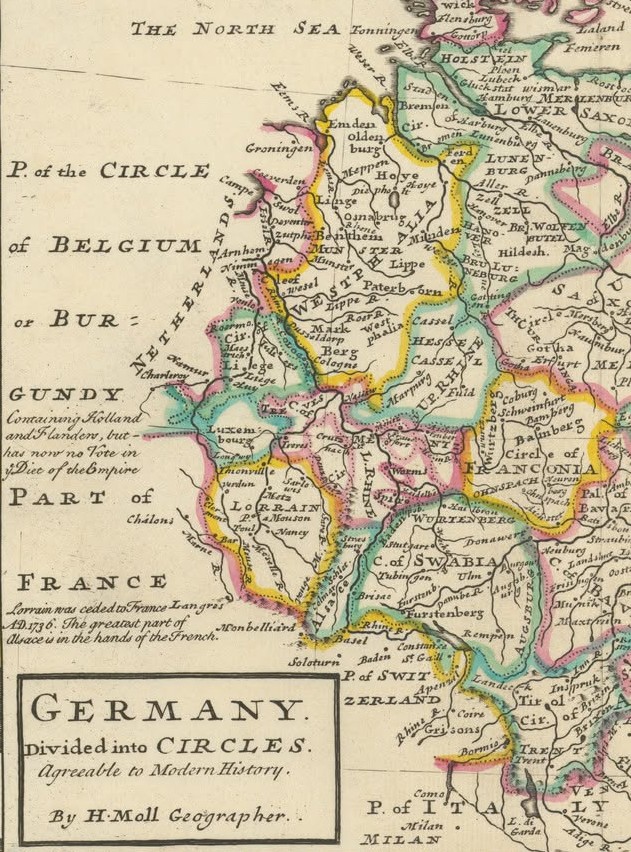
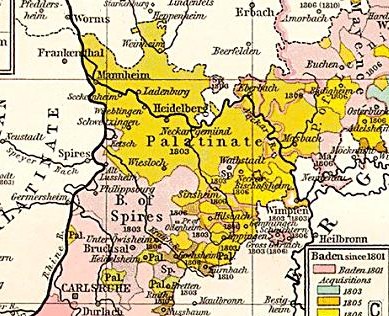
The Northern Kraichgau region where the Wolffs lived is in the Electoral Rhenish Circle which included the Palatinate. The free city of Spire (Speyer) is on this map. Spire sits on the left bank of the Rhine River. Steinsfurt is across this river and about 20 miles away from the Rhine. Steinsfurt was swallowed by Sinsheim when this map was made. It is east of Spires and south of Heidelberg.
Background
Religious Disruption and War
Much of the hardship that befell the Wolff family and many others in the Palatinate came from the actions of Kings, Prince Electors and religious heads. Historically, Catholic worship services came to Steinsfurt when the monks of Siesheim built a small church there in 1496. In1556, Elector Otto Henry forced Calvinism in the Palatinate, and this church became home to Calvinist 1565 under his son, Frederick III.
Sixty-two years later the Thirty Years’ War (1618-1645) began when the future Holy Roman emperor tried to make Catholicism the law of the Empire. A trigger to this was when Frederick V accepted the crown of Bohemia. The war ended with the Peace of Westphalia. Steinsfurt lost 80% of its residents in this period. The only part of Steinsfurt’s village church remaining was a footprint of where it had stood.
In 1648, the Peace of Westphalia recognized three religions- Catholicism, Calvinism (Reformed) and Lutheranism. Individuals could practice their faith privately. It also weakened the power of the Holy Roman Empire. In the past whoever had pollical sovereignty over an area could determine the religious faith of the residents.
Five years later in 1653, the Steinsfurt clergy wrote records would survive the next war. Bernhardt’s mother, Elisabetha Ludwig’s baptism, was the of the first events recorded. She was baptized in Steinsfurt Reformed (Calvinist) Church. this record survived and can be found on FamilySearch. In FamilySearch these records were under Steinsfurt, Baptism Records, 1650-1790. The German name was Evangelische Kirche Steinsfurt (A. Sinsheim).
In 1662, a group composed of Calvinists, Lutherans, and Catholics started to rebuild Steinsfurt’s church in the footprint of the old church. They finished in 1663. The Peace of Westphalia mandated church sharing. This didn’t go well with the Calvinist majority. Tension over the requirement for Protestants to kneel in the streets during Eucharistic processions produced ill feelings between the groups.
On March 2, 1674 Bernhardt was born.
The Protestants experienced more intolerance and religious repression under electors Philip William and his son Johann Wilhelm. Philip was the first Catholic elector in over a century. His succession triggered the Nine Years’ War (1668-1697). Again, the small church in Steinsfurt was burned and nearly destroyed.
This time the three groups occupying this building didn’t rebuild but waited until each congregation could build their own church. This happened more than 60 years later.
My 6th Great Grandfather didn’t wait for the new reformed church to be built.
Family
Bernhardt Wolff and his wife Susanna had children while living in Steinsfurt. Their marriage record has not been found. But the birth and baptism records of their children were recorded in the parish record and are as follows.
Hans Georg Wolff was born to Hans Bernhardt Wolff and his wife, Susanna, and baptized 28 Dec 1695.
Georg Michael who was born in 1699, died in 1702 and was buried 30 Mar 1702.
Johannes Bernard Wolff was baptized 11 Oct 1701.
Another Georg Michael who was probably named for his brother who died in 1702 was baptized 29 Dec 1703.
Anna Maria Wolff was baptized May 1706.
Jeremias Wolff was baptized on 29 Apr 1708.
Hans Jacob was baptized 4 Apr 1711 and died 31 Jan 1721.
Susanna Wolff was born 6 Mar 1714 and baptized 9 Mar 1924.
Anna Elisabetha was baptized in 1716.
From Steinsfurt to Rotterdam
When the Wolffs left Steinsfurt this village lost two blacksmiths. Both Bernhardt and his eldest son, Hans Geog, worked in the blacksmith trade. Bernhardt and his wife Susanna left behind the graves of two buried children.
Bernhardt’s oldest son, Hans Georg, a married man traveled with his wife, Catharina Klenk and two children. Bernhardt’s family unit consisted of his wife Susanna and their children-Johannes Bernhard, Georg Michael, Jeremias, Susanna and Anna Elisabetha. His sons were of age with 19-year-old Jeremias being the youngest.
They left in the spring of 1727.
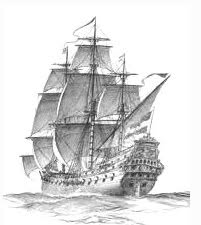
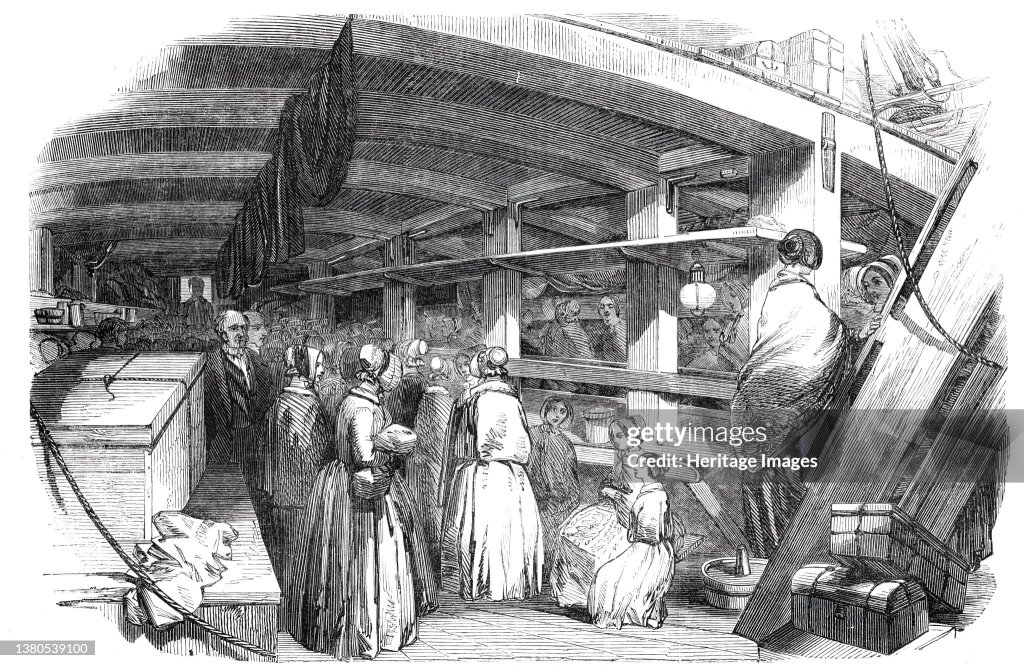
The ship depicted here, the Thistle of Scotland, carried about 260 emigrants. It operated in the same era as the William and Sarah but was bigger. It carried about 400 emigrants on the Wolff’s 1727 journey to Pennsylvania.
To the Rhine River
The options were limited. They could ride by horse and cart for about 15 miles to Helibronn or Bad Wimpfen where they could board a small river barge. From here they would travel on the Neckar River to Mannhein where the Neckar River joined the Rhine River.
Another choice would be traveling directly to Mannhein by horse and cart. This route was about 28 miles. Either way would be a bumpy ride with baggage and two small ones.
After arriving at the port of Mannheim, they boarded flat bottomed river boats known as rheinbarker. The barges were crowded and open to the weather. In addition, the barge stopped at multiple places where payment for passage was required. Tiny towns, Bishop owned land and independent cities all collected fees. There ranged from 26 to 36 stops. Because of all these stops the barge trip took between 4 to 6 weeks.
To Pennsylvania
So, the Wolffs reached the port of Rotterdam in May or June of 1727 where they boarded the William and Sarah for the transatlantic crossing. They sailed from Rotterdam with Captain William Hill as the master. Another stop at Dover, England to clear British customs followed. This stop was required because the trip’s destination was Pennsylvania, a British colony. Summer had arrived before the William and Sarah began their ocean voyage. Conditions on board included cramped quarters, sea rations, stale water and sickness. Also, many of these ships were infested with lice. Some of the men arrived too ill to sign the newly required oath of allegiance. Males over 16 were to sign the oath.
Arrival
The William and Sarah dropped anchor in the Delaware River, port of Philadelphia on September 18, 1727. The passengers waited 3 days before they were allowed to disembark. This was the first time the provisional government in Pennsylvania required non-British immigrant passengers to sign an oath of allegiance to King George of England. While Calvinist believed swearing a lawful oath to a government was reasonable, this was something new.
The religious leader of this group, George Michael Weiss, signed at the top of the list. Hans Bernhardt Wolff is third. His son Hans Georg Wolff is further down the list. Historians place Hans Georg Wolff as 32nd on the list. Georg wrote his name as Hans Jörg Wolff on this list.
The genealogical significance signing is that these physical signatures have been persevered. I can go to Pennsylvania German Pioneers, Volume II, and see them.


Leave a Reply