The Ferguson Brothers Go West
for week 28-travel
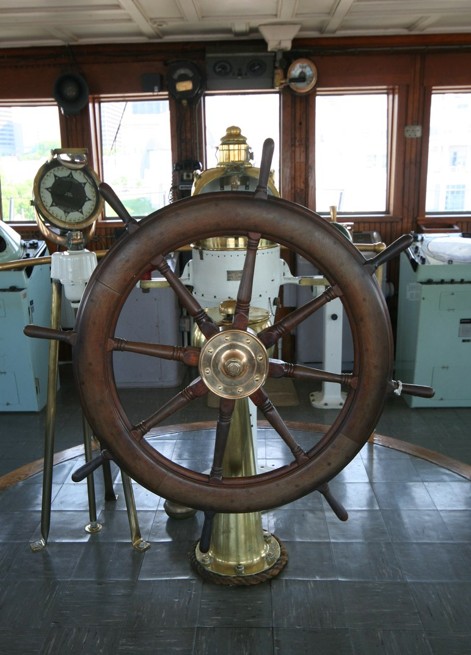
Daniel Howes Ferguson, my husband’s 3rd great grandfather traveled to San Francisco, California in 1849. Part of this trip he was with his brother, Thomas Jefferson Ferguson.
When I think of this trip, the nursery rhyme, “To Market, to Market”, comes to mind.
To market, to market to buy a fat pig:
Home again, home again, jiggety-jig.
To market, to market to buy a fat hog.
Home again, home again, jiggety-jog.
In this nursery rhyme the travelers rode in a cart or buggy pulled by a horse. The Ferguson brothers traveled by ship. Daniel left in the spring of 1849 from Norwalk Harbor, New York City. Thomas left from Key West, Florida. They met in Panama City and traveled together from there.
Letters exchanged between Thomas and his wife, Rosalinda, describe the doings of these two industrious and lucky gold miners. Mary Haffenreffer transcribed most of these letters and published them along with her research into the Ferguson family in the Florida Keys Sea Heritage Journal, fall 2012 and winter 2013. She also sent me copies of the original letters.
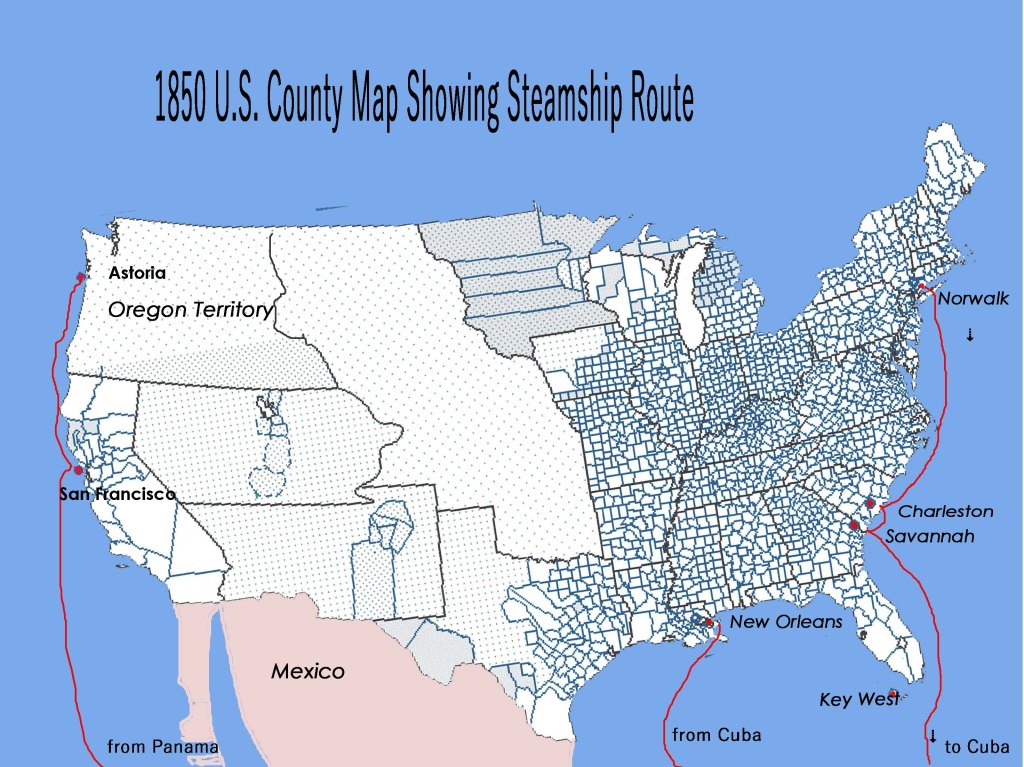
The Fergusons traveled on a mail boat steamship. The Falcon was the one Thomas rode. This small steamship with Captain Thomson at the helm, was one of the three ships carrying U.S. mail as well as passengers on the Atlantic side of the Isthmus of Panama. The Falcon’s first trip between New York City and Charges, Panama happened in December of 1848 and took 26 days. The Falcon left New York City on December 1 and arrived in Charges on December 27. The route was New York to Savannah to Charleston to Havana to New Orleans to Chargres. It included mail pick-ups and drop-offs as well as passenger pick-ups.
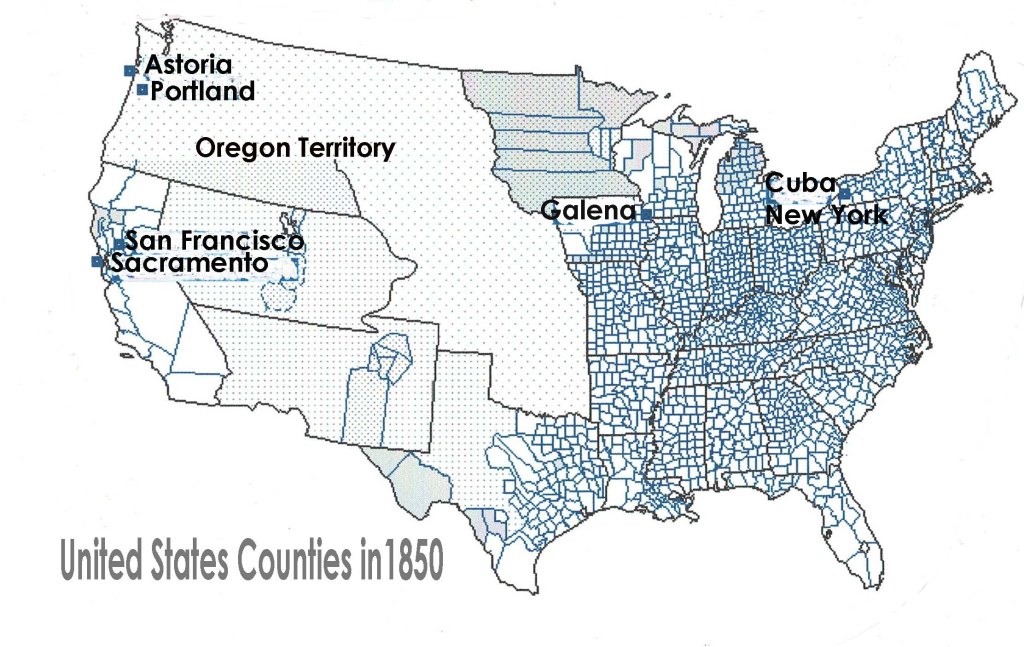
Here are maps showing the route.

Around the time Thomas left Key West Florida for Havana, Cuba, he received this letter from his brother William E. Ferguson. It reads:
Brother Thomas,
I have thought it advisable to write you to give you the particulars brought by the Steamer Northerner from Chagres.
I was conversing with a passenger who went from New York in company with fifteen others. They thought to get passage from Chagres but they found no opportunity to get from there. There is onboard three who bought steerage tickets in New York for $100.00 for each. One sold at Chagres for $450.00, one for$500.00 and the other for $700.00, and they state that there is 2500 persons on the Isthmus now waiting for a passage to San Francisco. My informant states that they think that there is a poor chance of the steamers returning from San Francisco and there is no sailing vessels at Panama. He states that he is going to New York to procure tickets if possible to go through, if not to write them to return to New York and proceed around the hook. I would advise you to go by land some route through Mexico if possible. I think we will get from here next week. They are getting every ready as soon as possible.
Remember me to all friends.
W.E. Ferguson
Letters to Rosalinda
Charleston April 5th, 1849
The first letter Thomas wrote to his wife Rosalinda Corcoran Ferguson reflects what his brother William said.
Havana, April the 8th, 1849
I arrived here at 9 o’clock the next morning after I left home. I learn here that there are two thousand passengers at Panama waiting for passage. I think of altering my route to Vera Cruz and go through Mexico.
The trouble with going through Mexico was that the United States had just won a war with Mexico, known as The Mexican War in the States and The American Intervention War in Mexico. Mexico lost on third of its territory by the “Treaty of Guadalupe Hidalgo”. Traveling from Vera Cruz through Mexico, those Americans who chose to that way were likely meet angry Mexican citizens who would have no interest in aiding them and might even rob and kill them.
In his next letter also written from Havana to his wife, he had changed his mind about traveling through Mexico. He now planned to sail to Chagres on the steamer Falcon.
Panama April the 22th, 1849
Dear Wife,
I write you once more from this place though I expected to leave here before this but receiving information from Vera Cruz not very favorable of the route through Mexico, I have altered my mind and shall go the way of Panama… I expect I shall find my brother Daniel there if he has not got passage away which is doubtful. The steamer Falcon will be here on the 25th going to Chagres… Write me whether you heard anything more from Albert before he left Charleston.
Thomas J. Ferguson
On April 25, 1849, Thomas Ferguson left Havana on the Falcon heading to Chagres. He arrived in Panama City on the Pacific side of the Isthmus on May 9, 1849. Thomas didn’t mention how he got across the Isthmus after he landed at the mouth of the Chagres River.
Up the Chagres River and on to Panama City
The 60 miles between the mouth of the Chagres River and Panama City is challenging for most. It involved first chugging up the Chagres River in a small steamboat for 12 miles. Then the river became very shallow. Travelers boarded flat bottomed canoes called bungas which were poled or dragged by men. Clouds of mosquitoes, stifling heat and big alligators added to the atmosphere. The passengers rode mules for the last 24 miles because the waterway ended at the very small village of Gorgona. Besides the discomfort caused by heat, reptiles, insects there were illnesses. People often caught cholera, malaria and yellow fever on this route.
Daniel had a similar though longer journey as he had traveled from Norwalk Harbor. He arrived in Panama City before his brother Thomas.
Letters to Rosalinda
Panama May the 11th, 1849
Dear Wife,
I arrived here day before yesterday and shall leave day after tomorrow morning on the ship Norman in company with my brother Daniel, Stafford and Saywood and the rest of the Key West party who I have found here all well, all excited to get away to the Land of Promise. Daniel tells me he had a talk with fifteen young men who arrived here a few days ago on the steamer Oregon from California on their way home. They said they got as much gold as they wanted and were going home to enjoy it. They had got seven bushels of pure gold with them that they had dug themselves in the space of six months. Daniel says they told him to keep cool, that there was enough gold there for all…I have got my passage in a first rate ship by Daniel’s having a pass engaged for his brother-in-law who hasn’t got here yet.
Thomas J. Ferguson
San Francisco- July 31st, 1849
Dear Wife,
I arrived here on the 15th of this month having sixty three days passage from Panama, rather a tedious passage but well and hearty, the weather at sea was calm and sea very Smooth. On my arrival here Daniel and I took a small job which we done in a week for which we got five hundred dollars. Since then we have built us a boat to go up to the mines and intend to leave tomorrow. I was offered sixteen dollars a day the day I got here and refuse good jobs now to go up to the mines so you may judge what I think of the prospect. The gold stories we heard about California before I left home was no humbug. I have seen lots of the gold here, one lump weighing fourteen and half pounds. I don’t know as I shall find any of those big lumps but I am bound to have gold of some sort; there is plenty of it here and no mistake. This place is very healthy though cold. I have wore flannel shirt and drawer with my thick buckskin pantaloons ever since I have been here and then been cold with a severe wind from the sea like our Northers in Key West but back from the coast it is warm. I eat apples, Pears and blackberries here. Some things here sell high, others very low .Clothing is cheaper than it is in the States, flour $10, pork $25, beef $5,of the best salt, fresh beef from 12 to 18 cents a lb., potatoes $10 for a hundred lbs., onions seventy five cents a pound, cheese fifty, saleratus (baking powder)$2.50, butter $1.50, cheese fifty cents. This town is overrun with goods, the streets and yards full, lying about open, nobody steals. There ain’t a quarter stores enough to hold them. …
Thomas J. Ferguson
By October they were on the Yuba River prospecting and had made a claim. The Yuba River, located in the Sierra Nevada’s in northern California, is a major tributary to the Feather River.
Uba (Yuba) River Calif. Oct 21st 1849
Dear Wife,
… I will now give you a statement of my success. After arriving here I spent a month in hunting, or prospecting as they call it here, up and down the river for a good place to locate. I at length found one which prove to be good on which my brother and myself built two machines for washing out gold and a water wheel to lift up water out of the holes we dig which works them all effectually so much so that we have made over five thousand dollars in the last three weeks…
By a great odd we have got the richest spot I have ever seen on the river. It is a small bar on the side of the river in the form of a triangle about fifty yards on each side with rocks ten feet high on two sides and the river on the other. We have the whole of it to ourselves and nobody troubles us…
I am faring very well here. We have got plenty of pork, dried beef, ham, flour, hard bread, beans, cornmeal, coffee, sugar, molasses, dried peaches and cherries. We get fresh beef every few days so we fare pretty well. I made some molasses cake this morning which went very well. It wasn’t quite as good as you used to make but it done very well.
Albert is not here. We are looking for him every day. I have wrote letters directing him where to find us. Thomas J. Ferguson
Selling Goods to Other Miners
Daniel’s and Thomas businesses have grown. They are buying more goods for sale to their fellow miners on the Yuba River. He writes to Rosalinda about this.
San Francisco Feb 28th, 1850
I am here now buying goods to take to the mines. Since I was here and wrote you, last, Daniel has been down and taken up $3000 worth of goods. Immediately on his return I came down again. We are selling a great many goods, as soon as I return now we shall start another store at Eliza Town on the Feather River at the head of Steam navigation. We purchased a lot there a few days since for which we paid six hundred dollars. We have been offered six hundred for one half of it. We also have another lot in the town given to us by the Proprietor of the town in consideration of our being the first who landed goods there from a steamboat… We have our own teams to haul our goods, eight mules and six horses, which we bought last winter when they were cheap. Now they are worth from two to three hundred dollars apiece.
By March of 1850 Daniel and Thomas established two more stores and are buying a stock of goods large enough to have freight bills over twenty five hundred dollars. Daniel has taken charge of the mining and trading operations in Yuba while Thomas travels up and down the river to buys goods.
In his April letter to Key West, Thomas said he had been to San Francisco three times buying about four thousand dollars’ worth of goods each time. Daniel worked on some damming projects to turn the river. Thomas also mentions three towns they had invested in, Elisa, Fredonia, and Lindd City. Could this be Linn City of Oregon, the town on the Willamette River where Daniel worked and lived when he brought his family west?
Thinking of Home and Family
Daniel and Thomas thoughts turned to home and family. In April Thomas writes, “I am beginning to like this country quite well. You needn’t think strange if I should be home this fall for you and Daniel’s wife and bring you out to this country.” Rosalinda answered this proposal in her May letter. She writes: “If you think that the place will suit me and the children I am willing to go any place under the globe to you. I’ve become acquainted with a fine Irish woman. She is willing to work and would be glad of the offer to go with me to California.
In November of 1850 Daniel and Thomas were preparing to go home. They gave their wives December 15th as the date they would start back. Daniel and Thomas Ferguson had taken ample gold out of their mine. They also had sold many items to their fellow miners. Thomas and Daniel planned to return via Havana together. From there, Thomas would ship to Key West and Daniel to New York.
The Ferguson brothers had done well. A newspaper article from San Francisco states: “Thomas J. and Daniel H. Ferguson, from Danbury, Ct., have obtained $150,000 in gold dust by mining operations upon the Yuba River, during the past summer.” Using an inflation calculator this would be about $4,829,000 in 2018.
Going back to the nursery rhyme “To Market”, the Ferguson brothers had certainly brought home the bacon. Their families would live high on the hog.
 francescabellcoursenperritt.com