Foster’s Jefferson House, Christmas 1998, built 1901
Week 13 Home Sweet Home
My husband, Craig and I lived in this house about 36 years. I would like to share what we know about its history.
Local historian, Mike Barnes of Jefferson identifies this old house at 421 North 2nd Street as the Clarence Miller home built in 1901. Clarence Miller about 2 years old in 1901 was the son of the original owner. Archer C Miller was a sheep raiser from Millersburg. Archer’ ‘s father, George S Miller was a pioneer from Illinois of 1852.
By 1910 descendants of the Looneys who crossed the plains in 1843 lived in this house. These Looneys included Benjamin F Looney and his family. His wife, Josephine Hale Looney, his son Evert, his daughter, Georgina Looney Smith and his son-in-law, William Smith made up his family.
The next family, the Smiths are listed in the 1920 census for Jefferson. We have had the good fortune to meet Georgina’s and William’s second son, Benjamin Smith. He shared memories of living in this this house. The 1920 Federal census shows William and Georgina Smith and their three sons, William, Benjamin and Everett still living here.
Benjamin Smith visited us here in the late 1970s and told us what he remembered about the house. His father built wall to wall glass fronted dish cupboard which is still in the dining room. Lumber from the Looney lumber mill provided wood for the house. When he lived here there was a wood store in the dining room. He remembered a chimney fire. An older women resident saved the wood stove from the fire by picking it up and carrying it outside. The house survived the fire with little damage as did the wood stove. Today a bookcase stands where the wood stove once did. Ben said the layout of the house was the same as when he lived here. He and his brother were in the bedroom upstairs above the kitchen. We later found a vintage valentine to Ben Smith in the floor boards in this bedroom. The Smith family moved from Jefferson to Arizona in 1929.
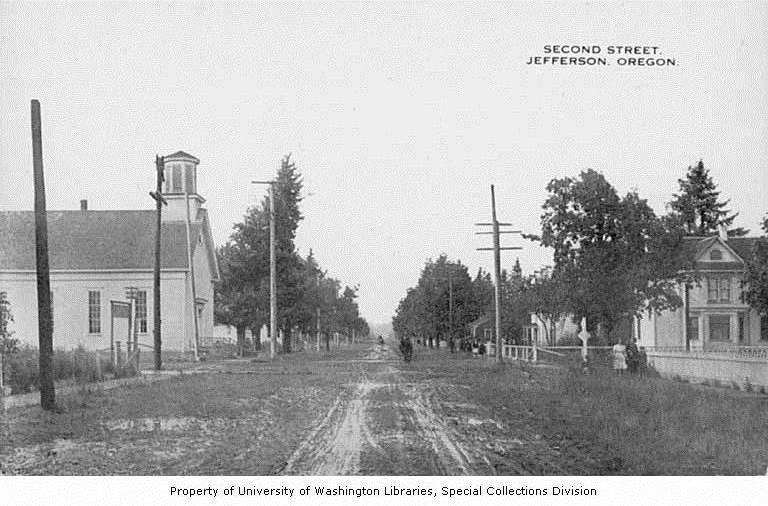
Our house is on the right side next to the telephone pole and behind the trees
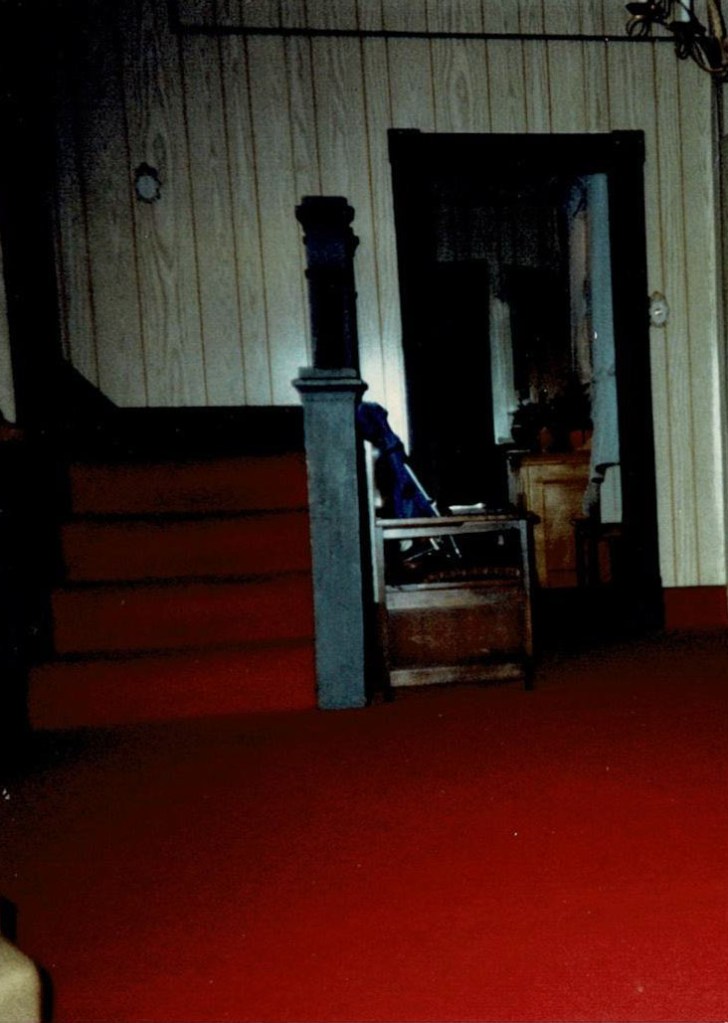
By 1972 Robert and Ruth Farrens owned the house. The house had been rented out for some time and was in need of repair and upkeep. The Farrens covered worn walls with Masonite wall paneling, the woodwork with porch paint and the floors with red carpeting.
We returned the walls to wainscoting and wallpaper. The floors were the original old growth fir which we refinished. We removed the porch paint from the woodwork finished it with a clear finish. Some of the light fixtures Robert Farrens added, we loved. He rescued three chandeliers from the old Gearhart Hotel near Seaside, Oregon. About the time he was working on this house, the Gearhart Hotel was razed and replaced with condos. In its heyday this grand hotel from the 1920s was one of the largest convention hotels in the state. One of these chandeliers went in the dining room and two in the downstairs living room.
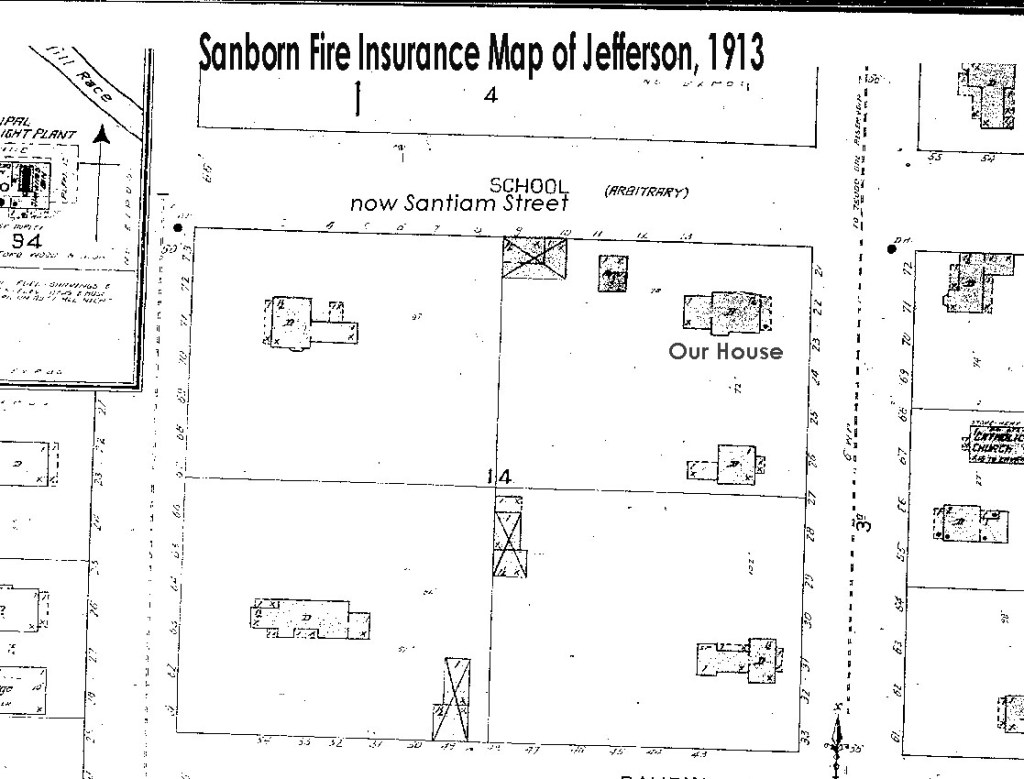
Robert Farrens as well another neighbor thought this house was used as a stage coach stop in its early life. The Sanborn Fire Insurance map of 1913 shows our house and a horse barn west of our house.
I have found horse shoes around our yard. We discovered the family room upstairs had been divided into three small rooms and a hall. When we took up the carpet in this big room, the floor boards had been painted. We saw the pattern of where the walls stood because these lines were not painted. Jefferson had a train stop by 1870 so I doubt the stage coach stop was needed.
In the 36 year we have lived here, we have updated and repaired trying to keep the character of the house intact. In 2002 we had the front yard professionally landscaped by Liz Frances of the Gardens Angels.
The story of Frances Cabell Coursen Perritt’s 9th great grandfather came in bits and pieces. The first hint I had of this man’s existence was from my husband’s mother. She and I were discussing her family history. She said one of her early relatives came to North America on the Mayflower. She thought he was a Cabell. She was sure he was from her mother’s side, that is Bessie Ferguson Reynolds Cabell’s side. She did not know the name of her Mayflower relative.
A few years later I started reading a picture book to my kindergarten children. In this story a boy who fell off the Mayflower. In this book the boy who fell overboard, John Howland, served the pilgrim’s leader as a cabin boy. They were traveling to the New World in search of religious freedom. The rescue of John Howland was suggested by an illustration of a boy clinging to a life preserver. In this picture book story, the pilgrims reached Plymouth. John grew up and married Elizabeth Tilley, another passenger on the Mayflower.
A Connection
After I retired from teaching and after I had been researching my husband’s family tree for more than five years, I learned the identity of my mother-in-law’s Mayflower relative.
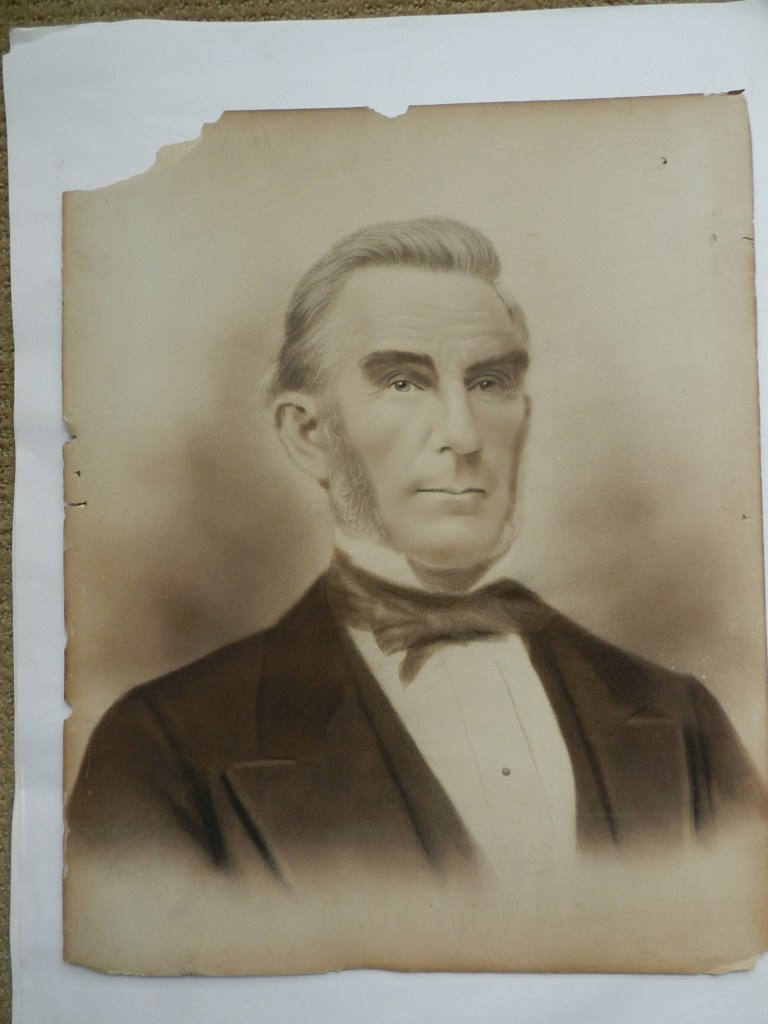
Grandmother Perritt’s scrapbook left clues. There was a black-edged calling card of Mrs. D.H. Ferguson. The D. H. stood for Daniel Howes. There was a charcoal drawing of Daniel H. Ferguson.
The name Howes puzzled me for a long time. I had published a photo of the charcoal portrait of Daniel on my ancestry site.
Then in January of 2013, a librarian from Morrow County Public Library in Florida contacted me. She wanted to know about the portrait of Daniel. She said,
The Florida History Room of the Monroe County Library has a collection of letters written by Thomas and Rosalinda Ferguson. These letters are from Thomas in California describing his finding gold and Rosalinda in Key West. I have transcribed the letters.
Daniel is the brother of Thomas Jefferson Ferguson… We have an original penned letter from Fanny Ferguson(mother) to Thomas J. In her letter she mentions two girls at home and the following sons: Thomas, George, Daniel, William, Albert, Fernando, Fred and Colbert. The letter is marked Danbury.
These letters were originally found 20 years ago in a tin can at one of our local museums- no one knew then how they came to be there.
I replied telling her what I knew of Daniel. I was able to send her this photo of Daniel’s portrait.
She sent me copies of her transcriptions and copies of Thomas’s and Rosalinda’s letters to each other, a copy of Fanny’s letter and another family letter. This last letter was from Malchus Reed Howes of Mobile, Alabama to Daniel M. Howes of New York. Malchus and Daniel Howes were both brothers of Fanny. The letter mentions two other siblings of Fanny’s. They were Nathan and Adelia, who had married William Ryder. Here is my transcription of Malchus’s letter.
Mobile July 15th 1826
Dear Brother,
I have received the Deed from Nathan that you spoke of in your last letter. I have executed it and shall send it in the trunk of clothes that I send to Cornelia that is to be left at Uncle John’s. I wish you to take it [the deed] from the trunk as you have already advanced money to my children and I expect you to advance more for at this season of the year it is impossible to get money that I could pay you with. Cornelia wants money to buy hats and shoes; her other clothes I shall send her. Please do see them well supplied and see yourself well paid in the delivery of the Deed. If there should be any [money] left, let Brother [Nathan] be bound to pay it to Mother [(Ruhamah Reed Howes] to support my boys as they want. Don’t see my children outdone by any for in all probability, they are all I shall ever have and I hope that they have aplenty to maintain themselves. If you think best that Adelia should have Cornelia, I wish you to get her to take her [there] and I will see her [Adelia] well paid. The yellow fever is paying us a visit this summer. There has been very sudden death in a few hours from the time they were taken [ill]. I shall see you next year if I should live as long. Give my respects to all friends. Don’t forget to write.
Yours Respectfully, M. R. Howes
Daniel Howes Ferguson
She sent me copies of her transcriptions. She also sent copies of Thomas’s and Rosalinda’s original letters to each other. Additionally she sent a copy of Fanny’s letter and another family letter. This last letter was from Malchus Reed Howes of Mobile, Alabama written to Daniel M. Howes of New York. Malchus and Daniel Howes were both brothers of Fanny. The letter mentions two other siblings of Fanny’s. They were Nathan and Adelia, who had married William Ryder.
Here is my transcription of Malchus’s letter to his brother Daniel M. Howes.
Mobile July 15th 1826
Dear Brother,
I have received the Deed from Nathan that you spoke of in your last letter. I have executed it and shall send it in the trunk of clothes that I send to Cornelia that is to be left at Uncle John’s. I wish you to take it [the deed] from the trunk as you have already advanced money to my children and I expect you to advance more for at this season of the year it is impossible to get money that I could pay you with. Cornelia wants money to buy hats and shoes; her other clothes I shall send her. Please do see them well supplied and see yourself well paid in the delivery of the Deed. If there should be any [money] left, let Brother [Nathan] be bound to pay it to Mother [(Ruhamah Reed Howes] to support my boys as they want. Don’t see my children outdone by any for in all probability, they are all I shall ever have and I hope that they have aplenty to maintain themselves. If you think best that Adelia should have Cornelia, I wish you to get her to take her [there] and I will see her [Adelia] well paid. The yellow fever is paying us a visit this summer. There has been very sudden death in a few hours from the time they were taken [ill]. I shall see you next year if I should live as long. Give my respects to all friends. Don’t forget to write.
Yours Respectfully, M. R. Howes
The above quoted letter was shared. This letter was well read, shared around the neighborhood and sent on to other family members. This letter from Malchus Howes to Daniel Morgan Howes had been read by another family member who wrote on the letter these words, “I was anxious to hear from Reed (Malchus) and thought no harm in opening this…”
The deed in this letter refers to an 1827 property sale by the heirs of Daniel Howes, Malchus’s and Fanny’s father. Here is my summary of the deed.
1827, 10 Apr. Putnam Co. Deeds, Vol. C, pp. 470-474
Ruhamah Howes of Southeast was the widow of Daniel Howes (1768-1824) of Southeast. Nathaniel Ferguson and wife Fanny, Thomas Ferguson and wife Phebe of Patterson, Putnam, New York, Nathan A. Howes and wife Clarissa, Morgan M. Howes of Southeast, William H. Ryder and wife Adelia of Danbury, Fairfield Co., CT. Fanny, Phebe. Nathan, Daniel Morgan Howes (1805-1830) and Adelia are the adult children of the late Daniel Howes. Jacob O., Esther, Lavinia, Reuben W. are the underage children of the late Daniel Howes. Three acres in Southeast were sold to Ebenezer Foster, John B. Foster and Eleazer Sprague of Southeast for the sum of $245 to be divided into 11 parts. Nathan was to be paid 2 parts for his role in managing the deal.
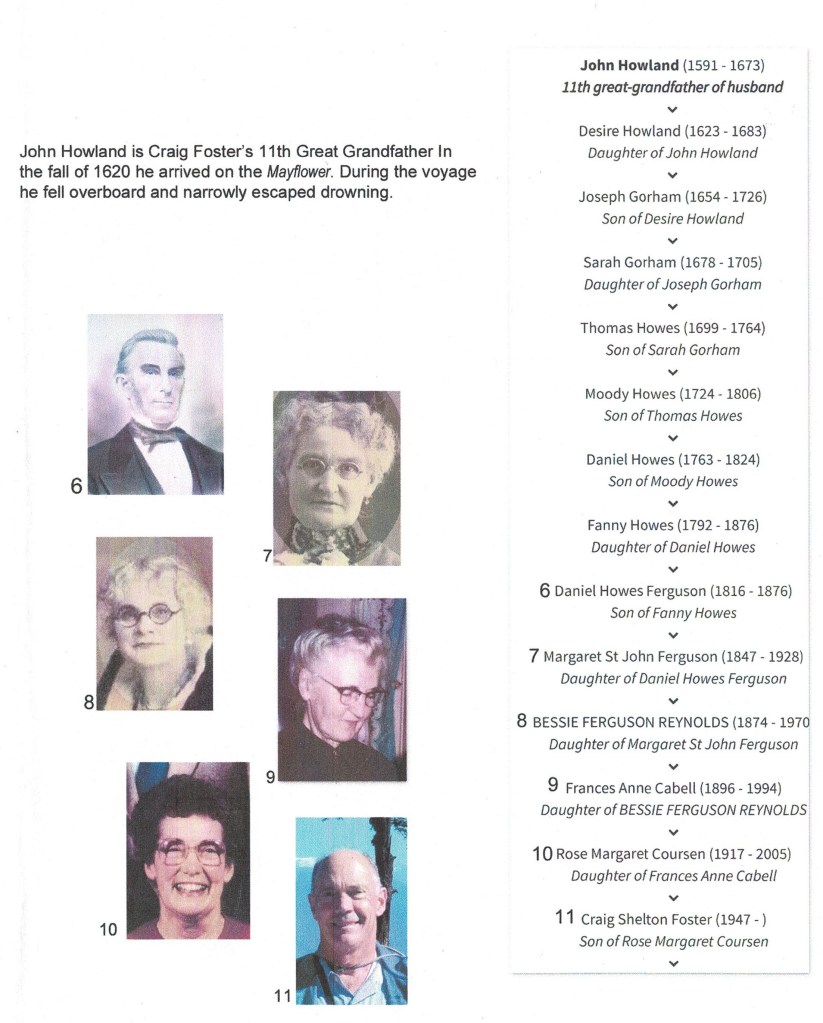
Soon after this treasure trove from my librarian friend at the Monroe County Library arrived, I worked out that Fanny’s family traced back to John Howland and Elizabeth Tilley. John and Elizabeth both arrived on the Mayflower in 1620. Elizabeth had come with her parents and was 14 at this time. Since I had read the picture book of John Howland’s near drowning to my kindergarten class many times, this new revelation seemed awesome.
The real John Howland almost drowned on his trip to the New World. He was not a cabin boy, but a 29-year-old man and one of two man-servants of Governor Carver. He was swept overboard in a strong storm. He managed catch hold of a rope for a top sail that tailed over the side and under water. He was brought back on to the Mayflower by the use of a boat hook. There is a sourced profile of John Howland on WikiTree
Here is Mike Haywood’s rendering of the event. Mike Haywood is an artist and holds a doctorate in Oceanography and specializes in marine paintings.
Image of an oil painting by Mike Haywood found on a Facebook ad for ordering prints of the painting
Final Thoughts
When I was a kindergarten teacher reading that historical fiction picture book to my class, I never dreamed I was telling a family story.
I made a list going from John Howland to my husband, Craig Shelton Foster
Thinking about the mistakes I made in my genealogy research, I’ve made plenty. I don’t think this was my biggest mistake, but it is my most memorable one.
When I retired from teaching in 2004, I started making a family tree on Ancestry.com. I remember the shaking leaf hint button announcing possible resources for my tree. Near the top of the profile I was working on a leaf image would show on the screen. This leaf would shake with gusto. I don’t think there was a ‘ding’ sound, but I was in the habit of leaving my speakers off.
I was working on John Breckenridge Cabell’s family when I made my big mistake. I was on John’s profile and one of these brazen shaking leaf showed up. The hint in the family tree category involved looking at other people’s family trees. I went back in time looking for parents of parents. I started finding Cabells born in the 1500s and getting suspicious. Eventually, I reached a couple with just given names. To my surprise, this couple referred to as Adam and Eve seemed to be the biblical Adam and Eve. After this, I disabled the automatic family tree hints. I became more systematic. I purchased the Alexander Brown book, called The Cabells and Their Kin: A Memorial Volume of History, Biography, and Genealogy (1895). I found this book to be well researched. I also found clues about John’s parents in Grandma Perritt’s scrapbook.
Louis Warrington Cabell and Anna Maria Perkins
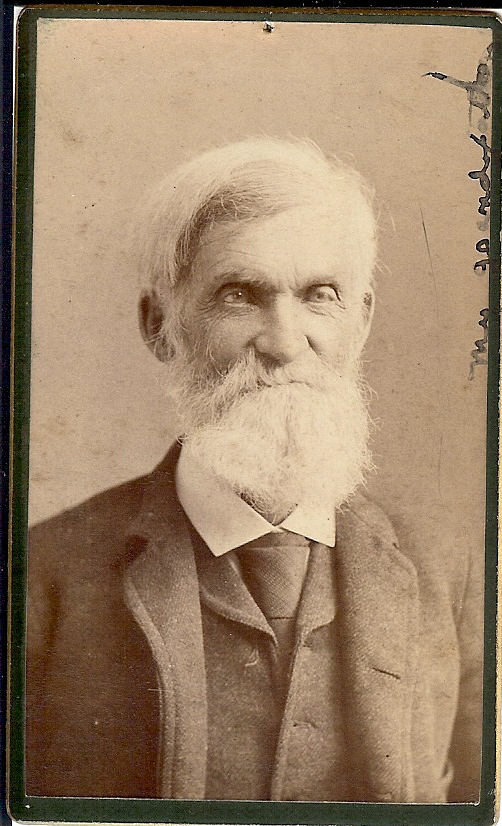
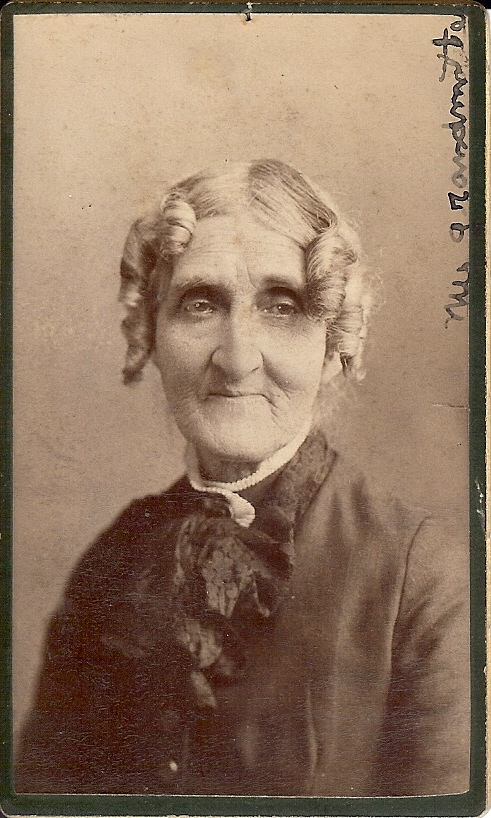
Frances Perritt, John Cabell’s daughter, had left clues in her scrapbook about John’s family in Virginia. She left photographs of John’s mother and father which she labeled “my grandfather” and my “grandmother”. Here are the photos.
Lewis Warrington Cabell
Anna Maria Perkins
The Cabell family of Virginia owned plantations spread along the banks of the James River. Some names were Elm Cottage, Green Hill, Struman, Buffalo Station, Clover Plains and Fernly.
Lewis Cabell called two of these plantations home– Struman where he was born and Green Hill which he inherited. The Green Hill plantation was on the south side of the James River in Buckingham County. His birth home, Struman, was on the north side of the James River and in Nelson County.
Lewis’s parents, Frederick and Alice Cabell, lived at Struman when their youngest child Lewis was born on June 12, 1814. Sadly, his mother, Alice died shortly after he was born.
Lewis studied at the University of Virginia in 1837 to 1839. He graduated on July 16, 1839. He was recognized both in the school of Natural Philosophy and the school of Chemistry. In July of 1840, he received a degree from the school of mathematics.
Frederick Cabell, Lewis’s Father
Lewis’s father, Frederick Cabell, left a will probated 25 February 1841. Frederick had died 10 days earlier on February 15, 1841. He was buried at his estate called Struman. He left some of his holdings on the south side of the James River to Lewis.
His will in part says:
I give to my son Lewis W. Cabell seven hundred and fifty acres of my Green Hill tract of land commencing at the stone quarry on James River …also ten Negroes and their future increase, as follow,
Reuban and Fanny, his wife, and his five children
Amy a negro woman
Peter and Cubby, his wife, and one child
Cassidy, a negro woman
Also, an equal portion of my personal Estate after all specific debts are paid.
So, after his father died, Lewis became a southern planter. In pre-Civil War days, this meant he was wealthy, owned a plantation and used enslaved people to farm his land.
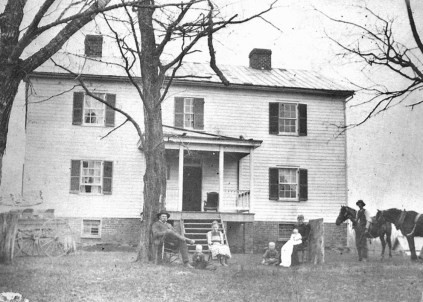
There was a house on the Green Hill property. It looked liked these.
1886 Green Hill (Madison Dixon Rebuild
So, after his father died, Lewis became a southern planter. In the days before the Civil War days, planters were wealthy landowners who used enslaved people to farm their land. There was a house on the Green Hill property.
Green Hill burned in 1878. This is a replica built by Madison Dixon. The photo is from the Cabell Society.
Anna Maria Perkins and Marriage
Anna Maria Perkins was born September 3, 1818, to George Perkins and Eliza of Cumberland County, Virginia.
Anna’s father, George owned a summer home in Cumberland County, Virginia called Hickory Hill. There is a marriage bond record for Lewis W Cabell and Maria A. Perkins, dated June 28, 1841, and listing their planned event to be in Cumberland County. Anna Perkins and Lewis Cabell married on July 8, 1841, at Hickory Hill, Cumberland, Virginia.
She and Lewis had these children.
George Perkins Cabell, born first, died as an infant.
Frederick Ernest Cabell, born 1844
George Perkins Cabell, born 1846; died 1850
Anna Maria Cabell, born 26 Jan 1848
John Breckenridge Cabell, born 1850
Lewis Winston Cabell, died as infant
Lewis Winston Cabell, born 1855
William Perkins Cabell, born about June 1857, died as an infant
Only Frederick, Anna Maria, John and the second Lewis lived to adulthood.
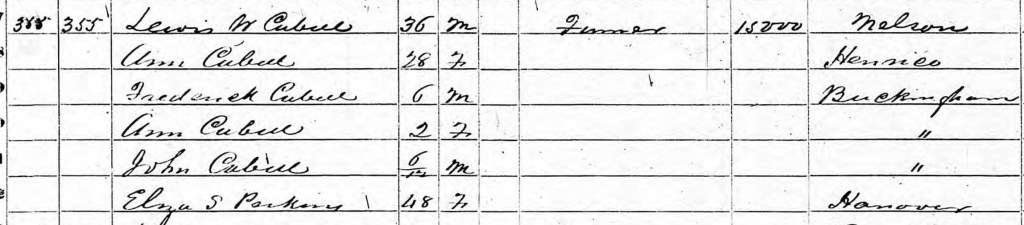
The 1850 US census for Mayville, Buckingham, Virginia showed Lewis W Cabell as the head of family number 355. He was a 36 year old farmer with property valued at $15,000. His wife, Ann, was 28. Their children Frederick, Ann and John were 6, 2 and 6 months. Here is a snippet of this census record.
Sadly, Lewis’s farm laborers were considered property. In this census record these enslaved people are shown only by sex and age.
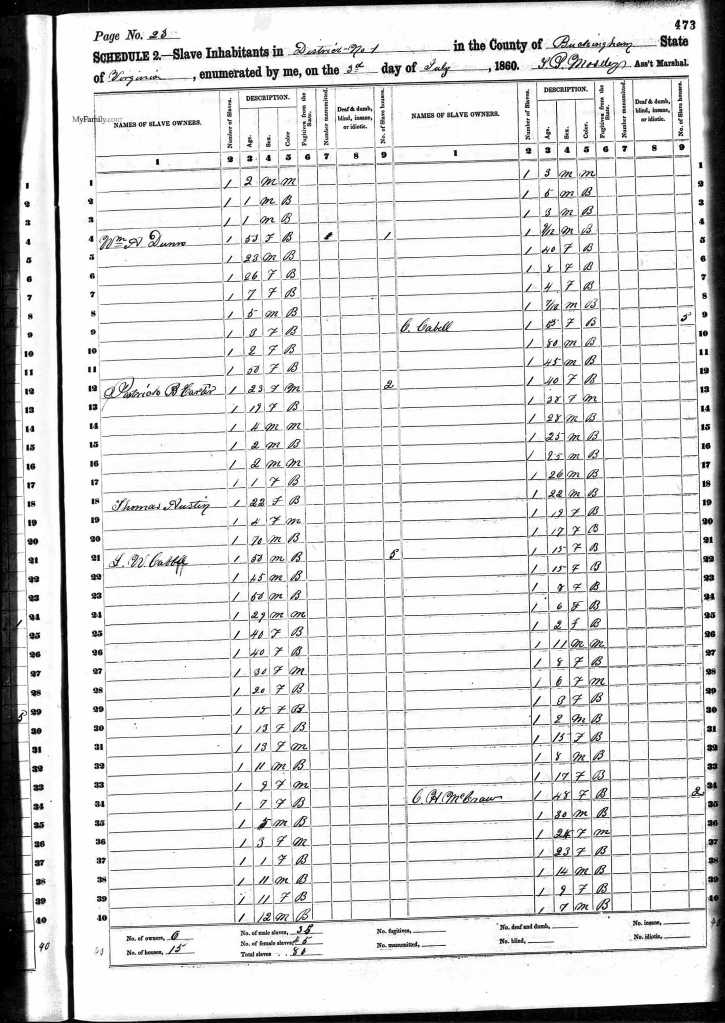
Buckingham County, Virginia slave schedule for 1850
Here is the Buckingham County, Virginia slave schedule for 1860. Lewis’s people are listed in the left column from 21 to 40. In the right column they are from 1 to 8.
New Interest
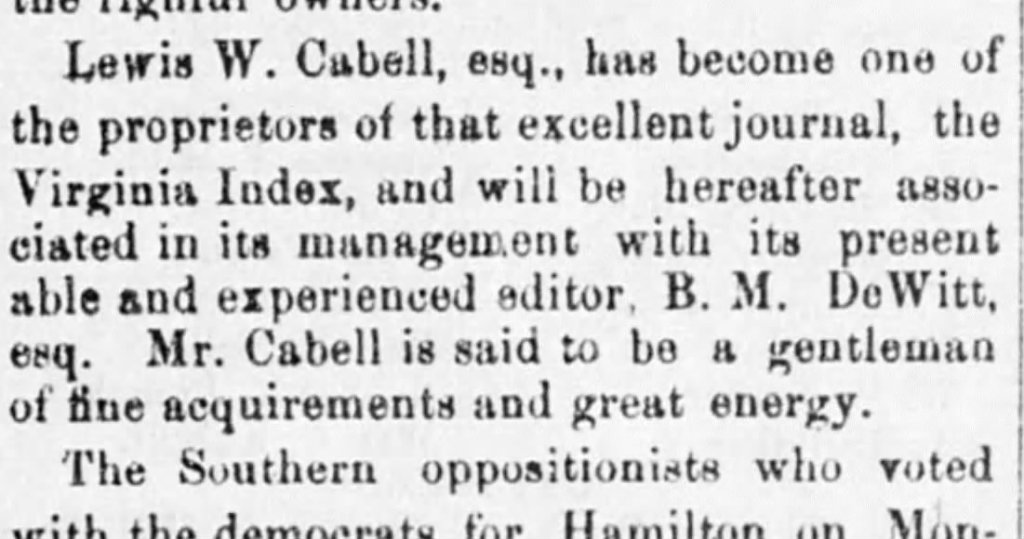
In January 1860 he owned the Virginia Index a newspaper. The Virginia Index was a semi-weekly journal published in Richmond, Virginia with B. M. DeWitt as the editor.
The Civil War Years
During the Civil War, the Green Hill house was used as a recovery place for wounded soldiers.
Then on January 30, 1878, Green Hill, the home of Lewis W. Cabell and his family, burned to the ground. The family escaped but all the contents of the house were burned. Here is a clipping from the Daily Dispatch. He sold the property not long after.
Lewis died 6 Oct 1890 in Nelson, Virginia, United States. He was buried there.
After Thoughts
When the story becomes morally reprehensible is it a mistake not to tell it? When “his” story of “her” story is your own family’s story should it be shared? Does forgotten history repeat itself?
Lewis Cabell kept Negro enslaved humans. A dozen of such humans were passed from his father to him by his father’s will. Even any children these people would have were willed to Lewis by this document. His enslaved population grew as shown by the 1850 and 1860 census schedules. This way of life even if all the other planters around are doing it is wrong. Lewis Cabell was blameworthy.
Did Katharine Connor’s parents use Finney as their baby girl middle name lest Katharine’s mother family not be overlooked? When Katharine married Isaac Roberts on November 13, 1828, in Charleston South Carolina, what did she think about changing her name to Mrs. Isaac Roberts? When she died in Albany, Oregon on December 1, 1889, and was buried in Sandridge Cemetery, did she plan to be buried in a unmarked grave?
I don’t have answers to these questions but thanks two men who interviewed Oregon pioneers—Edwin C. Roberts and Fred Lockley, I know something of this woman’s character.
Katharine grew up with music. She danced and sang and played the violin. After marriage and becoming a Methodist, she gave up dancing. Luckily, she still played the violin.
Early Life
Katharine Finney Connor was born in 1802 to John Connor and Katharine Finney. Her family lived in Charleston, Charleston, South Carolina, Untied States at the time of her birth. During her youth, she learned to play the violin quite well and still played as an adult. Before she married she had been one of the best dancers in the county of Charleston.
Marriage and Family
How and where Katharine met Isaac Roberts is not known. They married far from South Carolina on November 13, 1828. Clancy Smith married them in Jefferson County, Missouri. Their marriage record reads:
Let it be remembered that on the 13th day of November 1828, I Chancy Smith, a Justice of the Peace in and for said County (Jefferson) did join in the state of matrimony Isaac Roberts and Catherine F. Conner. Given under my hand this 13th Nov, 1828, Record Nov 13th 1828, Chancy Smith, Justice of the peace, C Smith clerk.
Dancing days were over after Katharine married this strict Methodist northerner who didn’t play cards or dance.
Their children, all born in Missouri, were Thomas who died as an infant, James Bruffey, Emily Catherine, and Samuel Huston. Samuel Houston was named for a cousin of Katharine’s.
Migration to Willamette Valley– Portland, Oregon
Isaac, Katharine, James, Emily and Samuel Roberts left Independence, Missouri in the spring of 1850.
Katharine Roberts, a pioneer woman of tact, bravery and quick thinking demonstrated these qualities during the trip West in a run end with a Sioux Chief in the Great Plains region. This chief rode into their camp and wanted to trade for their daughter Emily Roberts. Natives often traded with the people going west. He asked, “How many ponies?” Rather than discussing this topic Katharine picked up her violin and started playing. After a while, the chief left without losing face by having been turned down outright.
Katharine, like most settlers traveling by oxen hauled wagons, probably walked much of the time. Roughly 2000 miles separated Independence, Missouri and Portland, Oregon. The pace was slow- 11 to 17 miles per day and the days were long. The trail was more of a suggestion than an actual road. Bumps and holes made riding quite jarring. Katharine’s family arrived in Portland in the fall of 1850. They made a tent camp along the Willamette River near what is now 1st and Pine Street.
Portland, Oregon
Mr. William Warren, who was building a hotel, offered the Roberts accommodation in his building while it was being finished. The dining room and kitchen were finished. The Roberts expecting to pay took his offer; but, Mr. William would accept no money.
Katharine had cooked the long spring and summer over an open campfire in all kinds of weather. Living indoors and cooking on a stove would be luxurious. But William Warren had ulterior motives for his generosity. He was interested in her daughter, Emily Roberts.
Her daughter Emily Roberts had turned down William’s proposal of marriage. Emily had another suitor. Edward Griffin and Emily Roberts married on October 26, 1851. They were married by James Wilbur at the newly constructed Methodist Church on Taylor and 3rd Street. This was the church the Roberts helped build.
By December 9, 1850, the Roberts were living in their own home. Their house was the only house built on the block bounded by 4th, 5th, Columbia and Clay Streets.
The Move to Roberts Bridge
A chunk of land on the Calapooia River 10 miles south of Albany, Linn County, Oregon Territory, USA came to be known as Roberts Bridge or the Roberts Bridge community.
This is the site of Katharine’s next home. Katharine had mixed feelings about leaving her Portland community. Her friends and her church were in Portland. On the bright side, this move presented an opportunity to both her and her daughter Emily.
The United States Congress had enacted the Donation Land Claim Act before the Roberts arrived in Portland. It became effective on September 21, 1850. By this act, Katherine’s son, James Bruffey Roberts who was a white male U.S. citizen over 18 could claim 320 acres of federal land. He needed to take out the claim between 1 Dec 1850 and 1 Dec 1853. James did take out a claim next to his mother and father’s claim.
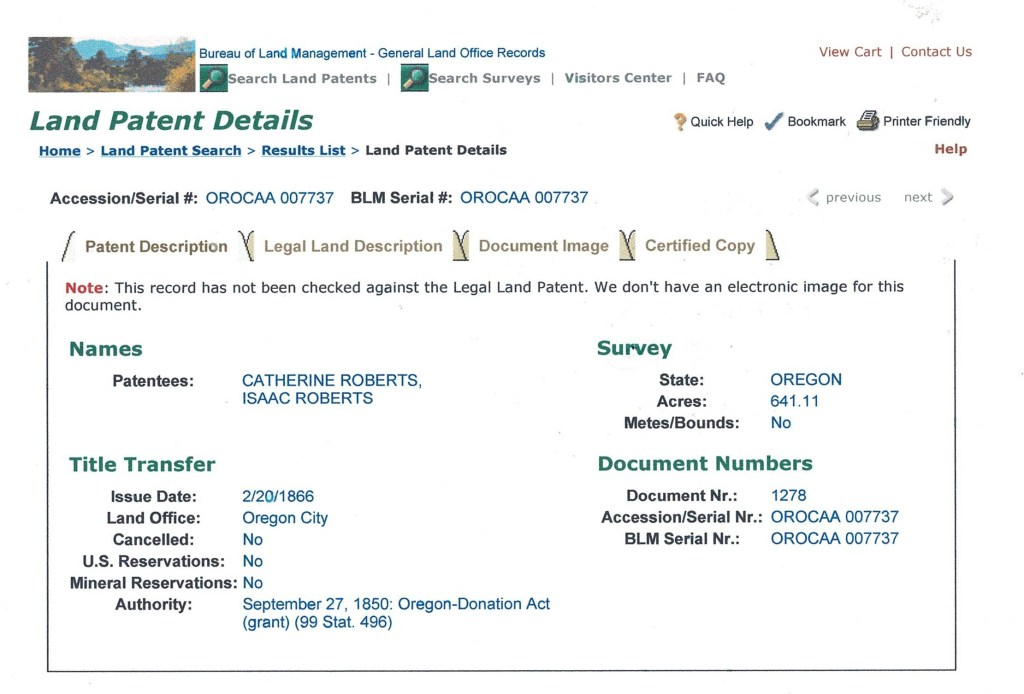
The plus for both Katharine and her daughter, Emily was that married women could own land by this act. As a married couple Katharine and Isaac took out a 640 acre claim, and 320 acres were in Katharine’s name. Allowing a married woman to own property was uncommon in the United States before this time. Here is a copy of the BLM GLO Land Patent Details.
The last in this family group to claim land here were Emily Roberts Griffin and her husband, Edward Griffin. Since they had married before December 1, 1851, they qualified for 640 acres. Their claim adjoined Emily’s parents claim and 320 acres was in Emily’s name.
Later Years
Katharine and Isaac had lived on their homestead less than 10 years when Isaac died there on September 6, 1860. After Isaac died, she acquired a home in Albany at the corner of 4th and Maple Street.
Her son-in-law, Edward Griffin put this ad in the States Rights Democrat in December of 1868.
Albany Home
Katharine moved from Robert’s Bridge area to Albany. She lived in Albany by the time the 1870 census was taken.
The 1870 U.S. census described Katharine F. Roberts as sixty-eight-year-old widow, born in South Carolina, with real estate valued at $550 and personal property of $1200. Also at this place was James A Warner, a thirty-four-year-old surveyor. Here is a snippet of that record.
In 1880, she was still living in Albany and James Warner is still rooming there too. In this census record, Katharine is spelled beginning with a “K” which was her way of spelling her name.
Death
Katherine died on December 1, 1889. Her obituary reads:
The mother of James Roberts, who died near Shedd on the first inst., was interred at Sand Ridge Cemetery. A sermon was preached by Rev. Gould at the home of James Roberts, where a large number of friends were gathered, many of whom followed her to her last resting place.
Some References
“Interview with Edwin C Roberts in Albany Oregon”. Leslie L Haskin, 1940. wpa-interviews, Linn Genealogical Society.
Lockley, Fred, “In Earlier Days”, The Oregon Daily Journal(Portland, Oregon),28 Feb 1914, page 4 (col. 8 paragraph 4)
A figurative brick wall is a challenging obstacle or obstruction. A brick wall can also refer to a wall made from bricks. In my paternal grandfather’s case both definitions apply. He knew how to build brick walls, and his ancestors are mostly unknown to me.
Thomas’s and Luise’s Brick House
Thomas Steven Lonski, my grandfather, knew how to build brick walls. He built brick walls for two Seattle area houses. I lived in one of these houses with my family during my first eight years of school. The other brick walls were for his house on Lander Street. He, his wife, Luise, and his children, Ruth, Walter and my father, Albert, lived in this house for many years.
The house Thomas built for his family had a partly daylight basement as it was built on a slope.
A living area with a living room, dining room, kitchen, half bathroom and entry hall topped the basement level. Upstairs were 3 bedrooms and a full bathroom. a steep roof topped this home.
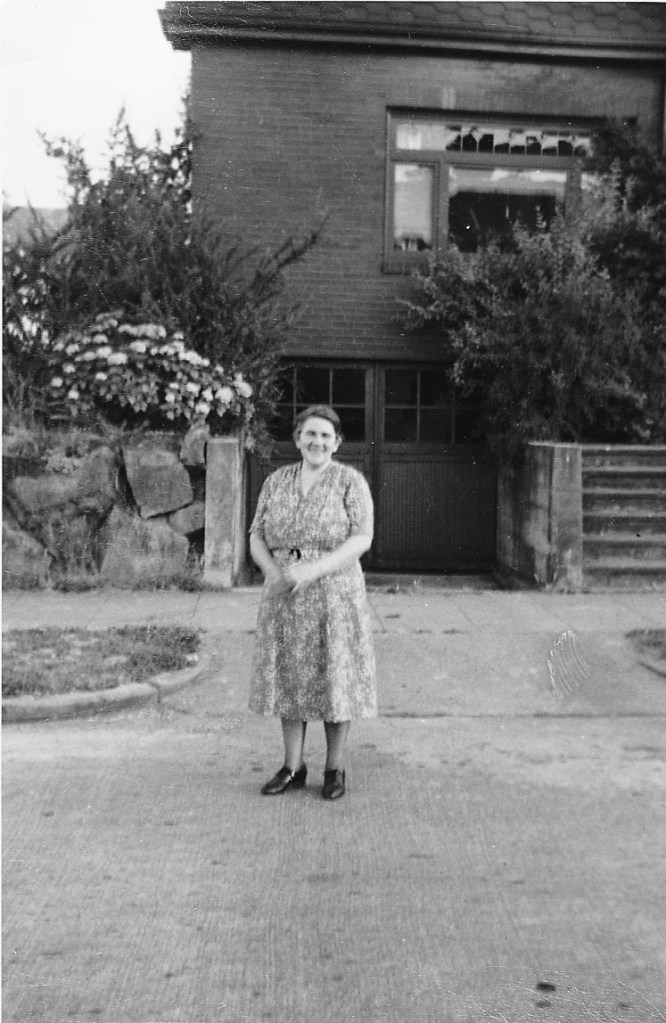
Luise in front of the brick house Thomas built for them
Albert’s Brick House
The brick walls he built for my family held up a different sort of house, although this house also sat on a slope. We had a great view of Lake Washington from this house.
Both Thomas and my father, Albert, worked on building this house. Thomas lay brick early in the day. Albert worked in the late afternoon and evening after his day job at Boeing Company.
Sometimes the neighbor who lived directly behind this building project. Thomas told this man named Edward Kennedy that the finished product would be a two-story house with a peaked roof.
One evening, while my father worked on our house, Edward came over asking about the thickness of floorboards, the height of the walls and the size of the attic. Edward looked and sounded decidedly grumpy. My father didn’t know why. Then my father explained that this house was to be a one-story building with a flat roof. Albert showed Edward the building plans, Edward smiled broadly; he knew his view would still be there.
After this, the old man laying bricks at Albert Lonski’s house site became known as a prankster and someone you shouldn’t play poker with.
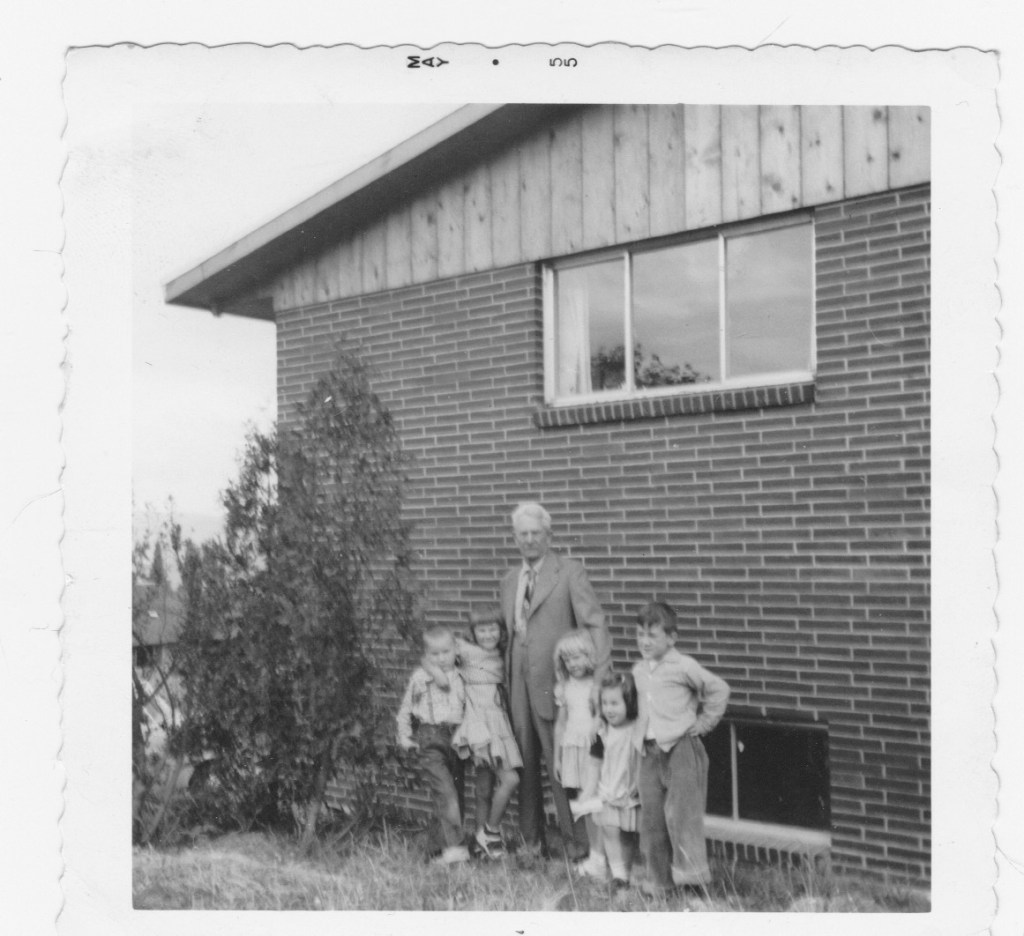
Thomas Lonski with his grandchildren.
So, my Grandfather Lonski built the bricks wall for my childhood home. More importantly, he was there for me during my formative years.
He took me on outings. If we ate out, we usually ordered French Dip sandwiches—his favorite.
During these times grandfather would tell me about our Lonski family. I remember his facial expressions. When he said his mother’s name, Marianna Napontiac, he looked wistful. His mouth was soft, and his eye pupils widened.
On the other hand, when Grandfather spoke of his father, Michael Lonski, his eyebrows came together, and his voice became louder. He said his father had once been Michael von Lonski. Because of problems with alcohol, he sold the “von” part of his name. Since von in German means from or of, could this mean Michael had owned land and sold his right to it?
When Grandfather was young, his hometown in Poland, was Tuchel (now called Tuchola). He lived with his mother, father and seven brothers—John, Michael, Paul, Vincent, Franz, William (named for the Kaiser) and Joseph. He was a middle child, born on December 17,1880. In 1880, 3,066 people lived in Tuchel. He grew up hearing both German and Polish spoken in his household so was fluent in both languages.
Military School
Grandfather told me he was in the German army from 1902 to 1904. There was compulsory military service for preteen boys in Kaiser Wilhelm’s army.
A young Thomas Lonski at Military School
When Gdansk Was Danzig
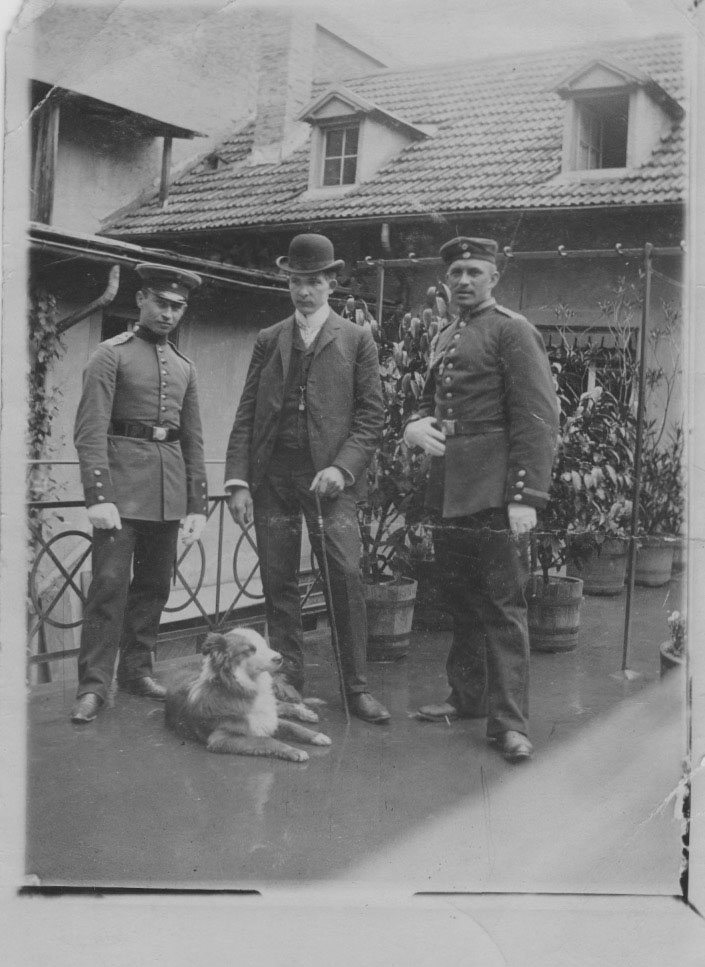
He and his two brothers would visit the large port city of Danzig (now called Gdansk) when they were young men. They would roam the streets of this city by the Baltic Sea together looking for fun. Paul, born in 1877, was 3 years older than Thomas. Vincent born in 1882, was 2 years younger. Here is a photo of the three together.
Vincent, Thomas and Paul in town before they went to Canada
Switzerland
He left home in 1910, he said, to avoid further military service. He found work in Switzerland as a tailor working as a cutter and fitter. I remember him talking about cutting many layers of wool fabric with extra-large scissors. I have the thimble he used from this job.
Canada
By 1913 he had migrated to Canada, obtained his British citizenship and lived in Saskatoon, Saskatchewan at Bose 1135. In May of 1913 his brothers Paul and Vincent met him in Saskatoon. they had in New York aboard the SS Zeeland. They had sailed from Antwerp, Belgium. These three young men Paul, a carpenter, Vincent, a plumber and Grandfather headed for Salmon Arms near Kamloops, British Columbia. They staked a land claim and built a cabin.
Paul and Vincent returned to German Poland in December of 1913. Paul returned to a wife in Dusseldorf and Vincent to a brother, Joseph Lonski, who also lived in Dusseldorf.
Grandfather stayed in Salmon Arms a while. He told my mother he lived with a woman there and left her rather abruptly. He went to Vancouver, B.C. where he met my grandmother, Anna Luise Taubert.
Anna Luise Taubert
Luise Taubert
Grandfather said a friend named George wanted to talk to the pretty German girl working for the von Roons. The von Roons were Germans living in Vancouver, B.C., Canada while the political situation in Germany settled down. because George didn’t speak German and Thomas did. Apparently, the things my grandfather said to Luise caused her to take an interest in him. Around this time the von Roons decided it was safe to go back to Germany. Luise decided to stay in Vancouver; Grandfather thought it was because of him.
Thomas crossed the border into the United States in 1816. Luise Taubert came to Seattle separately by ferry. They married at the courthouse in Seattle, Washington on April 18, 1916.
Thomas lost all contact with his family. He always looked unhappy when he spoke of this.
Climbing the Lonski Family Tree
About 20 years ago, I started writing down information about my family on tree forms. I didn’t find anything beyond what Thomas wrote on his application for social security. His father was Michael Lonski. His mother was Marianna Napontiac.
Then came the story of Camp No. 7, located in Tuchel and surrounded by the beautiful Tuchola forests. This was the forest Grandfather thought of when he hiked the trails around Mount Rainier close to Seattle.
Prisoner of war camps were located in and near Tuchel in WWI. Camp No. 7 was a prisoner of war camp ran by the Germans. Poles, Italians, French, and British captured persons with imprisoned there. Conditions there were horrible and many died.
At this time, I thought of genealogy as my hobby, It was supposed to be fun.
Renewed Effort
I revisited the Lonski family recently finding casualty list for German soldiers in WWI. The list (Verlustisten) named German and Austro-Hungarian soldiers who were dead, wounded, caught, missing or returned. I found 6 Vincenz Lonskis on this list. The Vincenz of Tuchel who died October 29, 1914 may have been Thomas Lonski’s brother. There were other men with the Lonski surname. There were 10 men named Franz Lonski, 11 named Johann Lonski, 5 named Josef Lonski and 1 named Paul Lonski.
Then I started having war dreams. I again stopped looking.
Thus, my grandfather, who had built the brick walls for our home, left me with another brick wall. It is the “I’m stuck” kind. But, I am extremely grateful he left Germanic Poland before WWI, knew and loved me and told me his stories.
Howard Melvin Foster at Jefferson , Oregon in 1986
On the whole, Howard Foster did not display secretive qualities. He willing talked about any topic that came up. He answered questions about himself in detail. If he didn’t know the details he filled in the details. The only thing he knew about his birth grandfather father was the name, John Lawrence Shelton.
Howard Melvin Foster, a glass half full person, was my father-in-law. Also, he was Grandmother Perritt’s son-in-law. I spent some time with him and my mother-in-law, Rose. This was when my husband was in the army, stationed in Shemya, Alaska. My obstetric doctor practiced medicine in Portland, Oregon where my in-laws lived.
Being the positive person Howard was, he was not about to share the unhappy parts of his life. If something bad had happened he quickly forgot about it.
Being the nosy person I am, I asked questions about his life. If the event was good, I got detailed answers. If not, I got half answers.
Howard’s Brother Dick
Charles Richard Foster, his half-brother, was born three years after Howard. They were close while growing up. Charles or “Dick” as the family called him, grew up to be an alcoholic. Howard grew up to be a family man with a house in the suburbs, a business of his own, a loving wife, two sons and a dog named Eagle.
Dick, on and off the wagon, showed up at regular intervals, drunk and asking for money. Howard helped him until he broke with Dick when his boys were under five.
I asked what happened to Dick. Howard said he thought he died sometime in the 1950s and his family lived in Silverton, Oregon. Years later, I was searching for a Charles Richard Foster and found him in a Silverton Phone Directive for 1997.
Dick Foster, Spokane, August 1943
Early Life
A wild story about Howard’s early life came from his half-sister, Jean Wardian. How Howard came to have a half-sister, and two half-brothers is a different story I will tell now.
Edna Naomi Miller fell in love with Carl Shelton in Portland, Oregon. They lived in the same Portland Ward. They were both in their early twenties. When Howard was born on July 31, 1914, in Portland, Oregon, Edna was 25 and Carl was 24.
Back to the wild story, the first part is true. Auntie Jean, Howard’s half-sister, said Howard’s small family moved to a small logging community in the northeastern part of Oregon. They moved to Enterprise and Enterprise is where Carl died and is buried. I found his grave in Enterprise Cemetery. He had died July 24, 1915, just a few days before Howard ‘s first birthday.
The wild part of this story involves the reason they moved. Jean said, “Carl’s parents were well off, well known in the Portland music scene and were trying to get custody of Howard.”
Howard Melvin Shelton at 3 months
New Father
Edna married again on June 10,1916 about a year after Carl died. Howard grew up knowing no other father beside Charles Wallace Foster.
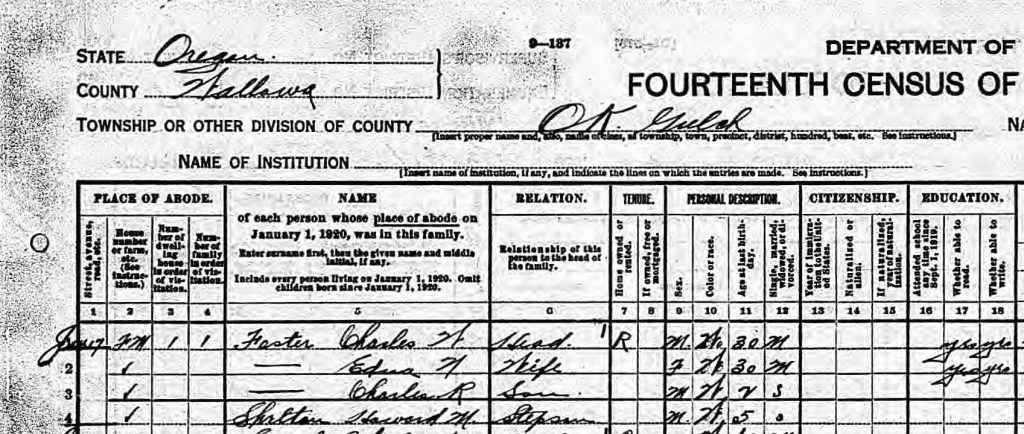
The Fosters used Shelton as Howard surname in the 1920 U.S. census. Here it is for OK Gulch, Wallowa County, Oregon.
1920 census showing Charlie Foster’s Family in OK Gulch, Wallowa, Oregon
Using Foster as His Surname
After Howard started school in Lewiston, Idaho, he used Foster as his last name. Here is the 1930 U.S. census from Mount Pleasant, Skamania, Washington.
1930 census showing Charlie Foster’s family in Skamania county, Washington
A Problem Develops Later in Life
In 1963 Howard needed a name change. He went through the Multnomah County circuit court system to change his name. His birth certificate named him Howard M. Shelton. In life people and institutions call him Howard Melvin Foster.
He graduated from Fort Vancouver High School as Howard Foster.
He studied for four years at Reed College as Howard Foster.
He married Rose Coursen on June 3,1940 as Howard Melvin Foster.
His two boys carried the surname of Foster.
His printing business was called Balwin-Foster Printing Co.
As a scout master from 1961-1965 he was known as Howard Foster.
He served his country in WWII and separated from the army as Private First-class Howard M. Foster.
I don’t know the immediate reason he needed to do this in 1963. I do know his church was planning a group trip to Israel and Rome. Howard would need a passport for this trip and a birth certificate with the name he had used for 45 years.
Certificate of Change of Name
On April 2, 1963, Howard Melvin Shelton, on his own behalf, petitioned the Circuit Court that his name be changed from Howard Melvin Shelton to Howard Melvin Foster. On April 29, 1963, his name was changed, and an official Certificate of Change of Name was issued to Howard.
Going Ahead to 1972
Moving ahead, I spent more time with my in-laws in Portland waiting for the baby. During my last month of pregnancy, my obstetrician wanted me to cut out my trips between Seattle where my parents lived and Lebanon where my grandmother lived. Being consigned to Portland, I had more chances to ask Howard about his life. He didn’t want to talk about his experiences in WWII.
Years later, going through Howard’s papers, I found his separation papers containing a summary of some of what he did. I was impressed. I don’t know if he didn’t talk about this last assignment because he didn’t want to, or he wasn’t supposed to. Here is the quote from his separation papers.
Title-Description-Related Civilian Occupation
Master, Ship: Served with 329 Harbor Craft in European Theater of Operations. Served aboard General McNarney’s private yatch. Was second in command of the boat. Drew all rations and supplies to be used. Acted as purchasing agent and bought on the civilian market. Supplies to be used that couldn’t be secured through the army.
At the time Howard was the Ship Master of this yatch, General Joseph T. McNarney was commanding general of the United States Army Forces, Mediterranean Theater. Howard separated from the army on March 17, 1946.
Howard Foster, center and army friends oversea on leave in France. Taken in 1944 or 1945.
Granddaughter
Then my daughter was born on a hot day in August of 1972 in Portland, Oregon. The grandparents had time to bond strongly with this new human.
In February of 1973, my husband came home from Shemya, Alaska. Soon after we headed to Fort Devens, Massachusetts where my husband finished his enlistment.
The grandparents were grieved with our going. This suggests the emotions in the family legend of Howard’s parents taking Howard away from his grandparents about 58 years ago.
We did come back to Oregon, living and working about 50 miles south of Portland. Howard and Rose attended their granddaughter’s wedding in 1998.
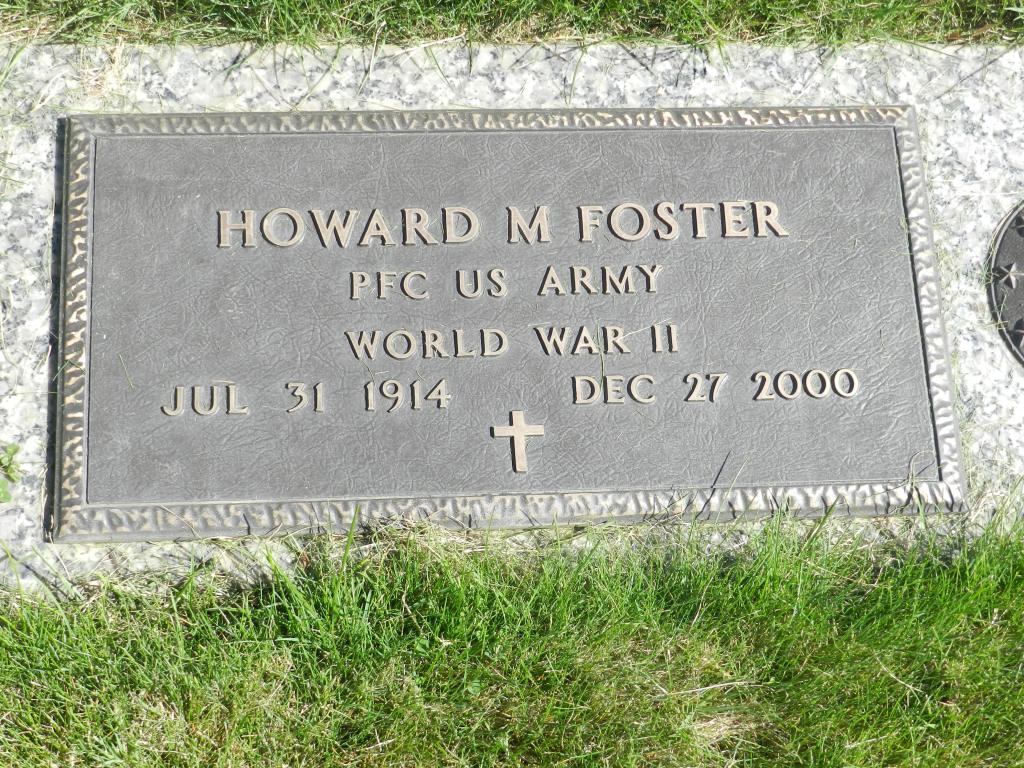
Howard died on December 27, 2000, in a care home in Portland, Oregon. We buried him in Skyline Memorial Gardens in Portland, Oregon. He has a flat bronze veterans headstone marker.














 francescabellcoursenperritt.com