Tag: history

  • Albert Lonski Wartime

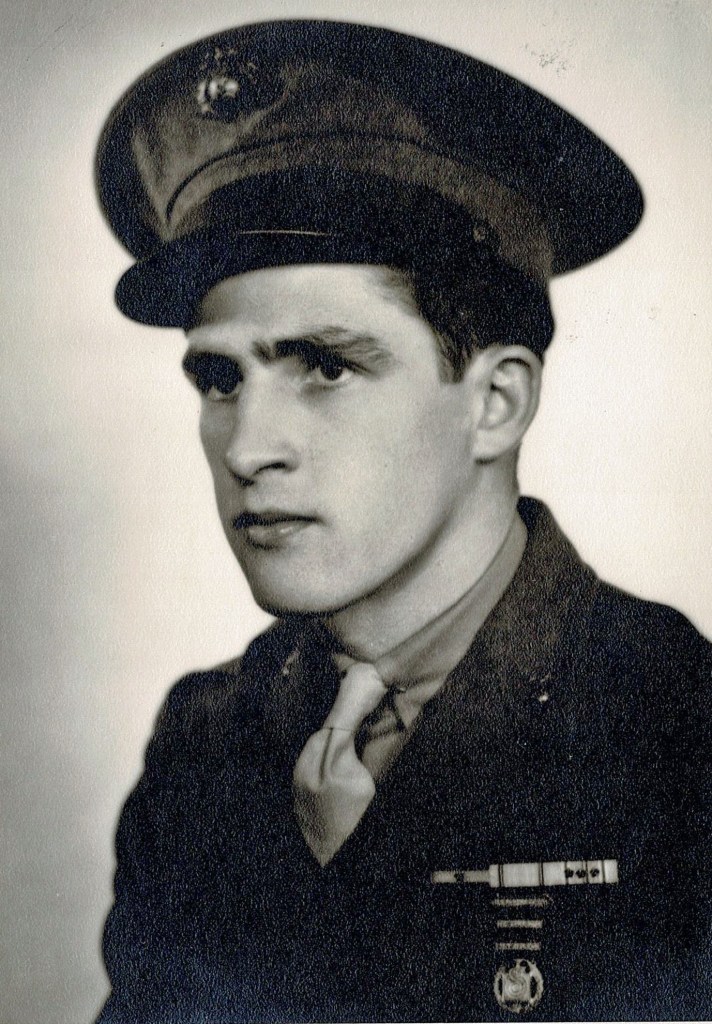
    My father, Albert Thomas Lonski, wore his dress uniform for this portrait photograph. This uniform, his dress uniform, included a forest green coat, trousers of the same color, a khaki shirt, and tie. The insignia on his hat and lapel was the Eagle, Globe and Anchor (EGA). This was Marine Corps symbol.  The next photo shows his Service ribbon bar at the top. This bar is divided into 3 parts. The Presidential Unit Citation on the left was awarded to all the men in his unit for heroism in action. His unit was Headquarters and Service company, !8th Marines. He was in the mapping section. In the center, the American Defense Service medal is represented. Military service members who served on active duty between 8 Sep 1939 and 6 Dec 1941 got this medal. In the right section is the Asiatic-Pacific Campaign Medal. It went to those who served in that area from 1941 to 1945. Albert had 3 service stars on this right side of his service bar. These stars were often called battle stars because they meant that he participated in a named campaign.

    Albert’s sweetheart, Helen Wolfe, also served during WW2 in Normandy, France. Toward the end of her life she wrote her story of day  of Victory in Europe.

    She, an army nurse, was my mother. In this piece she reacts to the news the war has ended. She heard it as “La Guerre est finie.”

    “La Guerre est finie” boomed the French voice from the radio shattering the darkness.
    I stood alone and listened. I was caring for a large ward of wounded soldiers. It was midnight in France in 1945 (May 8). To all of us this meant we could go home again to our own families and our country.
    I asked myself should I wake my soldiers and tell them. I didn’t, saying to myself what if it is a false report as it might be? For days the two armies faced each other in the valley. This meant that the Germans had finally surrendered the command to the Americans. It was very dramatic standing in that darkened room hearing the war was at last over. The radio became lively with chatter spoken in excited German voices. I spoke a little (German) and could make out only a little bit. I did understand that Hitler married his sweetheart, Eva Braun, then both committed suicides.
    I stood alone in the dark talking to myself with world shaking news leaking around me. Oh, why didn’t I wake up some of my soldiers? I didn’t. I did go to my night supper where all on duty went for a meal. There I got to share and say, “La Guerre est finie”. Most of them had not heard.
    How different was the next night! I left the radio on for all the soldiers to hear a discussion about the GI bill. This bill would make a difference in the lives of these young men. They could go home, marry their sweethearts, have babies and go to school (with the help of this GI bill). It was a wonderful investment in people. Our government’s G I bill would make a difference to each of us and we were grateful and ready.
    The next week I received five proposals of marriage. These soldiers were ready to start a family and start living.
    I had a recent quarrel with my Albert, but he still held my heart. I accepted one of the offers, knowing I would not keep it. I, too, wanted to go to school.
    Instead, we married as soon as we saw one another.
    Eventually, we had two beautiful daughters (their oldest one being born almost exactly 9 months after they married). There was enough to do. We used the GI benefits and felt so rich with the 90 dollars the government gave us to live on. We soon had everything. We had two lovely children and enough to eat and La Guerre est finie, no more war.
    We lived in my mother’s old house in Oregon. Albert remade it into a beautiful palace covered with stones he carried from the rock quarry (also on his mother-in-law’s property).
    Our daughters grew daily.
    Next part -Albert’s career
    After years (of higher education), Albert was tired of college. He contributed (his skills) to making airplanes. He helped develop the 747. We moved around the country a lot with him working for Boeing. He helped get the Saturn Booster in the air.
    It all ended (when Albert retired). We went back to our stone castle on the river. By that time we had four beautiful grandkids. What treasures they were and still are.
    Now our country is in a miserable war (Iraq War) which they cannot win. I hope these soldiers can come home and be ordinary people again. Then perhaps la Guerre est finie can happen.

    Albert Lonski Goes to War

    Early life

    Albert Thomas Lonski arrived in this world on February 6, 1922, In Bremerton, Washington, USA. This was the same year Hitler formed Jugenbund, predecessor to the Hitler Youth organization in Germany. Albert’s mother, Anna Luise Taubert, was born in central Germany. She came to North America as a young woman. Her brother, Walter Taubert, kept in contact with her and her family. He sent birthday cards to his nephew, Albert. Here is a photo of the postcard Albert received on January 21, 1933. Walter’s son, Helmut, who was Albert’s first cousin, wrote out the message. “Greetings to you, from your Helmet, Parents and Grandparents”. The grandparent would have been Luise’s mother who was also the grandmother of Albert.

    This same Helmut joined the German army when grown. He likely belonged to Hitler Youth as a teenager.

    When Albert was only 16, when he graduated from Franklin High School. Then in December of 1938, wanted to join the US Marine Corps. Young men were allowed to join at age 17 if they had written parental consent. It was likely Albert’s father, Thomas Lonski, who gave this consent. This must have been a difficult time in the Lonski household. Seventeen days after his 17th birthday on February 23,1939 Albert did join.

    In the Marine Reserves

    According to the Marine Muster Rolls from the National Archives, Albert drilled at the Canadian National Dock in Seattle. Dates included were March 1, 8, 15, 23, and 29.

    On December 20, 1939, he qualified as an Expert Rifleman.

    Albert’s unit, the second Division Combat Engineer Battalion, was activated on November 1, 1940, in San Diego, California. Albert stayed in Seattle, but drilled with his reserve unit at Aberdeen, Washington.

    Out of the Reserves into Training- Camp Elliott

    Pearl Harbor Attack occurred on December 7, 1941

    Albert went to Camp Elliott before the Pearl Harbor attack. He trained at this camp in San Diego and is here in April 1941.  Second Lieutenant, Ben Webtherwax, led class 2. Albert was a topographer. On the October muster roll he was also a topographer.

    Still at Fort Elliott in January 1942, Albert was then a private 1st class working in the mapping section.

    Camp Dunlap, Miland, California

    By July of 1942, Albert trained in a California desert camp, Camp Dunlap. Here he met Helen Wolfe, a nurse working at Brawley Hospital. Three liberty passes for Albert have the wrong birth date typed at the top. This made him seem two years older than he was. Helen was 24 when they met; Albert was 20. When Albert showed Helen his liberty pass, she thought he was 22. Of course, the truth came much later and she was mad.

    His October 1942 Muster Roll read,” Albert Lonski, computer, mapping section”.

    New Zealand

    In 1942 and 1943 New Zealanders in Wellington shared their space with 15,000 young American Marines. The U.S. Marine corps used Wellington, New Zealand as a base for training and staging during WW 2. It was also a place for soldiers to rest and recover from being in the field.

     Albert with the 2nd Marine Division arrived in January 1943. His unit was stationed at Camp McKay. Albert took photos. Few had written descriptions; many were stamped on the back with this mark.

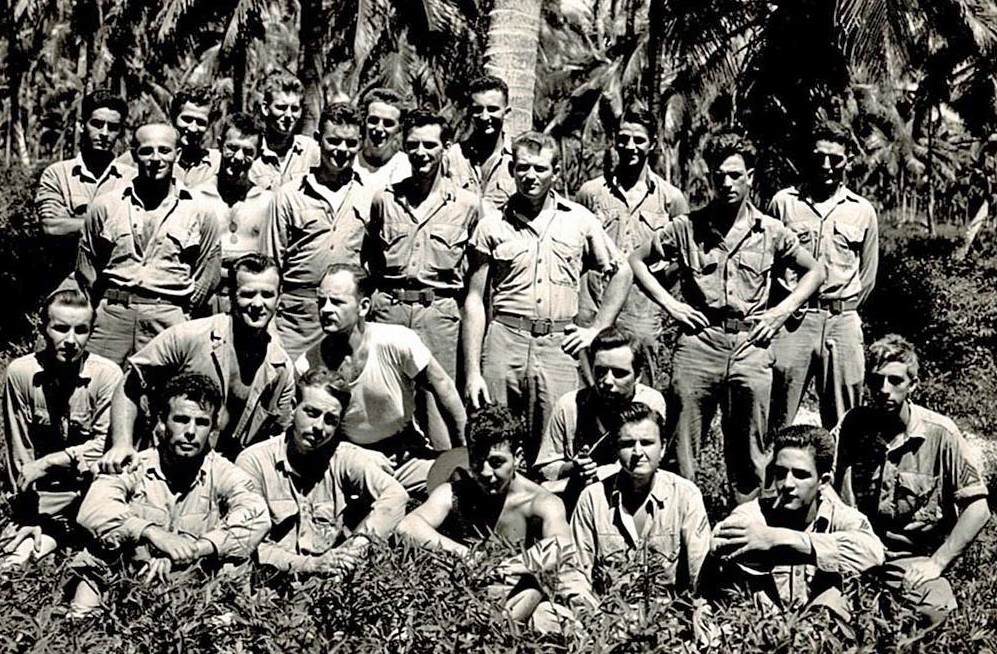
    Here is a group photo of his unit in New Zealand. He is in front on the right. This is written on the back, “March 29, 1943, after 3 months.” Albert is in the front on the right.

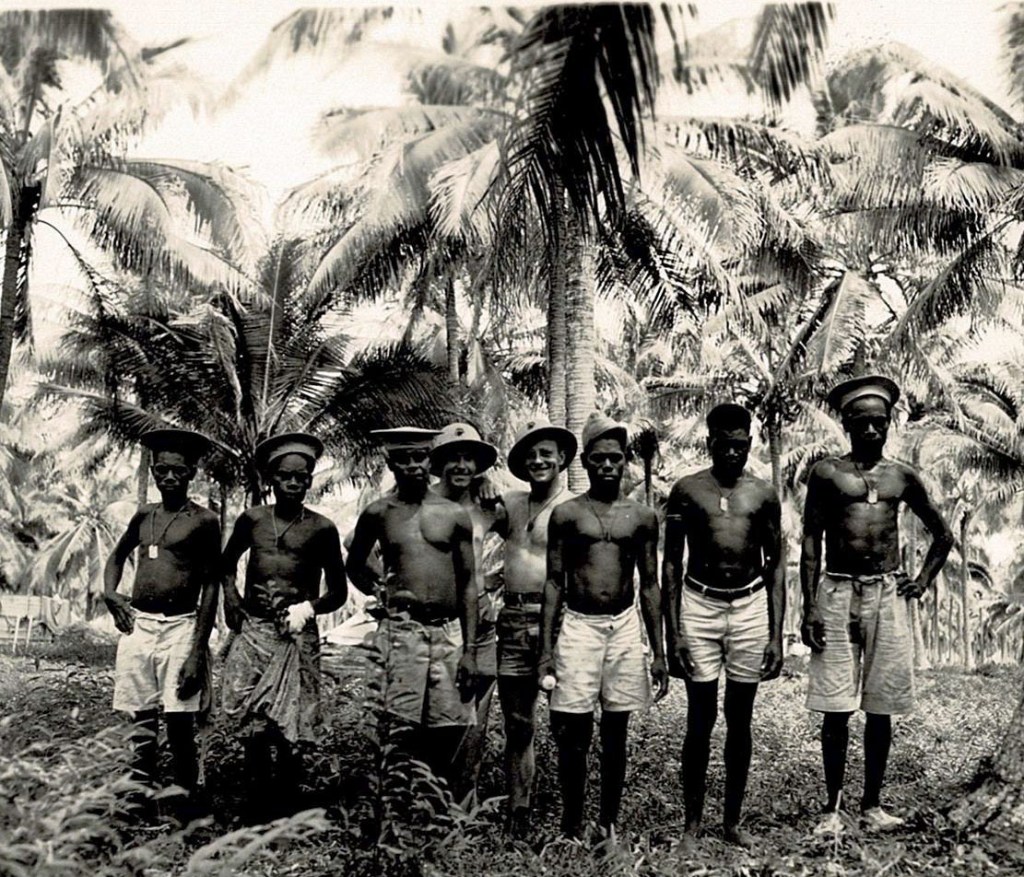
    He photographed more than a few natives while in New Zealand.

    More photos

    In the Field

    His first stay here was brief. He left on December 12, 1942 aboard the USS Bellatrix. He wore the 3 stripes of a technical sergeant on his sleeve. The Marine Muster Rolls don’t say where he went, just that he went to sea and was in the field.

    Campaigns

    On September 8, 1942, headquarters changed Albert’s Division to the first H&S co., 18th Marine (engineer), 2nd Marine Division. H & S stood for Headquarters and Service.

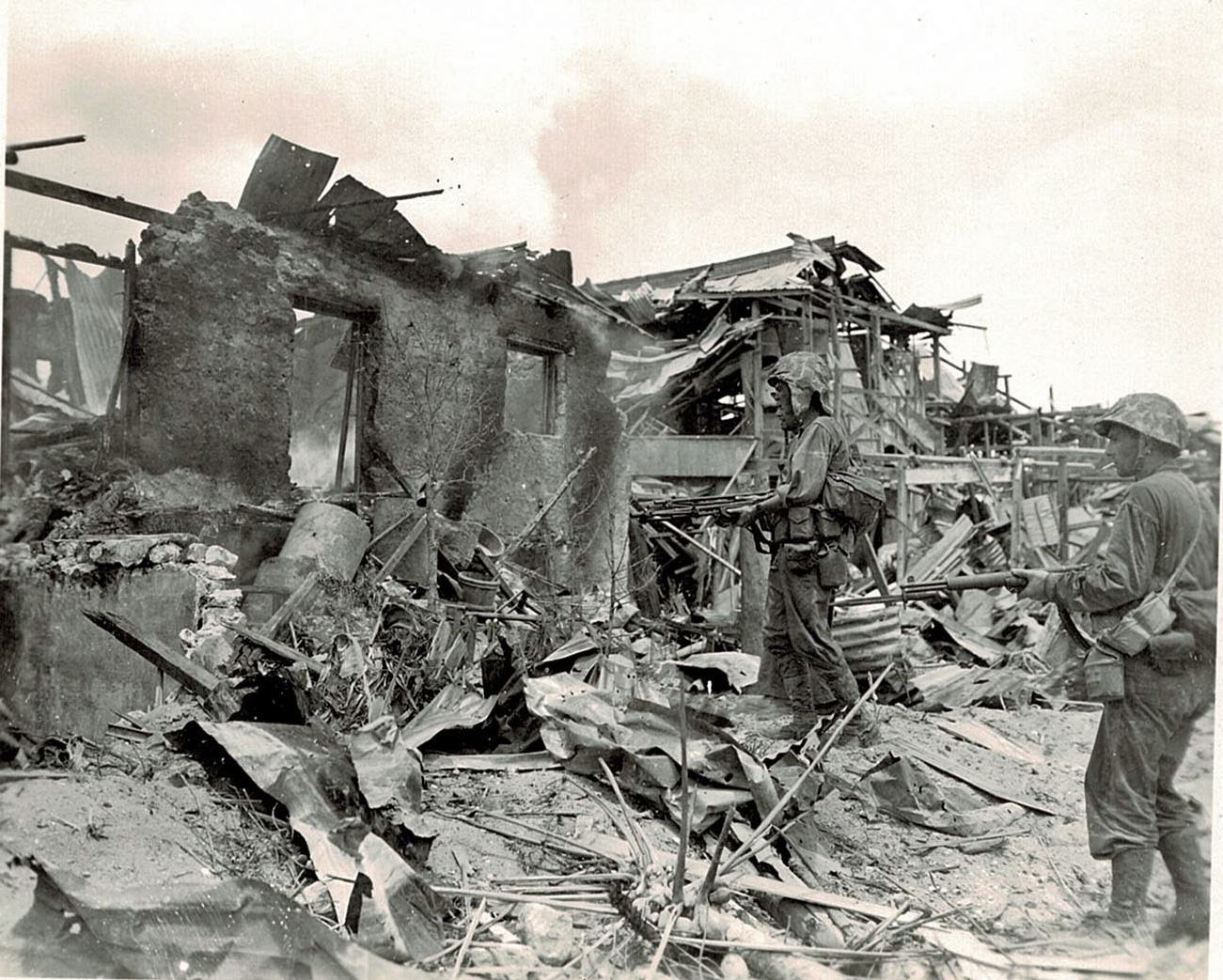
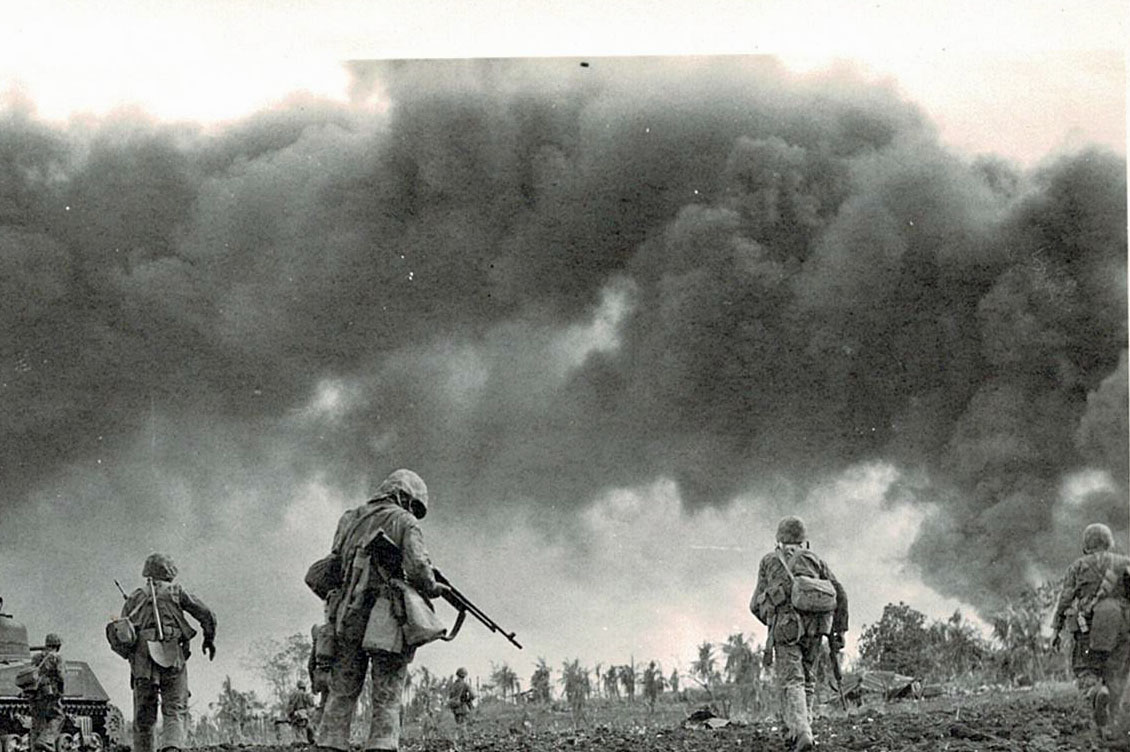
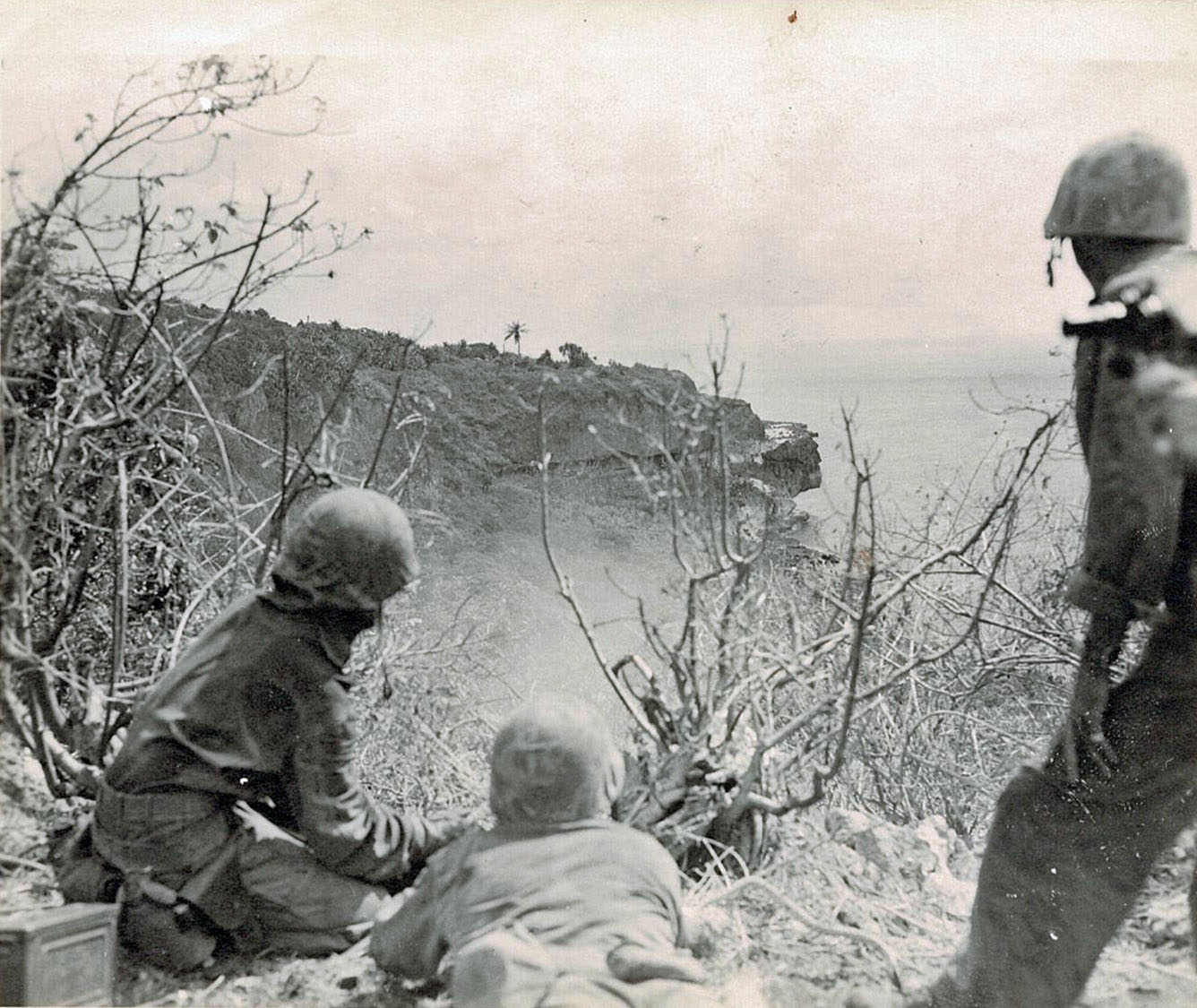
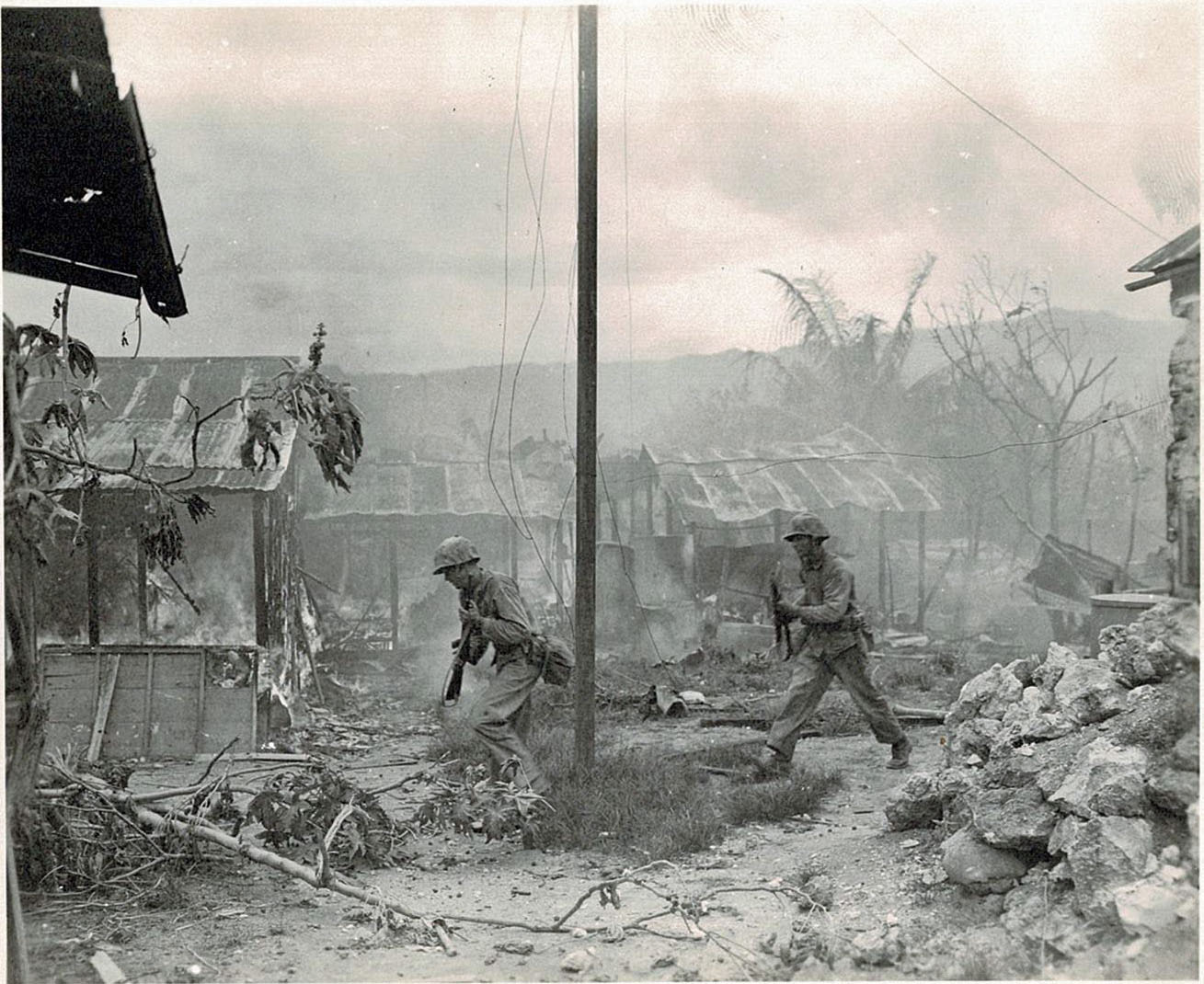
    The engineers of the 18th took part in campaigns in Guadalcanal, Tarawa, Saipan, Tinian and Okinawa. According to his discharge papers, Albert “participated in action against the enemy”. He was at the Battle of Saipan of the Marianas Islands from 16 June 1944 to 9 July 1944”.

    Saipan

    Before Japan attacked the fleet at Pearl Harbor on December 7, 1941, crippling the fleet, Saipan was a farming community. After Japan took formal control of Saipan in 1919, large sugar cane plantations were planted there. Warm, humid air, year-round rain and much sun made the land lush with plants. The terrain was mountainous. Cliffs and gullies dotted the landscape. There were many dark caves and swarms of mosquitoes. Malaria was a problem.

    Months before the U.S. Army, Marines and Navy attacked on June 15, 1944, the Japanese had fortified the island with extra troops. Many of the civilians’ homes were confiscated for military housing. People were forced to live in caves.

    War raged in Saipan from June 15 to July 9, 1944. These are the dates on Albert’s separation papers that he fought there. About 3,426 Americans were killed. Japan lost 24,000 soldiers and 22,000 civilians were also lost. Many of these civilians committed suicide; some were shot by their own soldiers.

    Before this battle Albert had been temporarily attached to the 2nd Division Marine Fleet. He was then with the Amphibians Corps. The first day of the Battle of Saipan saw a fight between American amphibious tanks and Japanese tanks. At the end of the first day most of these vehicles had been damaged beyond repair. Most were put out of commission by soldiers in fox holes.

    Albert, a phototopographer in the mapping section and a technical sergeant, never mentioned his fighting days in Saipan. What he did talk about was his surveying and mapping of Saipan. A phototopographer surveys and maps a terrain based on territorial photographs. The navel construction battalions, the Seabees, built the Navel Advance Base, Kogman Point Airfield and Isley Field on Saipan. Airbases on these islands were critical to winning the war in the Pacific.

    There is a documentary online from Real Time History called Saipan 1944 Total War in the Pacific. Here is a link to Total War.

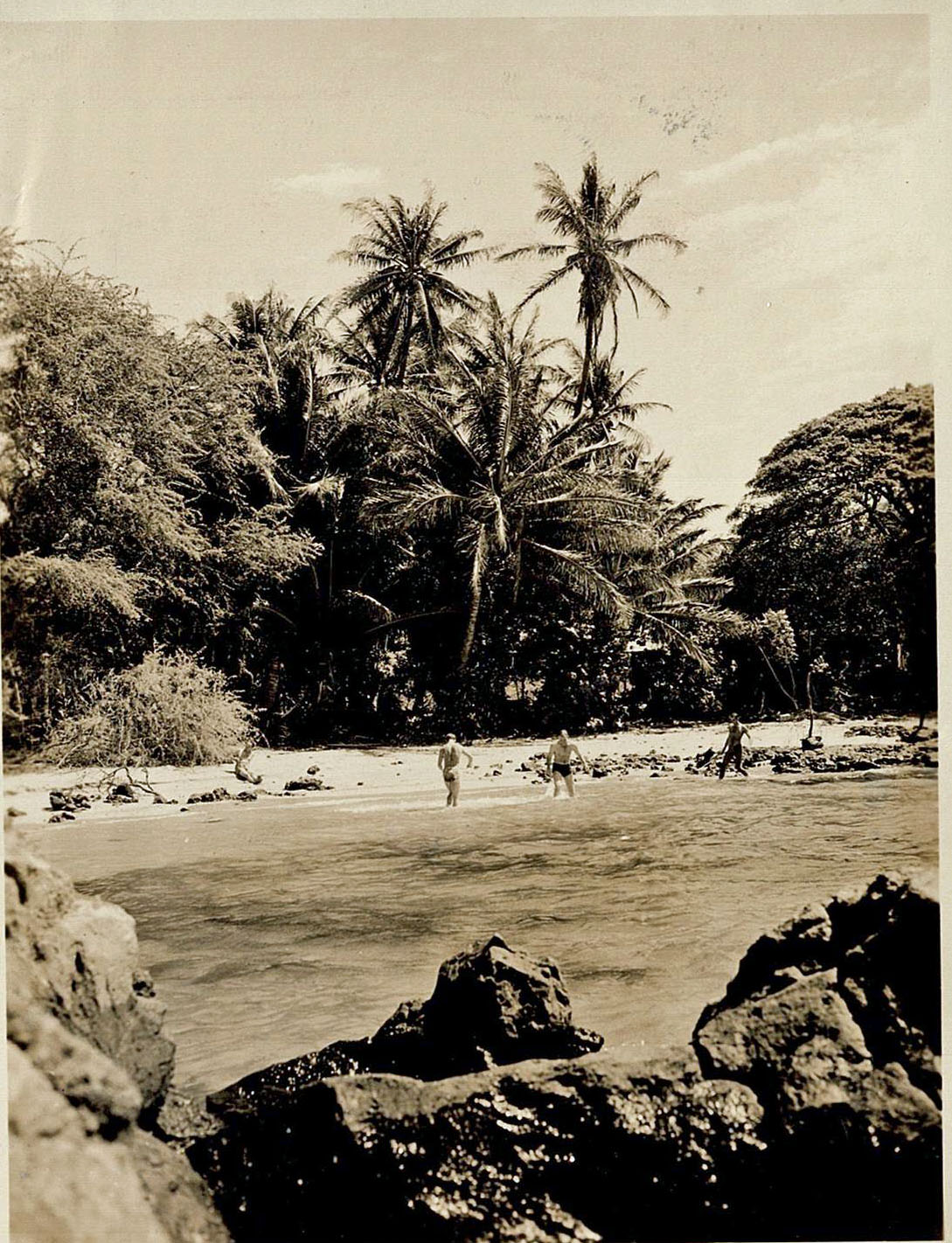
    Albert took photos.

    Going Home

    By September 1945, Albert back in the United States, was assigned to Camp Lejeune, North Carolina .Albert had been assigned to active duty on November 7, 1940. He received his Honorable Discharge Button at Camp Lejeune, North Carolina on September 20, 1945. The Marine Corps also gave him a travel allowance of 5 cents per mile to get home to Seattle, Washington.

    In Albert’s collection of photos from his service days, I found a photo that touched me. An Asian child, barefoot and beautiful, leans against a dead snag on a deserted beach. The sun is shining as shown by the sharp dark shadows behind the snag.
    I don’t know if the photo is posed or is something Albert just happened across.

    I do know I felt achingly sad, looking at it.

    What was Albert doing here? He had become an engineer. Engineers like to build things.

  • James Crowley-Encounters with the Law

    James Riley Crowley is a 3rd Great Uncle to my husband. I wrote a biography about James a few years ago. The biography is on Wiki under James Crowley.

    I want to share a part of this biography that tells about three of James’s experiences with the law. He had three such experiences in the space of eleven years.

    James migrated from Ray County, Missouri to Polk County, Oregon with his parents 1864. Here in Oregon, he married, started a family and acquired land. He first owned a farm in Perrydale, Polk County. Secondly, he owned land on Cascade Head, Tillamook County.

    In June of 1882, his troubling times in Oregon courts began. James didn’t see the murder. He heard the gun shots and found the body.

    The Nathan Nott Case

    The first trial involved James’s hired hand who lived with the Crowleys. James was a key witness at two of these trials. In the first trial Nathan Nott, James’s hired hand, was tried for the murder of William Frakes.

    The 1880 census for Salt Lake District, Polk, Oregon shows these people living in dwelling #132 with James R. Crowley, age 37. They are his wife, Martha C., age 31, his daughter Mary J., age 10, and two sons, Walter, age 3, and James R. (Ralph), age 1. Also, living here was a single farm worker from Illinois named Nathan L. Nott, age 30.

    A disturbing news item from the Corvallis Gazette went to print on June 9, 1882. This article featured Crowley’s boarder, one, N. L. Nott.

    Hired Hand commits a murder- Nott trial 

    On Tuesday evening last week, William Frakes, an old resident of this county, was murdered at Bear Camp, on the Salmon River Road, by N.L. Nott, says the Dallas Itemizer. From the information we have been able to obtain it seems that Nott had formerly been keeping some stock for Mrs. Frakes on the shares and some misunderstanding arose regarding the matter. On Sunday last Mr. Frakes started from home to bring back a cow and calf, which had been in Nott’s possession, and which had been left on the range. On Tuesday Nott, James Crowley and Billy McKinney started from Salt Creek with some stock which they were taking to Salmon River. They met Frakes at the place where he was murdered, and it is said that Nott remarked to McKinney that he had a job to attend to, and left him and in a few minutes, shots were heard and Nott came back, announcing that he had killed Frakes

    “Murder”, The Corvallis Gazette, (Corvallis, OR), 9 Jun 1882, p.3, col 1, (https://oregonnews.uoregon.edu/lccn/sn84022650/1882-06-09/ed-1/seq-3/

    A second article printed on June 10, 1882, in the Eugene Guardian continued the story saying,

    A Murderer Under Arrest 

    McKinney was then sent to the house of Mr. Mulligan, about a mile distant, and when he arrived at the camp Crowley and Nott had eaten their supper and were there; Mr. Mulligan was requested to take the body to Perrydale, which he consented to do, and on Wednesday he brought the remains to the place named. Nott, Crowley and McKinney proceeded on their way to Salmon River. John Crowley started after them on Wednesday, and Nott was met by Sheriff Hall at Grand Ronde on Thursday. He claimed he had acted in self- defense and was coming back to give himself up. He was brought to Perrydale, and his examination postponed until Wednesday next. He is now in jail at this place. Frakes received four shots, one in the breast proving fatal. Both arms were broken and he was shot through the thigh It is supposed he was on his horse when shot.

    “A murderer Under Arrest”, Eugene City Guardian (Eugene, Oregon), June 10, 1882, p 5, col. 2 near top (https://oregonnews.uoregon.edu/lccn/sn84022653/1882-06-10/ed-1/seq-5/#words=Frake+Frakes+Nott
    • On July 29, 1882 Nott was on trial for killing William Frakes as the Polk County Itemizer went to print.
    • Two weeks later the Polk County Itemizer reported that Nott had been found guilty of murder in the second degree.

    Naoma Shelton vs John L Shelton

    James’s younger sister, Naoma Crowley, was born when James was 17. On October 25, 1880 Naoma married John Lawrence Shelton at the home of John’s mother. They had four boys. When Naoma was 32 years-old, she filed for divorce.

    James and John had known each since 1873. Both were farmers living in the vicinity of Dallas, Oregon. Naoma met John much later.

    In April of 1891 James rescued his younger sister, Naoma Crowley Shelton, from a house in Portland, Multnomah, Oregon. In Portland she lived with her four boys and her abusive husband, John Lawrence Shelton. James took her and her sons to his home near Dallas, Oregon. She filed for divorce on April 10, 1891. The case came to court on May 10, 1892. Naoma was 32 and still living in Dallas, as did James Crowley.

    James said in his testimony he had known John L. Shelton for 18 years and Naoma all her life. He also said that John had ran through Naoma’s property. She had owned 400 acres of land when they married. John drank and gambled it away. Here is a partial transcript of James’s testimony:

    James’s Testimony

     She wrote me that he was treating her so badly that she could not live with him, so I went and brought her to Dallas. At that time, they were living in Multnomah County. He accused her of being intimate with other men in my presence. When I went after her, she told me that he had been abusing her, that she couldn’t live with him and was afraid to do so. When I went after her, I found her and her children almost destitute of clothing. On a number of occasions, I heard him use abusive language toward her. After she came to my house, he came there drunk and used such abusive language towards her that on two or three different times, I was compelled to put him out of the house.

    Circuit Court of the State of Oregon, Polk County, Divorce Record, Naomi Shelton vs John Shelton, Record # 16009, Case #2247, Oregon State Archives, Salem Oregon, in the files of Jill Foster

    Here is a copy of the last page of James’s testimony with his signature.

    Bowker’s Trial

    James’s next exposure to Oregon’s legal system came in the summer of 1893. The court at Dallas, Oregon subpoenaed him and his sister Naoma Shelton as witnesses at the Bowker’s Trial.

    Charles A. Bowker, who worked the Southern Pacific railroads at the time of his arrest, had been a Baptist preacher. Charles had delivered services at the Baptist Church in Dallas attended by the Crowleys. When he was preaching in Dallas he was respected and well-liked.

    Charles was the fireman on the evening train running between McMinnville and Portland. He was arrested and tried for manslaughter in Portland. It seems he got a young woman pregnant, a seventeen-year-old named Helen Wilson. This happened in Portland, Oregon. Charles was charged with having arranged the abortion which killed Helen.

    In this first trial Charles was acquitted. But, more trials were conducted and he was charged and spent time in prison. In November of 1894, he secured a new trial, and he was released on bail. This case eventually went to the Oregon Supreme Court. The Oregon Supreme Court reversed Charles’s conviction and he was acquitted.

    More Troubles

    It would seem that these three court cases would be enough for one man to bear. But in 1893, James’s wife died.

    The announcement of Martha’s death was made in several Oregon newspapers. She died of cancer at her Dallas home on Tuesday, June 13, 1893. The family buried her at Crowley, Oregon in the Oak Grove Cemetery (Etna Cemetery) on Thursday, June 22 1893.

  • Water and Steamboats

    Part 3 of the Daniel Ferguson Story

    Frances Perritt, my husband grandmother, saved a clipping of her grandmother’s obituary. Her Grandmother, Margaret St John Ferguson Reynolds, was Daniel’s daughter. The part in the obituary about Daniel reads:

    Her father Daniel H Ferguson was a mill man and steamboat owner. In the early days and at one time he owned the dam where Oregon City locks are now located.

    The obituary of Louis P. Reynolds reads that “he was the grandson of the late Daniel H. Ferguson who was one of the principal owners of the Willamette Falls Canal and Milling Co. of Oregon City, in 1852 to 1853.”

    In my search for the owner of Willamette Falls Canal and Milling Co., I found several articles about Robert Moore saying he was the owner of this company. Then after much searching, I found a newspaper article In the Oregon Argus, dated August 21, 1858. This article explained the ownership of this company. But first a little background would be appropriate.

    Before Daniel bringing his family to Willamette Valley, he prospected for gold on the Yuba River in northern California. He and his brother, Thomas, had other business besides gold mining. One was investing in fast growing towns. Thomas wrote in a letter to his wife in Florida in April of 1850. He said “I have invested in Lindd <sic> City (Linn City, Oregon) one thousand dollars.”

    Daniel and Thomas were in business together. They referred to themselves as Ferguson & Ferguson or the Ferguson Brothers.

    So, Daniel had some dealings with Linn City a couple of years before his arrival in Oregon.

    The Main Water Ways of Oregon

    Before railroads came to the Willamette Valley, travel by steamboat was the main way to get between Astoria and Marysville. Shipping on the upper and lower Willamette was a profitable enterprise.

    Two river dominated Daniel’s life after he moved with his family to Oregon—the Columbia and the Willamette. The Columbia River separated Washington Territory from Oregon Territory when Washington Territory was established on March 2, 1853.

    The Willamette River flows through the Willamette Valley north from Eugene. The upper tributaries of the Willamette originate in the mountains outside Eugene.  On its way north to the Columbia River this river flows through the many Oregon towns. Some of these towns along the upper Willamette are Eugene, Corvallis, Albany, Salem, Newburg, Wilsonville, Oregon City, and Portland. It empties into the Columbia River at Kelley Point, Portland, Oregon. It is the 13th largest river by volume in the United States. The Willamette Falls is located between West Linn and Oregon city. It is the second largest waterfall by volume of water in the U.S.

    This large waterfall was an obstacle to steamboat travel on the Willamette River between the upper and lower river.

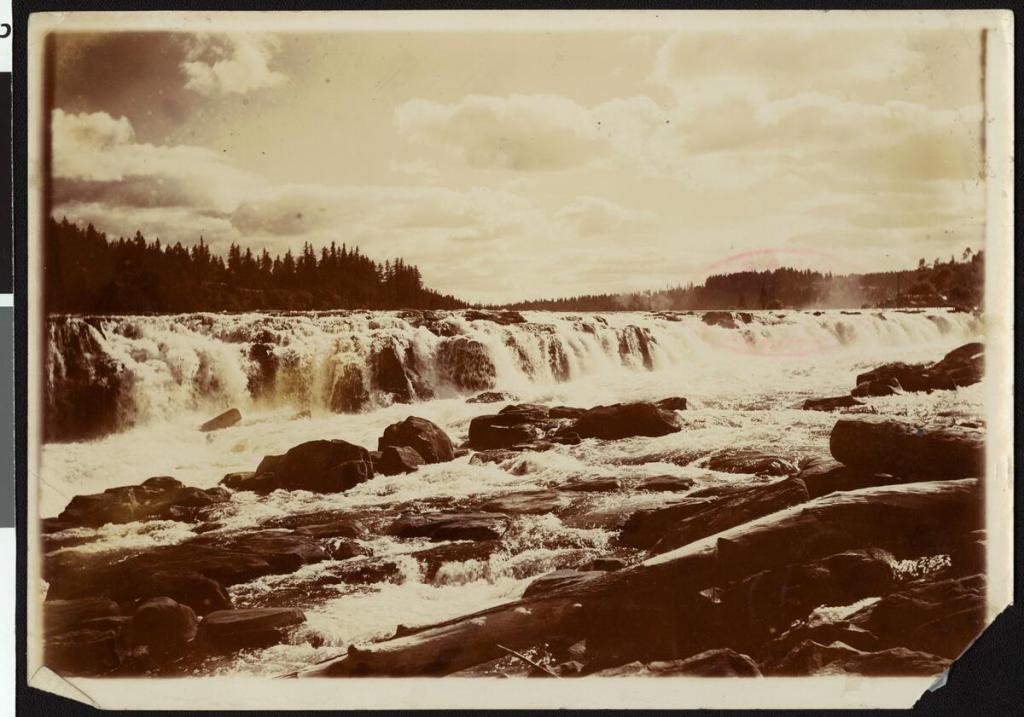
    Photograph of Willamette Falls in Oregon City, Oregon, from California Historic Society and USC

    Grass crops like wheat and rye did well in the upper Willamette Valley. The excess crops needed to be transported down the Willamette to Portland and beyond.

    Ideally transporting these excess crops on the river would solve the problem. The typical steamship was large and deep keeled. It couldn’t maneuver in the shallow water of the upper river beyond Oregon City. The Lot Whitcomb, built in Milwaukie, Oregon in 1850, ran on the lower Willamette. She traveled between Milwaukie and Astoria. Daniel planned to enter this new industry with boats designed for the shallower upper river waters. Getting the right design of steamboat was not the only problem.

    The other problem was getting the goods from the upper river to the lower river.  There was a 35 feet drop over Willamette Falls at Oregon City. A portage road around the falls existed at this time.

    Robert Moore’s Linn City

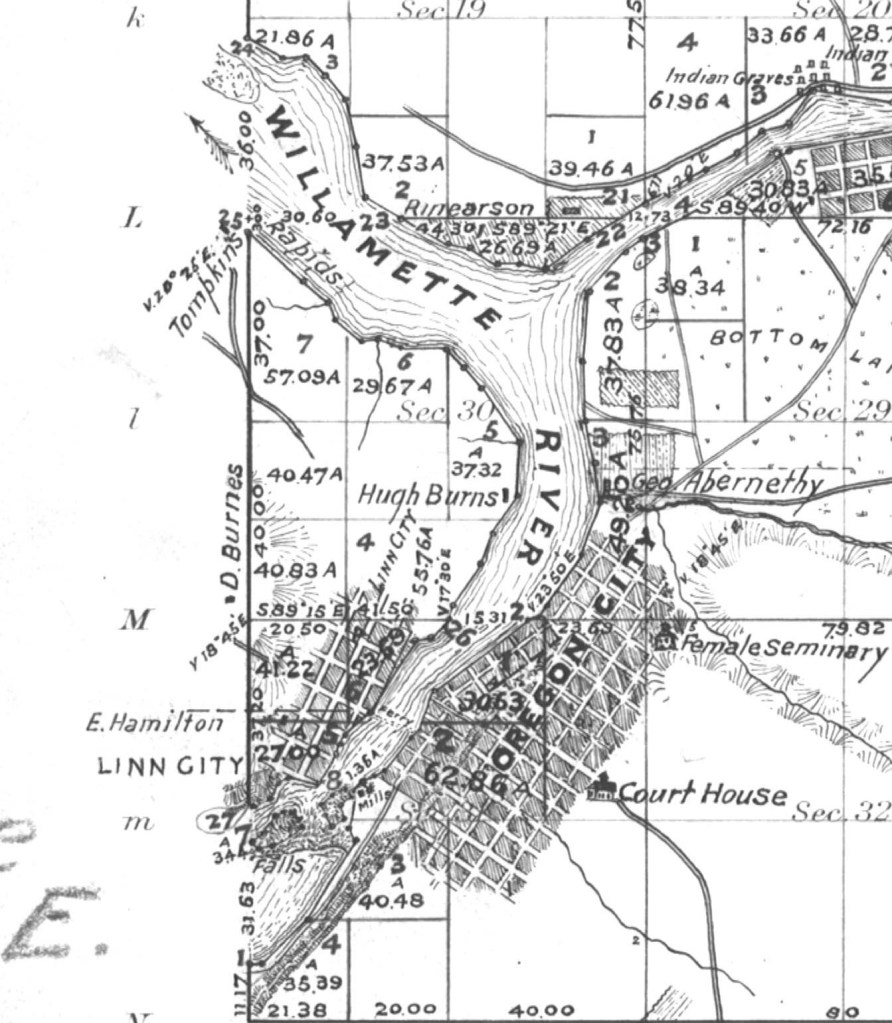
    Donation Land Claim Map 1852 Linn City and Oregon City from West Linn Historical Society

    Robert Moore’s Linn City (West Linn) was situated on the west bank of the Willamette River. Oregon City on the east side was directly across the river. In 1846, Linn City consisted of about 15 houses occupied by mechanics employed by Moore. They worked in his flour and lumber mills. His employees also ran a ferry which crossed the river to Oregon City. Moore also owned Willamette Falls, Canal, Milling and Transportation Company and a newspaper, The Spectator.

    Daniel Ferguson in Linn City

    When the Ferguson family came to Portland, they soon acquired a home there. Their house stood on 2nd Street, one door down north of Mill Street. It was close to the Willamette River. Soon after they were settled in Portland, Daniel started traveling upriver to Linn City. By 1853 Daniel even had living quarters on the hillside overlooking Linn City. Robert Moore lived nearby. By the time, this man was tremendously overweight, unhealthy and had debts.

    In December 1852, Robert Moore transferred the title and the land of this company to Daniel. Robert gained some capital and a promissory note. Daniel acquired a ten-year mortgage. Daniel was now the owner of the Willamette Falls, Canal, Milling and Transportation Company. He also owned the land where the Oregon City Locks are now located. Daniel’s ownership of these properties lasted only a few months.

     In January, 1853, he asked the provincial government of the Oregon territory for permission to incorporate this business. Then in March of that year he transferred the title and the debt to this new corporation. People referred to this company as the Willamette Falls Company, the Willamette Falls Canal Company, D. Ferguson Company and Messrs., Ferguson and Company.

    Daniel’s Building Projects at Canemah

    In June of 1853 Daniel ran this ad in The Weekly Oregonian.

    Wanted Immediately

    Twelve good drillers and blasters; Fifty good common labors, person used to quarrying and working rock; Six good carpenters, such as are used to working timber; Three good hands used to boating and rafting timber; Also One good blacksmith, one that is competent to do all kinds of black smith work.

    Constant employment and good wages will be given to such by applying to the office of the Willamette Falls Canal Company.

    Daniel H. Ferguson         Superintendent

    “Wanted Immediately,” Weekly Oregonian (Portland, Oregon) 2 July 1853, p.3; digital images, GenealogyBank (http//:www.genealogybank.com

    Daniel wanted to build a breakwater. His men would dig a basin big enough to accommodate a steamboat while loading and unloading cargo. This work would be carried out at Canemah. Canemah was at the southern end of portage around Willamette Falls. It was used by native Americans as a takeout place for canoes before carrying the canoes around the falls. Here boat traffic from the upper Willamette River stopped. People and goods were unloaded and taken around the falls to Oregon City around the falls. Then they were loaded into another boat.

    Before Daniel left Canemah he and his men had built a sawmill, gristmill a warehouse, and a wharf.

    In August of 1853 Daniel Ferguson is praised by the editor of the Oregon Spectator. The article reads.

    At Canemah, within the past twelve months…Our neighbor too, Linn City is not behind in enterprise and good works. Under the energetic management of D. Ferguson and Company, a fine breakwater and dam are rapidly advancing to completion. Mills and warehouses are now framed and soon to be erected, all calculated to give unsurpassed facilities for transportation of merchandise above and below the falls together with magnificent water power which could drive all the mills of Lowell and Rochester combined. The work is built so far as we can judge, in the most durable and permanent manner, with great strength and on a judicious plan. Nature has done wonders for the locality, and Messrs., Ferguson and Co. are most ably seconding her labors.

    “Improvement,” Oregon Spectator, (Oregon City, Oregon) 26 August 1853, p.2 col 2; digital images; Historic Oregon Newspapers,(http://oregonnews.edu

    In the January 7th 1854, the editor of the Spectator again praises Daniel’s work in Linn City. The editor describes the breakwater Daniel is having built. The editor also describes a device Daniel is having built that will make unloading and loading the boats much easier.

    The plan is admirable, and no giant power of water could have been more completely controlled and managed. The breakwater is some thirty rods cast from, and running parallel with the west bluff of the river, and continues near one-fourth of a mile up the river from the perpendicular falls, so that by a connection of the west bluff with the breakwater by a dam passing along near the brink of the precipice, the various designs and objects in view of water into are fully accomplished, viz: the reception of water into the harbor for the admission of steamers, and for the purpose of driving their and extensive saw and flouring mills and enable them  to exchange the lading from boats above and below the falls, loaded with the various products of the upper country, and those below laden with  goods, can come together and have their freight discharged by a timber built into cribs, which  are piled with stone and sufficiently covered with plank. The works are placed upon the solid rock and are as lasting and durable as the very hills. Ferguson and Co. are much applauded for the undertaking of that which seemed almost impossible…

    “For the Spectator,” Oregon Spectator, (Oregon City, Oregon) 7 January 1854, p.2 col 3; digital images; Historic Oregon Newspapers,(http://oregonnews.edu

    The Steamboats

    In 1851, the only way boating on the upper Willamette was by canoe. The trip to Salem and Marysville (Corvallis) was long, tiring and not practical for transporting goods.

    In 1853, four steamboats operated out of Canemah. They were the Oregon, the Wallamet, the Portland and the Belle. Daniel’s Willamette Falls Company, owned the Belle and the Oregon. In April 1854 ,Daniel planned to launch another steamboat that was being built at Canemah. This steamboat, the Gazelle, would run on the upper river between Marysville and Canemah.

    The Belle, which was already in service ran on the lower river. With the launch of the Gazelle the company would have three steamboats on the Willamette River.

    On March 4, 1854, Daniel puts this ad in the Weekly Oregonian.

    Notice to the Public

    The Willamette Falls Co. is now ready to receive and forward all kinds of merchandise, through their new warehouse, up and down the river. The steamer Belle, Capt. Wells, is running from Portland to the falls in connection with the steamer Oregon from our new warehouse to the head of navigation on the upper Willamette.

    The new steamer Gazelle, under the command of Capt. R. Hereford, will be ready to run in a few days.

    Charge for passing freight over the fall is $1 per ton.

    Passengers will be conveyed to and from Oregon City at all times with dispatch.

    D. H. FERGUSON, Superintendent

    Notice to the Public,” Weekly Oregonian, (Portland, Oregon) 4March 1854, p.5 Col. 1, digital images, GenealogyBank.com,  (http://www.genealogybank.com

    On March 11, 1854, Daniel puts this ad in the Weekly Oregonian.

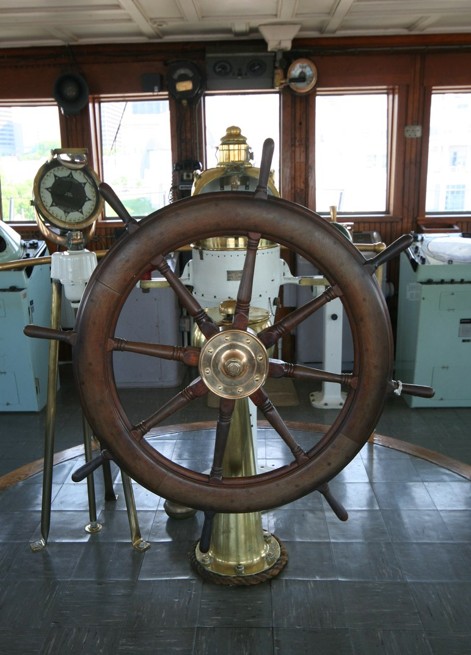
    On March 18, 1854 the Gazelle made her first run on the upper Willamette with Capt. Robert Hereford at the helm.  A local newspaper had this to say about the run.

    The fine weather and good music tended not a little to enhance the pleasure of the ladies and gentlemen on board, and all were highly entertained and pleased. Her tables are laden with Oregon’s choicest productions, together with a select variety of imported fruit, etc. Who wishes for better accommodations, even in this Tyee day of Oregon refinement?

    “Gazelle (sidewheeler,1854)”, Wikipedia, Sept. 1, 2011, (http://en.wikipedia.org:

    In this description of the Gazelle’s first trip on the upper Willamette, the editor uses the term “Typee day. The term, “Typee day”, comes from a novel by Herman Melville called Typee and published in 1846. It means a relaxed and unhurried day. This is a high point in Daniel’s life’s work and is about to change. It would be a long time before Daniel had a Typee day again.

  • Traveling by Mailboat

    The Ferguson Brothers Go West

    for week 28-travel

    Daniel Howes Ferguson, my husband’s 3rd great grandfather traveled to San Francisco, California in 1849. Part of this trip he was with his brother, Thomas Jefferson Ferguson.

    When I think of this trip, the nursery rhyme, “To Market, to Market”, comes to mind.

    To market, to market to buy a fat pig:
    Home again, home again, jiggety-jig.
    To market, to market to buy a fat hog.
    Home again, home again, jiggety-jog.

    In this nursery rhyme the travelers rode in a cart or buggy pulled by a horse. The Ferguson brothers traveled by ship. Daniel left in the spring of 1849 from Norwalk Harbor, New York City. Thomas left from Key West, Florida. They met in Panama City and traveled together from there.

    Letters exchanged between Thomas and his wife, Rosalinda, describe the doings of these two industrious and lucky gold miners. Mary Haffenreffer transcribed most of these letters and published them along with her research into the Ferguson family in the Florida Keys Sea Heritage Journal, fall 2012 and winter 2013. She also sent me copies of the original letters.

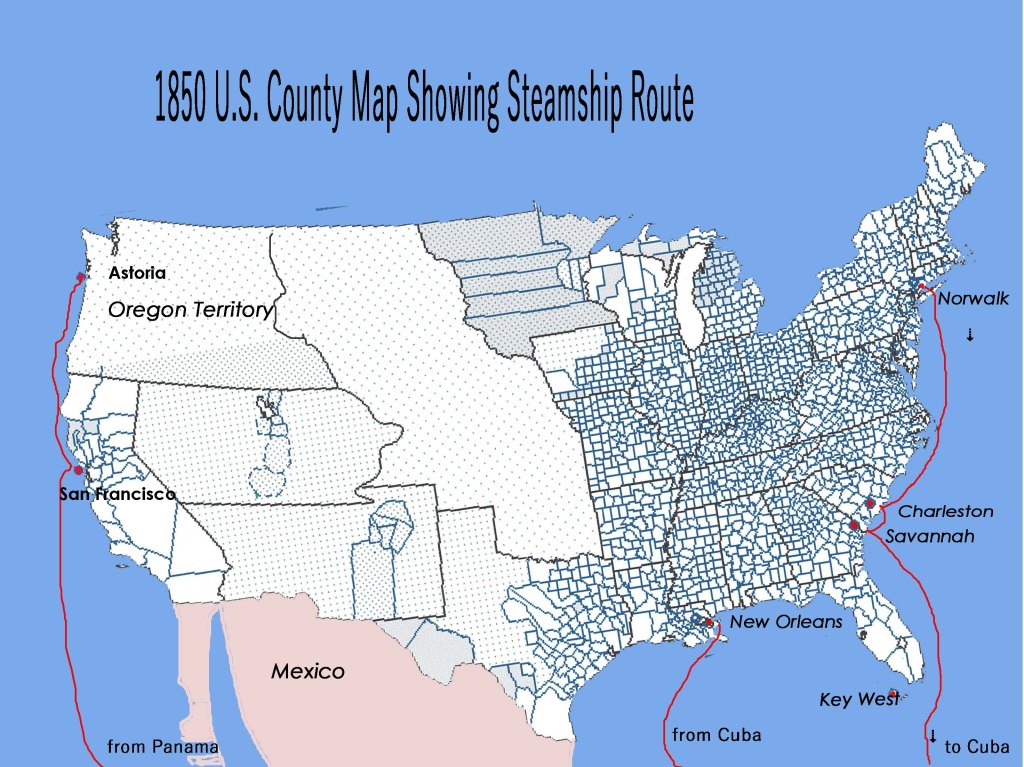
    The Fergusons traveled on a mail boat steamship. The Falcon was the one Thomas rode. This small steamship with Captain Thomson at the helm, was one of the three ships carrying U.S. mail as well as passengers on the Atlantic side of the Isthmus of Panama. The Falcon’s first trip between New York City and Charges, Panama happened in December of 1848 and took 26 days. The Falcon left New York City on December 1 and arrived in Charges on December 27. The route was New York to Savannah to Charleston to Havana to New Orleans to Chargres. It included mail pick-ups and drop-offs as well as passenger pick-ups.

    Here are maps showing the route.

    Around the time Thomas left Key West Florida for Havana, Cuba, he received this letter from his brother William E. Ferguson. It reads:

    Brother Thomas,

    I have thought it advisable to write you to give you the particulars brought by the Steamer Northerner from Chagres.

    I was conversing with a passenger who went from New York in company with fifteen others. They thought to get passage from Chagres but they found no opportunity to get from there. There is onboard three who bought steerage tickets in New York for $100.00 for each. One sold at Chagres for $450.00, one for$500.00 and the other for $700.00, and they state that there is 2500 persons on the Isthmus now waiting for a passage to San Francisco. My informant states that they think that there is a poor chance of the steamers returning from San Francisco and there is no sailing vessels at Panama. He states that he is going to New York to procure tickets if possible to go through, if not to write them to return to New York and proceed around the hook. I would advise you to go by land some route through Mexico if possible. I think we will get from here next week. They are getting every ready as soon as possible.

    Remember me to all friends.

    W.E. Ferguson

    Letters to Rosalinda

    Charleston April 5th, 1849

    The first letter Thomas wrote to his wife Rosalinda Corcoran Ferguson reflects what his brother William said.

    Havana, April the 8th, 1849

    I arrived here at 9 o’clock the next morning after I left home. I learn here that there are two thousand passengers at Panama waiting for passage. I think of altering my route to Vera Cruz and go through Mexico.

    The trouble with going through Mexico was that the United States had just won a war with Mexico, known as The Mexican War in the States and The American Intervention War in Mexico.  Mexico lost on third of its territory by the “Treaty of Guadalupe Hidalgo”. Traveling from Vera Cruz through Mexico, those Americans who chose to that way were likely meet angry Mexican citizens who would have no interest in aiding them and might even rob and kill them.

    In his next letter also written from Havana to his wife, he had changed his mind about traveling through Mexico.    He now planned to sail to Chagres on the steamer Falcon.

    Panama April the 22th, 1849

    Dear Wife,

    I write you once more from this place though I expected to leave here before this but receiving information from Vera Cruz not very favorable of the route through Mexico, I have altered my mind and shall go the way of Panama…  I expect I shall find my brother Daniel there if he has not got passage away which is doubtful. The steamer Falcon will be here on the 25th going to Chagres… Write me whether you heard anything more from Albert before he left Charleston.

                                     Thomas J. Ferguson

    On April 25, 1849, Thomas Ferguson left Havana on the Falcon heading to Chagres. He arrived in Panama City on the Pacific side of the Isthmus on May 9, 1849. Thomas didn’t mention how he got across the Isthmus after he landed at the mouth of the Chagres River.

    Up the Chagres River and on to Panama City

    The 60 miles between the mouth of the Chagres River and Panama City is challenging for most. It involved first chugging up the Chagres River in a small steamboat for 12 miles. Then the river became very shallow. Travelers boarded flat bottomed canoes called bungas which were poled or dragged by men. Clouds of mosquitoes, stifling heat and big alligators added to the atmosphere.  The passengers rode mules for the last 24 miles because the waterway ended at the very small village of Gorgona. Besides the discomfort caused by heat, reptiles, insects there were illnesses. People often caught cholera, malaria and yellow fever on this route.

    Daniel had a similar though longer journey as he had traveled from Norwalk Harbor. He arrived in Panama City before his brother Thomas.

    Letters to Rosalinda

    Panama May the 11th, 1849

    Dear Wife,

    I arrived here day before yesterday and shall leave day after tomorrow morning on the ship Norman in company with my brother Daniel, Stafford and Saywood and the rest of the Key West party who I have found here all well, all excited to get away to the Land of Promise. Daniel tells me he had a talk with fifteen young men who arrived here a few days ago on the steamer Oregon from California on their way home. They said they got as much gold as they wanted and were going home to enjoy it. They had got seven bushels of pure gold with them that they had dug themselves in the space of six months. Daniel says they told him to keep cool, that there was enough gold there for all…I have got my passage in a first rate ship by Daniel’s having a pass engaged for his brother-in-law who hasn’t got here yet.

                                                         Thomas J. Ferguson

    San Francisco- July 31st, 1849

    Dear Wife,

    I arrived here on the 15th of this month having sixty three days passage from Panama, rather a tedious  passage but well and hearty, the weather at sea was calm and sea very Smooth. On my arrival here Daniel and I took a small job which we done in a week for which we got five hundred dollars. Since then we have built us a boat to go up to the mines and intend to leave tomorrow. I was offered sixteen dollars a day the day I got here and refuse good jobs now to go up to the mines so you may judge what I think of the prospect. The gold stories we heard about California before I left home was no humbug. I have seen lots of the gold here, one lump weighing fourteen and half pounds. I don’t know as I shall find any of those big lumps but I am bound to have gold of some sort; there is plenty of it here and no mistake. This place is very healthy though cold. I have wore flannel shirt and drawer with my thick buckskin pantaloons ever since I have been here and then been cold with a severe wind from the sea like our Northers in Key West but back from the coast it is warm.  I eat apples, Pears and blackberries here. Some things here sell high, others very low .Clothing is cheaper than it is in the States,  flour $10, pork $25, beef $5,of the best salt, fresh beef from 12 to 18 cents a lb., potatoes $10 for a hundred lbs., onions seventy five cents a pound, cheese fifty, saleratus (baking powder)$2.50, butter $1.50, cheese fifty cents. This town is overrun with goods, the streets and yards full, lying about open, nobody steals. There ain’t a quarter stores enough to hold them. …

                                                                 Thomas J. Ferguson

    By October they were on the Yuba River prospecting and had made a claim. The Yuba River, located in the Sierra Nevada’s in northern California, is a major tributary to the Feather River.

    Uba (Yuba) River Calif. Oct 21st 1849

    Dear Wife,

    … I will now give you a statement of my success. After arriving here I spent a month in hunting, or prospecting as they call it here, up and down the river for a good place to locate. I at length found one which prove to be good on which my brother and myself built two machines for washing out gold and a water wheel to lift up water out of the holes we dig which works them all effectually so much so that we have made over five thousand dollars in the last three weeks…

    By a great odd we have got the richest spot I have ever seen on the river. It is a small bar on the side of the river in the form of a triangle about fifty yards on each side with rocks ten feet high on two sides and the river on the other. We have the whole of it to ourselves and nobody troubles us…

    I am faring very well here. We have got plenty of pork, dried beef, ham, flour, hard bread, beans, cornmeal, coffee, sugar, molasses, dried peaches and cherries. We get fresh beef every few days so we fare pretty well. I made some molasses cake this morning which went very well. It wasn’t quite as good as you used to make but it done very well.

    Albert is not here. We are looking for him every day. I have wrote letters directing him where to find us.                                                                            Thomas J. Ferguson

    Selling Goods to Other Miners

    Daniel’s and Thomas businesses have grown. They are buying more goods for sale to their fellow miners on the Yuba River. He writes to Rosalinda about this.

    San Francisco Feb 28th, 1850

    I am here now buying goods to take to the mines. Since I was here and wrote you, last, Daniel has been down and taken up $3000 worth of goods. Immediately on his return I came down again. We are selling a great many goods, as soon as I return now we shall start another store at Eliza Town on the Feather River at the head of Steam navigation. We purchased a lot there a few days since for which we paid six hundred dollars. We have been offered six hundred for one half of it. We also have another lot in the town given to us by the Proprietor of the town in consideration of our being the first who landed goods there from a steamboat… We have our own teams to haul our goods, eight mules and six horses, which we bought last winter when they were cheap. Now they are worth from two to three hundred dollars apiece.

    By March of 1850 Daniel and Thomas established two more stores and are buying a stock of goods large enough to have freight bills over twenty five hundred dollars. Daniel has taken charge of the mining and trading operations in Yuba while Thomas travels up and down the river to buys goods.

    In his April letter to Key West, Thomas said he had been to San Francisco three times buying about four thousand dollars’ worth of goods each time. Daniel worked on some damming projects to turn the river. Thomas also mentions three towns they had invested in, Elisa, Fredonia, and Lindd City. Could this be Linn City of Oregon, the town on the Willamette River where Daniel worked and lived when he brought his family west?

    Thinking of Home and Family

    Daniel and Thomas thoughts turned to home and family. In April Thomas writes, “I am beginning to like this country quite well. You needn’t think strange if I should be home this fall for you and Daniel’s wife and bring you out to this country.” Rosalinda answered this proposal in her May letter. She writes: “If you think that the place will suit me and the children I am willing to go any place under the globe to you. I’ve become acquainted with a fine Irish woman. She is willing to work and would be glad of the offer to go with me to California.


    In November of 1850 Daniel and Thomas were preparing to go home. They gave their wives December 15th as the date they would start back. Daniel and Thomas Ferguson had taken ample gold out of their mine. They also had sold many items to their fellow miners. Thomas and Daniel planned to return via Havana together. From there, Thomas would ship to Key West and Daniel to New York.

    The Ferguson brothers had done well.  A newspaper article from San Francisco states: “Thomas J. and Daniel H. Ferguson, from Danbury, Ct., have obtained $150,000 in gold dust by mining operations upon the Yuba River, during the past summer.” Using an inflation calculator this would be about $4,829,000 in 2018.


    Going back to the nursery rhyme “To Market”, the Ferguson brothers had certainly brought home the bacon. Their families would live high on the hog.

  • More Places

    week 27 Family Business

    Edward Griffin’ s Work

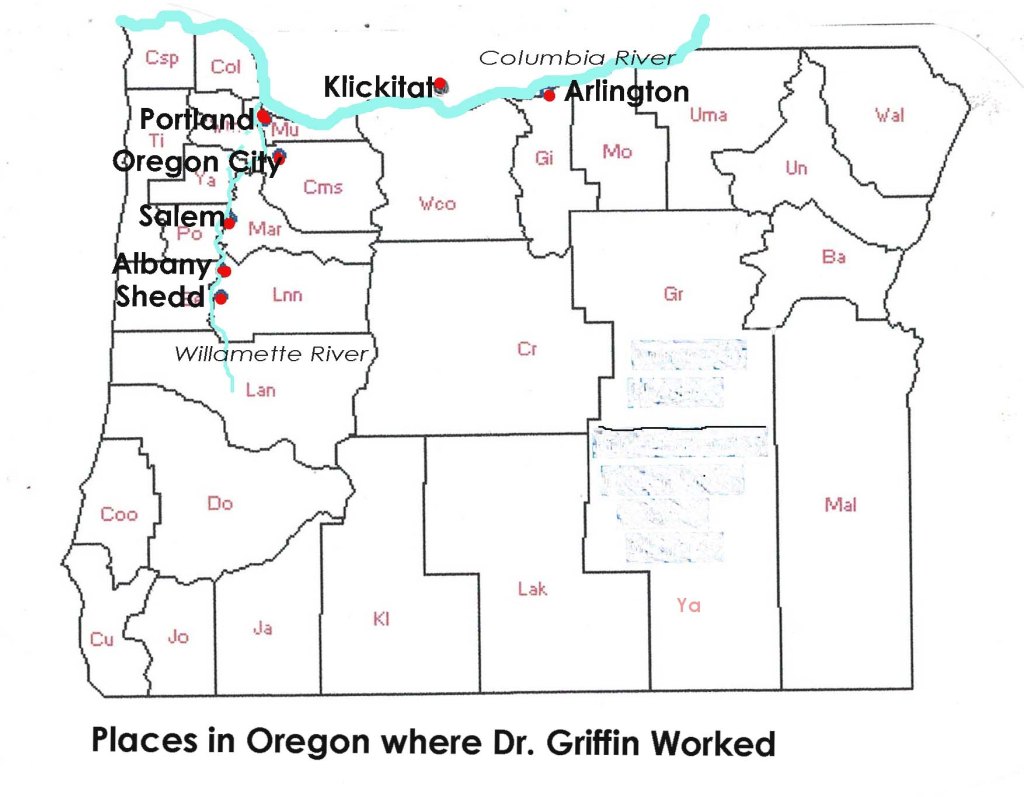
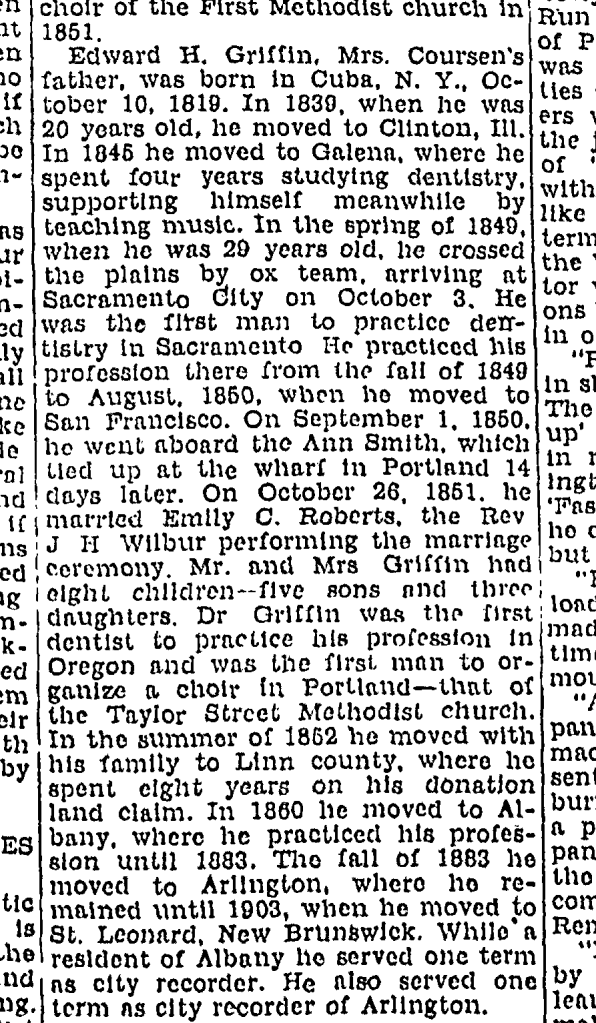
    Dr. Edward Henry Griffin, my husband’s 2nd great grandfather and the first dentist in Portland, traveled for his work. He also posted ads in local newspapers.

    On October 10, 1850, Dr. Edward H. Griffin posted this ad in the Oregon Spectator. This paper was the first newspaper printed west of the Rocky Mountains. The ad ran from October 1850 to July 1851. A transcript of this ad reads:

    Dental Surgeon

    Dr. E. H. Griffin offers his professional services to the citizens of Oregon City and vicinity. Careful attention will be given to all operations in his department of surgery. Cleaning, filling and extracting performed in such a manner as to give satisfaction, Also, teeth inserted on gold plate in the most substantial and tasteful manner.

    Office at Main-street House   Oregon City, October 10, 1850

    House in Portland- Office in Oregon City

    The 12 miles between his house in east Portland and his office in Oregon City could be done by horse. Edward was a good rider. But the trip by horse would have taken about two and one-half hours or more. In 1850 a steamboat, the Lot Whitcomb, ran from Astoria to Oregon City. Its top speed was 12 mph. This would have made it possible for Edward to get to work faster.

    Emily Helps Out

    An 1852 advertisement from the Weekly Oregonian gave the impression that Edward had an assistant. Edward used anesthesia in some of his procedures. Nitrous oxide or ether was available in the 1840s. He offered lady patients an assistant from his family to help them when they under anesthesia. In 1852, his family of two were himself and Emily, his wife.

    A transcript of this ad reads:

    Dentistry

    Dr. E. H. Griffin, Surgeon Dentist, offers his professional services to the inhabitants of Portland and vicinity. FILLING, CLEANING, and EXTRACTING, executed in the most desirable manner. ARTIFICIAL TEETH inserted on gold plate and made useful for eating. PIVOT TEETH inserted with wooden pivots, or with gold and wood combined. All Operations Warranted. Office or at his residence

    N. B. Ladies from the county, can be provided for in my family, while being operated for.

    Nov 22                                                                                                                        E.H. Griffin

    Emily Griffin Talks about Her Husband’s Dentistry

    Emily in an interview with Fred Lockley dated March 2, 1914. This interview was printed in the Oregon Journal, a Portland newspaper. Emily told of Edward’ s practice in Oregon City before a second dentist came to Portland, a Dr. Cardwell. Emily said:

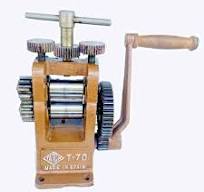
    My husband charged $5 for pulling a tooth, $300 for a half set of false teeth, and $500 for a double set. In those days they did not have rubber plates on which to attach the teeth. They were fastened to gold plates. Dr. Griffin bought a rolling mill. I used to help him roll out the $50 gold slugs. We rolled them until they were as thin as a calling card. From three sheets of gold, he made the plates for the sets of artificial teeth.

    antique rolling mill

    Edward sporadically paid Emily for her part in the dentistry business. Here is what Emily said about that.

    In the early fifties (1850s) money was plentiful. Oftentimes my husband would throw a half dozen $50 gold slugs in my lap and say. “I had a good day today. There is your share.”

    Homestead in Linn County

    While still working as a dentist, Edward and Emily homesteaded land in Linn County, Oregon. He planted an orchard and raised Spanish cattle. This was between October 1852 and October 1860. Four of their children were born here on the homestead-Edward S., Hallock Augustus, Alice Mabel and Wilbur. Annie F., Hiram Edward, Charlotte and Ferdinand were born in Albany.

    Edward still did dentistry. Here is a schedule found in the Weekly Oregonian in 1857. A transcript reads:

    Dr. E.H. Griffin offers his professional services to the inhabitants of Portland and vicinity,

    Office, first door above 1, Snow & Co., upstairs. Will continue his operations through the month of December.

    Will operate in Oregon City from the 1st to the 12th of January

    In Salem, from the 15th of January to the 1st of February

    At Albany from the 24th of February to the 10th of March and from thence to Portland, where he designs locating permanently.

    N.B.—Advice given in all departments of his profession gratis.

    Nov. 27th, 1857

    In 1860, Edward was at his residence at Robert’s Bridge. Here is an ad giving details.

    Dr E. H. Griffin may be found at his residence, in Linn County, on Calapooia Creek, near Roberts Bridge until about the 1st of May.

    Albany, April 9, 1860

    In Albany from 1860 to 1883

    In 1860 Emily thought it was time for the older children to go to school. The Griffins moved to Albany, Linn, Oregon. Edward practiced dentistry in Albany for twenty-three years.

    According to the Albany City Directory for 1878 dentistry was not the only thing Edward did.

    In 1866, he was elected to the office of city recorder. That year he also gave $200 towards building the Albany Collegiate Institute.

    His dental office listing read,” Griffin, E.H., 65 West First, upstairs.”

    His residence listing read,” Griffin, E. H., Dentist, residence, SW corner, Seventh and Walnut.”

    In 1870 this family of Albany included Edward, dentist, Emily, keeping house, Hallock, 10, at school, Alice, 13, at school, Annie, 8, Hiram, 4, Lottie (Charlotte), 2. Edward and Emily had lost two children right after their move to Albany-their oldest Edward S. and their infant son, Wilbur.

    In 1874 they had another child. This one they called Ferdinand Corbett.

    More Griffin Dentists

    When Emily and Edward were first married, Emily was Edward’s assistant. Now Edward tried this with two of his children. One child eventually became a dentist and other married a noted Portland organist and became a singer.

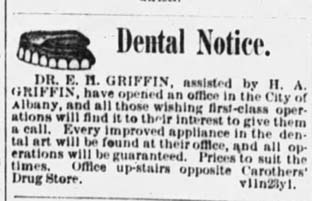
    In 1876 he ran this ad.

    H. A. Griffin, known to his family as Hallock, didn’t stay as Edward’s assistant. In 1876, he started running cattle in Klickitat, Washington Territory.

    The 1880 census for Albany recorded eighteen-year-old Annie Griffin, Edward’s daughter, as “learning dentistry”. She married Edgar Coursen in Portland, Oregon on 11 April 1883 and continued a singing career.

    Hallock ended up being a dentist after 10 years of cattle ranching. First, he married and started a family in Klickitat. He settled in Fresno, California. He became a dentist, first graduating from the San Francisco College of Science. The San Francisco Examiner carried an article, “Healing from Science”. It listed Hallock Augustus Griffin among those receiving their Doctor of Science degree in 1895.

    Emily and Edward live in Separate Locations

    Edward moved to Arlington, Oregon in the fall of 1883. He stayed there about 20 years. An article in the Condon Globe, dated 28 Oct 1892, places him there. It says.

    Dr. E. H. Griffin, Arlington’s popular dentist, gave us a pleasant call a few days ago as he passed through town…The doctor is one of the most honorable and sociable old gentlemen in the world, and has remarkable vitality for his age, 73 years.

    Emily also moved in 1883. She moved to San Francisco with Hiram, Charlotte and Ferdinand.

    But Ferdinand also lived with his father. In 1887, according to the Washington Territory census record there were Griffins living in Klickitat. This census listed Hallock Griffin now married to Annie and their children-Clifford, 9, Mable, 7 and Eddie, 5.

    Next listed are E.H. Griffin, dentist, 68, and F. (Ferdinand) Griffin, 13.

    Edward is presumed to be still working in Arlington. There was a steamboat route from Klickitat to Arlington.

    Edward Griffin as an Elderly Man

    In 1903, at the age of 84, Dr. Edward Griffin moved to St. Leonard, New Brunswick, Canada. This family story comes from a reliable source. His son-in-law, Edgar Coursen, gave a summary of Edward’s life in 1930. This summary by Fred Lockley was printed in the Oregon Journal on December 4,1930. This summary can be found near the beginning of my first blog about Edward Griffin called “A Matter of Place”.

    After returning from Canada, Edward spent some time with his family in California. On the 1910 Federal census for Berkeley, Alameda, California, both Edward and Emily Griffin were living with William and Charlotte Coleman. Edward and Emily are listed as father-in-law and mother-in-law to William Coleman.

    Edward died a year later September 1, 1911.

    I copied the details from a ledger titled” Records of Deaths, Portland “.  It was in volume 8 on page 152. I found this book in the record room of the Oregon State Archives in Salem, Oregon.

       The entry reads:

    Griffin, Edw, H., male, 91 years, 9 months, 21 days, nativity: New York, place of death: 658 Lovejoy, occupation: dentist, cause of death: hypostatic pneumonia, doctor: P.E. Hale, place of interment: crematorium, undertaker: E. Holmen

    The address, 658 Lovejoy, was the home of his son-in-law, Edgar Coursen and his daughter, Annie Griffin Coursen.

    Here is his obituary published in the Oregonian on September 6, 1911. Like most obituaries it has some false information.

  • A Matter of Place

    week 28 -Wedding Bells

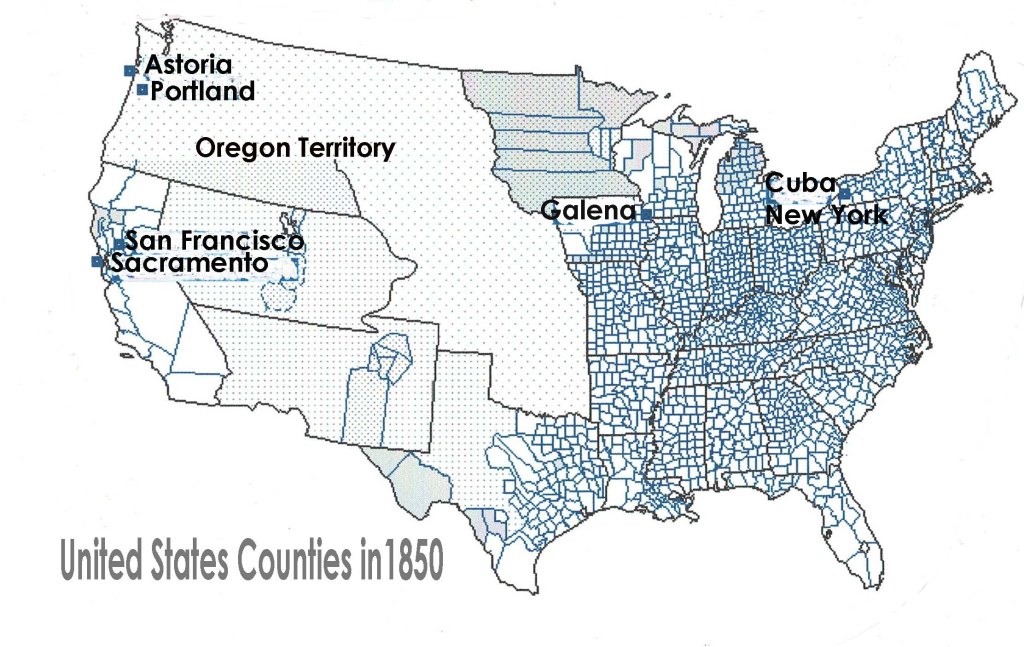
    Edward Henry Griffin wasn’t looking for love when he left his home in Cuba, New York. He was only twenty when he arrived in Clinton, Illinois. He wanted a career. He trained to be a dentist in Galena. Then he went west. First to the gold field of California, then to Portland, Oregon.

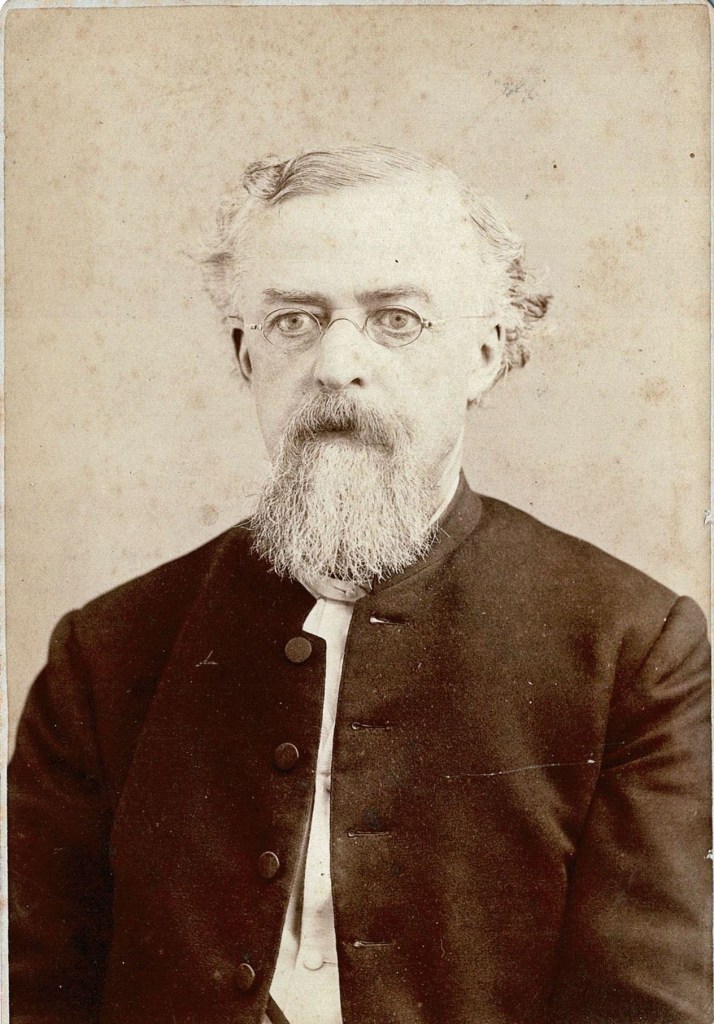
    When Fred Lockley interviewed Edgar Coursen in 1930, Lockley wanted information about Oregon pioneers for a series of newspaper articles. Edgar’s father-in-law, Edward Henry Griffin, came to Oregon in 1850 as a practicing dentist. He was the first dentist in Portland, Oregon.

    A news item about firsts in Oregon reads,

    “The first dentist in Portland was E.H. Griffin. He offered his services to a suffering public on November 22, 1851.”

    Here is a part of the interview conducted by Fred Lockley.

    Ed Lockley, Oregon Journal, 4 Dec 1930

    Lockley captured the industry of Edward Henry Griffin but not the passion. Coursen recalled the facts of Edward’s moves quite well.

    Galena, Illinois

    Edward did arrive in Galena about when his father-in-law said. He had letters remaining at the Galena Post Office on January 5, 1846 and March 5, 1846. Here are copies of the Lists of Letters for those dates.

    Semi-Weekly Galena Jeffersonian 5 Jan 1946

    Training

    Semi-Weekly Galena Jeffersonian 5 Mar 1946

    In 1845, when Edward first arrived in Galena there were no dental schools in Illinois. The first dental school in the United States was built in Baltimore, Maryland in 1840. It was the Baltimore School of Dental Surgery.

    It is reasonable to conclude that Edward learned dentistry through an apprenticeship with an established dentist here. This was the usual way of learning this profession in the United States during the 1840s. He made his living expenses doing work he knew. He gave music lessons while training to be a dentist.

    Gold in California

    Listed as an Oregon Territory pioneer in 1850, Edward came west on the Oregon Trail. He took a California cut off and ended his trip at Fort Sutter, California. Before there was Sacramento there was a fort owned by John Sutter. Gold discovery near here in 1848 triggered the California Gold Rush. John Sutter sold his property to Alden Bally in late 1849.

    The area around this Fort became a busy hub for river traffic and trade. This area would become known as Old Sacramento. Dr. Edward Griffin arrived here in 1849. No doubt, Edward considered mining for gold himself. He practiced dentistry here for about a year. Then he chose to go to Oregon.

    From Fort Sutter Edward traveled to San Francisco. From here he sailed along Pacific Ocean coast to his next destination . He boarded the Ann Smith in late August. Sixteen days later on the 2nd day of September of 1850 arrived in Astoria, Oregon. Another passenger had a role to play in the next year of Edward’s life. J. H. Wilbur was also a passenger on this voyage. Here is a newspaper item detailing this trip.

    item from Oregon Spectator 2 Sep 1850, p.3. col.1

    Emily Roberts

    Emily Roberts Griffin described the first time she saw Edward Griffin in a February 27, 1914 interview with Fred Lockley. These interviews were published in the Oregon Journal, a Portland newspaper.

    I met my fate two days after arriving in Portland. We put up our tent on the riverbank at what is now the foot of Pine Street. We decided to camp there till father was able to find a house. The second morning I was sitting in the tent doing some work while mother was working over our camp stove. I heard voices and looking out I saw a very handsome young man with a silk hat and Prince Albert coat. He had a large white water pitcher in his hand. He was explaining to mother that he had just come down to the river to get a pitcher of water. He said his name was Edward Griffen and had a room at DeWitt’s City Hotel nearby. He explained while he ordinarily got his water at the hotel, he believed the river water was colder and better. I noticed him shift his position until he could look into the tent and see me. I wondered if his explanation was the real reason why he had come down to our camp. After I married him, I discovered that my intuition had been correct. He had caught a glimpse of me the day before and wanted a nearer view of his future wife.

    After Edward’s first view of Emily Roberts, the romance in the man got the better of him. He, being not only a dentist with prospects but a music teacher, went to woo her. He used what he knew. He offered singing lessons and a group to sing with.

    Emily had a second interview with Lockley on February 28, 1914. This is what Emily had to say about her second meeting with Edward..

    Shortly after we moved into the hotel and while I was singing one evening. Mother who was a master hand with the violin, was playing the accompaniment. Dr. Edward H. Griffin, who had a room at De Witt’s City Hotel, passed and heard the music. He stopped and listened until we were through. Next day he came to mother and said I had a wonderful voice. But it needed training. He said he had decided to start a singing school, and he would like to enroll me for his first pupil. Mother was willing. He was young and handsome and a good singer. So, I was willing.

    The singing school was started in the schoolhouse. We soon had a fine crowd of young folks. There was A. B. Hallock and Squire Davis and his wife and Warren and Tom, Davis and the two Davis girls, Sarah and Mary, and George I. Story, who still lives in Portland. He married Sarah Davis.

    Edward’s singing school turned into a choir. This was the first church choir west of the Rocky Mountains.  This choir sang for the Taylor Street Church, built on Third and Taylor Streets. Edward helped James H. Wilbur build this church.

    On December 4, 1925, The Morning Oregonian published an article on page 49. The title was “Covered Wagons Brought Many Settlers Here In 1850”. It listed the pioneers who came to Oregon Territory in 1850. A photo of this first church choir illustrated this article.

    Portland, 1850, Emily Roberts Griffin, 2nd from left, front, Edward Griffin, back, far right

    Wedding Bells

    On October 26, 1851, James H. Wilbur performed the marriage ceremony for Edward Henry Griffin and Emily Roberts. Rev. Thomas H. Pearne assisted. Only a few weddings in the village of Portland occurred before this one.  This wedding was the second in the Taylor Street Church.

    This Methodist church “stood in the middle between 2nd and 3rd, Facing north… back to the woods. The only way to reach it was by walking on single narrow planks strung lengthwise.”

    Early image of Taylor Street Church from the Oregon Historical Society Research Library

  • Institutions

    Hunting for Mary Lucina Taylor

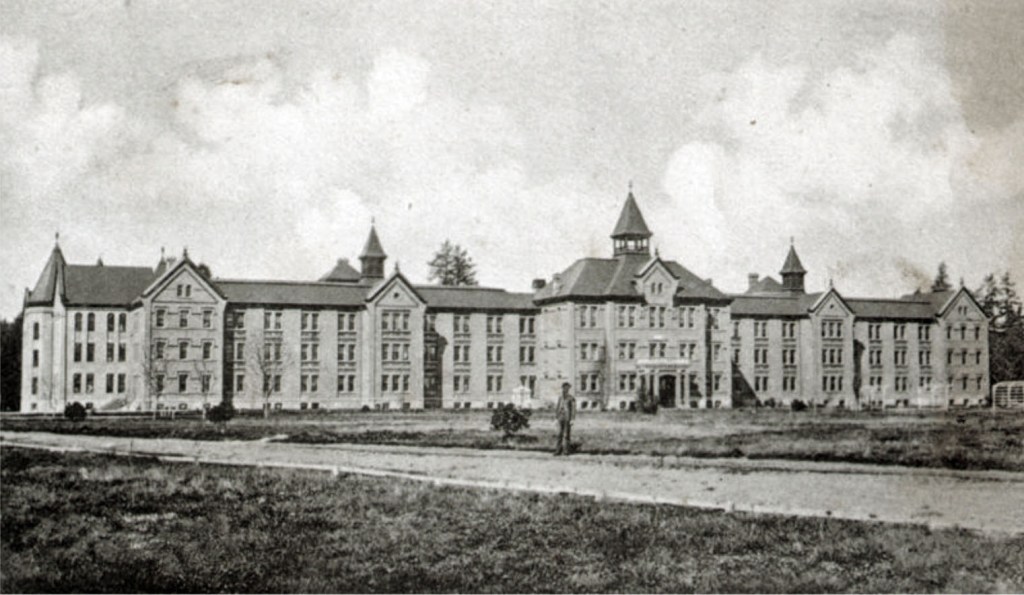
    Western Washington Hospital at Steilacoom, Main Hospital Building, 1892

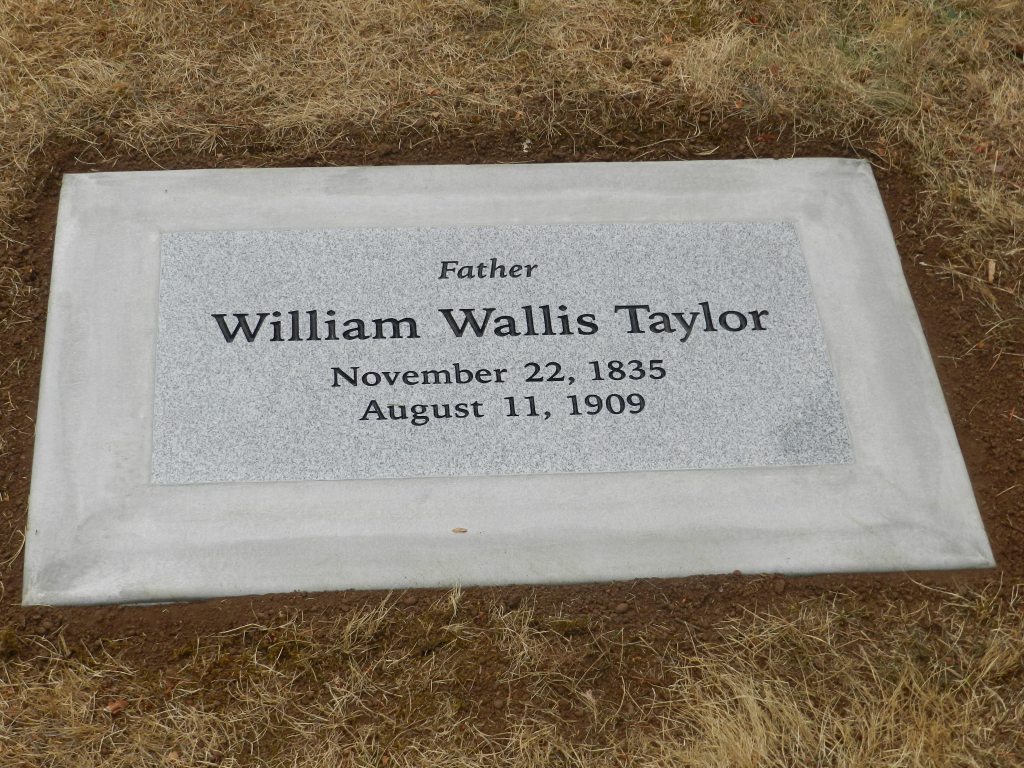
    Why do these stories sometime take on a life of their own? This story was to be about an institution and an institution is involved. Death of a loved one is a somber time for families, marked with family gatherings, funerals, burials and graves markers. This story involves two stone grave markers both made long after the deceased had died. One marker made for William Wallis Taylor was set in 2015. The marker for Mary Lucinda Taylor Miller was completed in 2006.

    I wrote this story about my husband’s 2nd great grandparents and their daughter, Mary Lucina. I searched for years for Mary’s death date and burial place. The institution involved in Mary’s last years was Western State Hospital at Steilacoom. This hospital is located between Olympia and Tacoma, Washington. I had been looking for Mary about 15 years before I found a death date.

    William Wallis Taylor’s Marker

    Craig, my husband and I became acquainted with one of his cousins. This cousin also traced back to Craig’s 2nd great grandparents, Mary Ann Sayles and William Wallis Taylor. We met and traded records. I had found Mary Ann’s grave site in Springwater Cemetery in Clackamas County, Oregon. The cousin’s family held the bible of William. The dates and places in both our records matched.

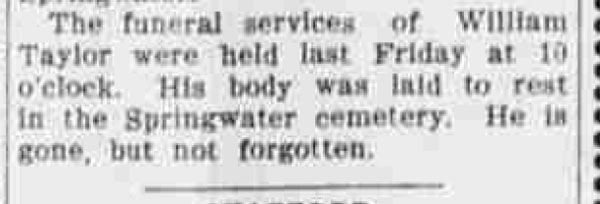
    Both the cousin and I had found an obituary of William’s saying he had died at the home of his son near Aurora, Oregon on August 11, 1909. William was buried in Springwater Cemetery where his wife Mary was buried. Here are copies of William’s obituary and funeral notice from the Oregon City Enterprise, dated 20 August 1909.

    William Wallis Taylor Obituary
    Page 2

    We were sorely disappointed when we visited Springwater Cemetery and didn’t find William’s burial next to Mary Ann’s grave marker. We searched the entire small cemetery. Craig’s cousin convinced the combination groundskeeper and cemetery record keeper that William Taylor was buried there next to his wife. We had a new marker made. It was placed to the left of Mary Ann’s grave site.

    Here is a photo of this new marker.

    Mary Lucina Taylor Miller

    Before this event, I knew quite something about William and Mary Ann’s first child, Mary Lucina Taylor Miller. Mary was my husband’s great grandmother. I had become acquainted with the cousin’s grandmother, Madeline Taylor Wells. She was the granddaughter of William and Mary Ann Taylor and had family photos of her Aunt Mary Lucina.

    Mary Lucina and Siblings about 1865

    Mary Lucina seated in the middle

    Born in LaPorte County on 7 Aug 1857

    Orril Adell on the left

    Born in Will County, Minn. on 18 Sep 1862

    Otha Beardslee on right

    Born Will County, Minn. on 6 Sep 1864

    Mary Lucina Taylor and Edward Arthur Miller

    Wed in Multnomah County, Oregon on 28 Oct 1885

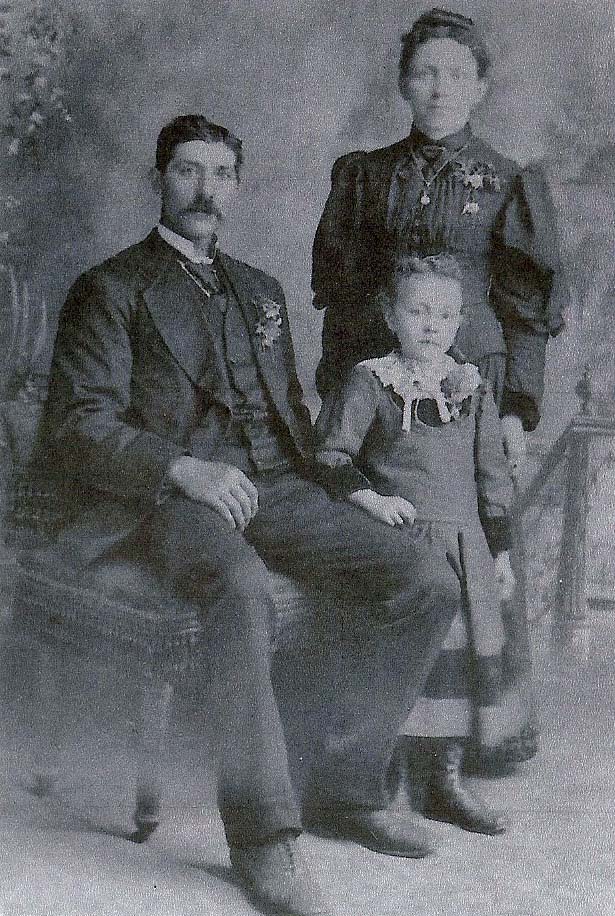
    Taylor Family about 1896 in Springwater, Oregon

    Edward Miller on left

    Mary Lucina Miller in back

    Daughter, Edna Naomi Miller

    Born in Dodge, Clackamas, Oregon on 24 Aug 1889

    They homesteaded a farm in the Dodge Springwater area

    Move to Portland, Oregon

    By 1910 the Miller family had sold their farm in Dodge, Oregon. They now lived in Ward 8 of Portland, Oregon. According to census records, Mary and Edward had been married 25 years. Edna Miller, their twenty-year-old daughter, lived with them and their house was on East 35th Street.

    In 1912, Edward A Miller and his daughter Edna N Miller still lived at at 192 E 35th Street. This information comes from to the 1912 City Directory of Portland, Oregon, Mary is not listed on this record.

    I found Mary in the 1915 City Directory of Portland, Oregon. She is listed as Mary L Miller, widow of Edward and living at 4927 66th SE. Twenty-four years later she still identified herself as a widow of a man named Miller. On her death certificate it is noted that the first name of her deceased husband is not known.

    Edward Living St Joseph, Michigan

    Edward filed for divorce on 1 December 1917 at the courthouse in St. Joseph, Michigan. The grounds were desertion. Edward was the complainant.  His divorce was granted on 22 July 1918. He married Bessie Gadson on 18 August 1918.

    Daughter Edna Married

    Before Mary entered Western State Hospital in 1929, her daughter, Edna had lost her first husband and married a second, Charles Foster. She brought to this second marriage a small boy, Howard Shelton, son of her first husband. She and Charlie had 3 children. Charlie informally adopted Howard. Howard was a teenager when his grandmother, Mary, lived at Western State Hospital. He visited Mary there and remembered these visits being sad.


    The Institution on the Cowlitz River

    Many years before in 1854, the “Poor Law” was passed by Washington Territory. Its aim was to find a better way to care for and house for the poor, disabled and mentally ill. It shifted the support of these individuals from their families to the counties where they lived. At first patients were cared for through a contract system.

    Twenty-one such person went first to a place in Monticello (now Longview, Washington). It was located along the Cowlitz River in Cowlitz County.

    This institution was set up by a pair of businessmen from Monticello. They knew how to make money, but not how to care for “this class of sufferers”. James Huntington and his son-in-law, W.W. Hays built and ran this place. They received a dollar a day for each patient under their care.

    A big problem for this enterprise was the location. Here is a quote from Starlyn Stout’s Care For the “Unfriended Insane in Washington Territory (1854 to 1889)”.

    The buildings of the asylum were revealed by the elements to be merely temporary. In his history of the region, Hubert Howe Bancroft surmised that accommodation opposite Monticello on the Cowlitz River were inadequate. So much so that an event of melting snow from Mt. Rainier brought on an “unusual flood” in December 1867, in which the improvements were swept away. Huntington’s hastily built buildings were now needing to be hastily salvaged and rebuilt to maintain his part of the contract. They published a letter addressing community concerns about their facility, claiming that they too were victims of the territory not fulfilling its part of the agreement. “The Territory must meet the expenses as per contract…  We only ask that our money be paid when due”.

    Dorothy Dix

    A 19th century social reformer, Elizabeth Meriwether Gilmer, who was better known by her pen name, Dorothy Dix, had friends inspect this place in 1869. She wrote:

    Just as I was prepared to leave for California, I first learned from some military officers and reliable civilians your territory was responsible for a rightly intended provision for certain unfriended insane men and women … It being impossible to visit the place referred to myself, I earnestly requested an experienced medical man and a carefully judging citizen of Oregon to see if the statements … were borne by facts, as they understood right care for this helpless, irresponsible class of sufferers. (“Miss Dix on the Insane”).

    It was found that some patients were doing all the cleaning, laundry and cooking. Other patients were confined to their cells. Filthiness was found throughout the faculty.

    Dorothy wrote about this. When Dorothy mentions the Doctor and Inspectors, she is talking about Washington county people who were responsible for the asylum.

    The patients sleep in bunks, in cells, in a coarsely finished, unplastered building, parts of which are described to me as very little better than a barn … the visitors added that, judging from any efficient and proper standard, they could not consider the institution otherwise than inadequately provided both for care and cure of the insane … badly maintained by parties in charge, who possibly may know no better … The Doctor and inspectors are parties interested in perpetuating the present system; the ‘one by his salary easily earned, the others by trade’” (“Insane Asylum”).

    More Letters from Dorothy Dix

    She also wrote to two authorities in Washington Territory—Governor Alan Flanders and former Governor Elwood Evans. Changes were made.  After relating her assessment of the situation, she said this. “At this distance I can only write to you, sir, knowing your sense of pity for these poor creatures will induce early and, I hope personal attention.

      Changes Were Made

      Fort Steilacoom, an old army base which had been built in 1849, was out of use and run down. On April 22, 1868, the staff lowered the last flag at this army fort. The fort located in the Puget Sound region near Tacoma, Washington would be the new home for 21 Monticello patients. The new inmates who had lived with the conditions at Monticello bought their stories with them. Even to this day their tales of poor treatment and the demons that haunted them abound.

      In 1887, the Washington Territory legislature approved $100,000 to build a new institution on the Fort’s grounds. In 1888 this institution became known as Western State Hospital for the Insane. In 1915 the institution’s name was changed again- this time to Western State Hospital.

      My Search for Mary’s Death and Grave

      Before Craig and I knew that his great grandmother, Mary Lucina Taylor Miller, had spent her last years in a mental institution, we were puzzled by the lack of results in the hunt for her death date. Because she was a direct ancestor to my husband this lack was an ongoing source of frustration. I had looked in both Washington and Oregon death indexes many times before I found her in the Washington death index. I ordered her death record from the Washington State Department of Health. I did the paperwork showing my husband, who was requesting the record, was her oldest living direct relative. Since Mary had died in 1939 this record was about 75 years old when I finally got it.

      Mary had lived at Western State Hospital for almost ten years when she died on March 9,1939. She died of a heart and lung condition. Senile psychosis was said to be a contributory cause. She was cremated on March 14, 1939.

      Also, from the death certificate, we learned Mary had entered Western State Hospital on August 27, 1929. She died on March 9, 1939, and was cremated there on March 14, 1939.  Her hometown was Washougal, Washington.

      Disturbing Article in Spokane Newspaper

      The Title, Bill Could Help Families Find Ancestors’ Graves, hints that there was something in the Washington State laws preventing family from locating relatives who died in Washington State’s mental institutions. A Washington State statute designed to protect the mentally ill from shame restricted anyone from getting their relative’s death certificates. This statute prevented a volunteer organization called Grave Concerns from identifying who was buried and where they were buried in the institution’s cemetery. The state had decided these patients were people to be ashamed of and hid their records. Here is a quote from the article.

        At Western State Hospital, a facility worker once found a shed full of human remains packed into tobacco tins and canning jars. And at Northern State Hospital in Sedro Woolley. Wash., now closed part of the cemetery was plowed under and farmed.

        Cremated remains were often buried together in mass graves, said Laural Lemke, Western’s ombudsman and chair of The Grave Concerns Association, a volunteer group that repairs grave sites. After the 1950s, many unnamed remains were sent to crematoriums.

        Making the job of restoring dignity to Western State Hospital’s cemetery was the fact that “many of the state’s records of the dead are incomplete or missing even when records are located…the cemeteries which volunteers have only recently began to recover are often overgrown and in disrepair.

        Our Visit to Western State Hospital

        Craig and I met Laurel Lemke, a woman greatly involved with the Grave Concerns Association, on March 10, 2015. She described life at the hospital when Mary lived there.

        Mary slept in a narrow bed in a narrow room with few personal belongings and a barred door.

        Because Western State Hospital grew its own food and kept livestock, Mary had plenty to eat. At this time the Great Depression was causing misery throughout the land. Patients worked on the farm. Mary may have worked preparing food or sewing. Physical labor was considered therapeutic.

        From 1911 to 1961 hydrotherapy was used to sedate patients. Bath treatments of 2 hours included hot and cold water sprayed up and down a patient’s spine.

        Washington State Hospital’s Cemetery

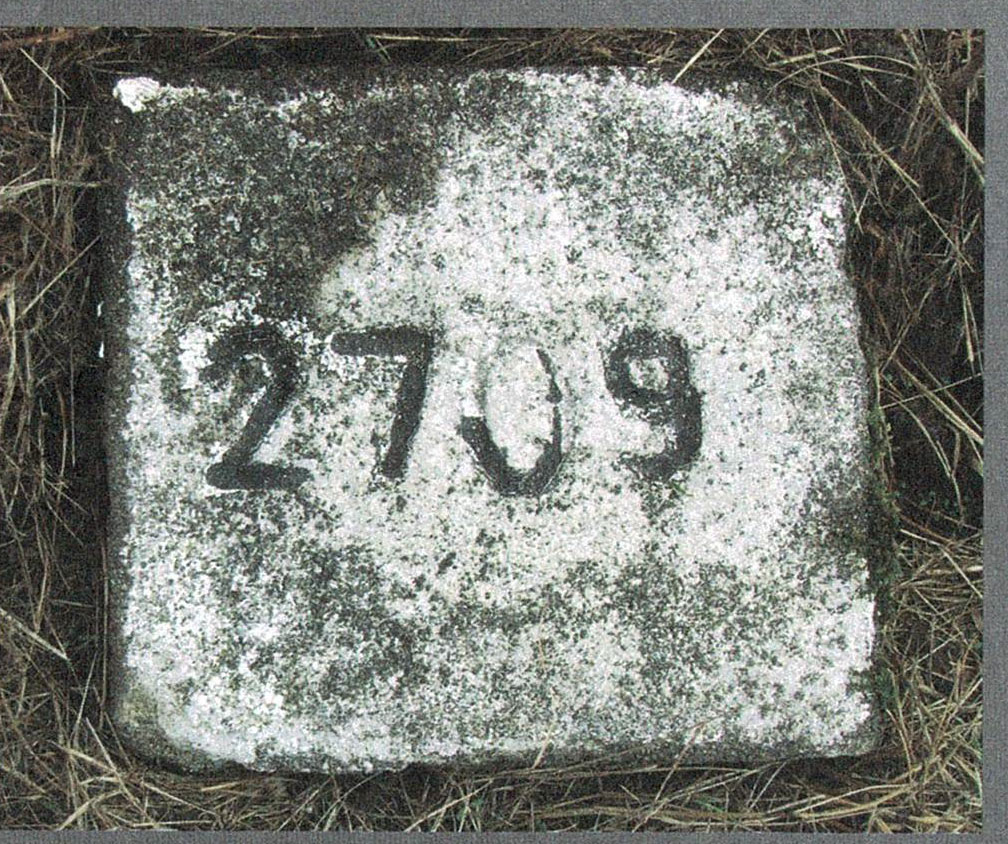
        Before we left, Laurel showed us the cemetery. Volunteers for Grave Concerns had been restoring and upgrading the grave sites for about ten years. It was no longer tangled in blackberries with graves only marked with numbers etched on small concrete squares. The Grave Concern Association had found names to go with the numbers. As they raised money, they replaced the old unreadable number blocks with granite grave markers. These markers showed the patients name, the birth date and death date. Here is an example.

        anonymous marker and John Ryan- dignity restored

        We were hoping to find Mary’ grave marked like the marker on the right. We had set a granite grave stone for her father, William Willis Taylor buried in Springwater Cemetery.

        This was not to be. It is sad to say Mary’s remains were among the unidentified. Perhaps, her unidentified remains were in a canning jar or tobacco tin found stored in the garden shed. Her remains were buried in the mass grave with a large granite marker. Her name and dates were there. We laughed and cried that day. Here are some photos.

        Craig and Jill Foster Viewing Giant Grave Marker
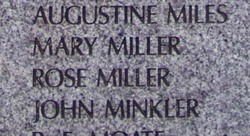
        Mary Miller’s Name on Giant Grave Marker
      • A little Joy

        Week 17 DNA

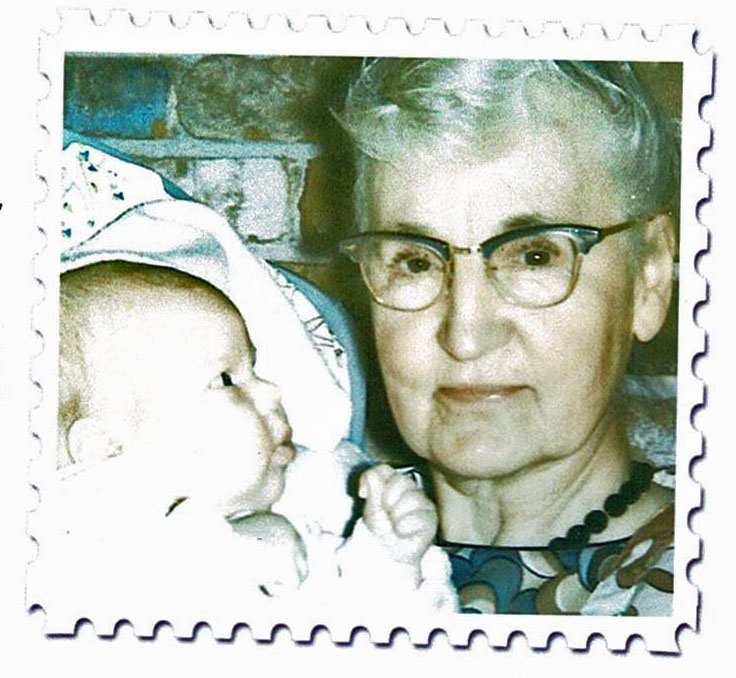
        Frances Cabell Coursen Perritt and my baby daughter

        I felt connected to the mother of my husband. I felt more than just a liking for her as a person or loving her as an extension of my husband. Rose Foster resembled my husband, Craig, in many ways. Both were shy and brave, had dark good looks, loved and worked with numbers. Concise, efficient, self-controlled and kind-hearted described them. Even though Rose and I did not share DNA, I had a kinship with her.

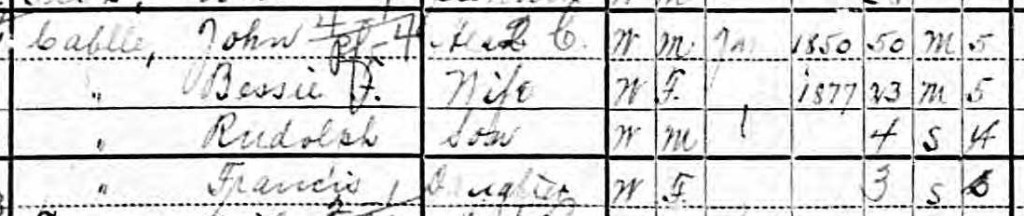
        Both Rose and her sister, Elizabeth Coursen, carried mitochondrial DNA that their family traced back to Jeanette Keeler Ferguson. The mitochondrial DNA is inherited only from the mother. It is passed down from mother to daughter through the egg cell during fertilization. Rose and Betty (Elizabeth) were the daughters of Frances Cabell.  Frances was the daughter of Bessie Reynolds. Bessie was the daughter of Margaret Ferguson. Margaret was the daughter of Jeannette Keeler. Frances Cabell’s scrapbook held mementos and memories of all these women.  Here is a photo of Betty’s daughter, Betty, Rose, Frances and Bessie. Five carriers of Jeannette Keeler’s mitochondrial DNA and four generations are pictured here.

        Betty’s daughter, Betty, Rose, Frances, Bessie

        I happened to be pregnant with my first child when my husband and Rose’s oldest son, Craig Foster, was sent to serve a tour of duty on a small island. Shemya, Alaska, located 1,200 miles southwest of Anchorage, is 2 miles wide and 4 miles long. It is mostly runway. Some liken it to a prison without walls. More known as an Air Force base, army personnel also served there. Craig served in the Army Security Agency.

        Shemya is 280 miles from a Russia-owned island and is almost touching the International Date Line. Craig said from Shemya he saw tomorrow.

        Husband on Shemya, Me with Relatives

        Husband on Shemya, Me with Relatives

        When my husband was away and I was pregnant, I drove between my parent’s house in Seattle and my husband’s parents in Portland. My OB doctor had his practice in Portland. This was early in our marriage, and I hadn’t quite left the nest.

        I talked Rose into taking La Maze birthing classes with me and being my coach when I had the baby. We would pant and breathe together through the labor pains. She would be in the delivery room for birth.  Fifty years ago, having family in the delivery room was beginning to be in style. It was mostly for the fathers.

        Rose and I followed the plan. I presented our family with a beautiful baby girl. Rose and my father-in-law, Howard Foster, did not stop smiling. We called Craig in Shemya and talked. Then the crabby night nurse sent my family home. She was out of sorts for being told by my doctor that Rose was to be allowed in the delivery room. She was still muttering about that as she sent Rose and Howard home. The hospital did allow my daughter to be in my room in a bassinet by my bed.

        I loved the fact that these people were contributing DNA to Craig’s and my daughter.

        My Mitochondrial DNA

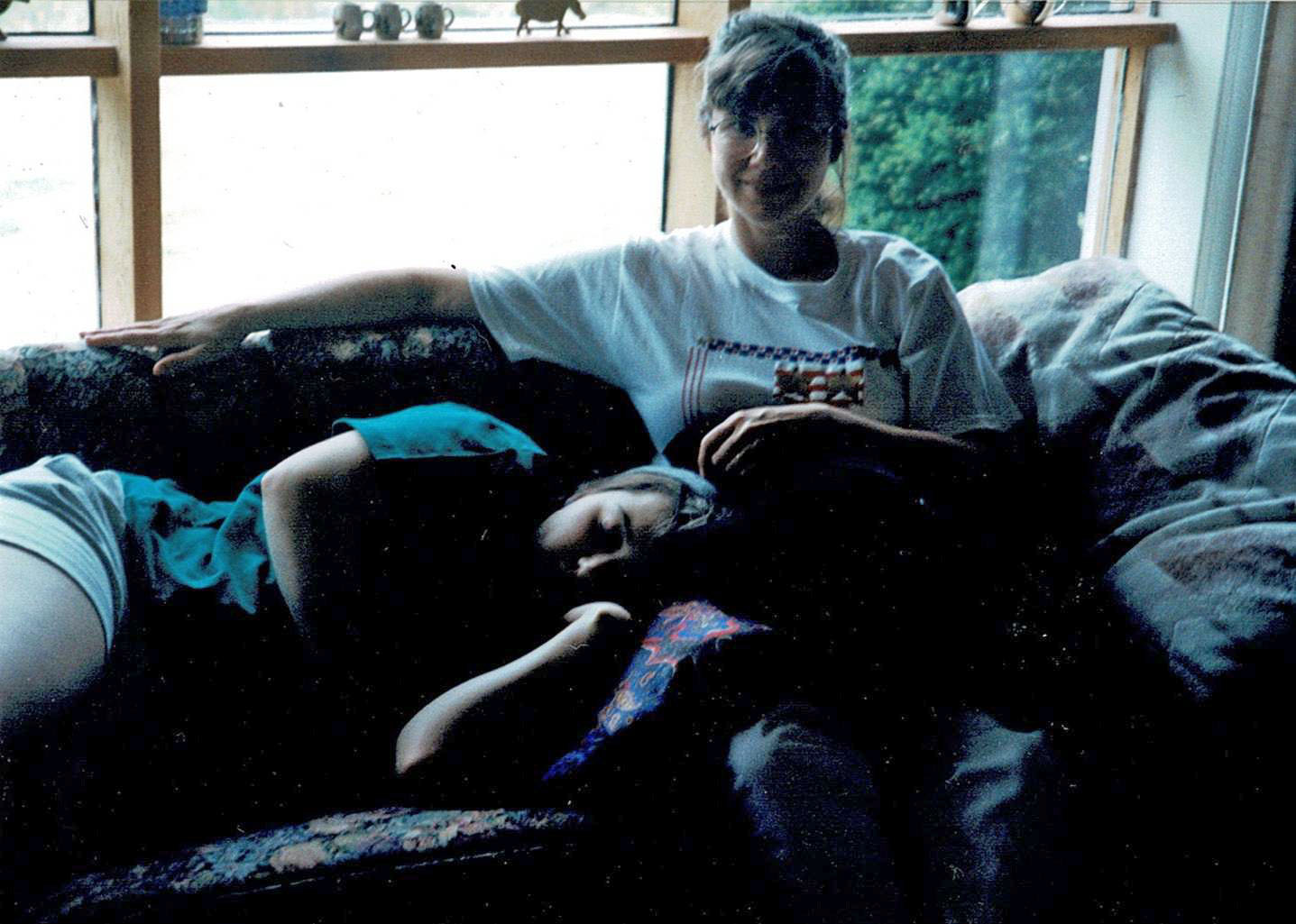
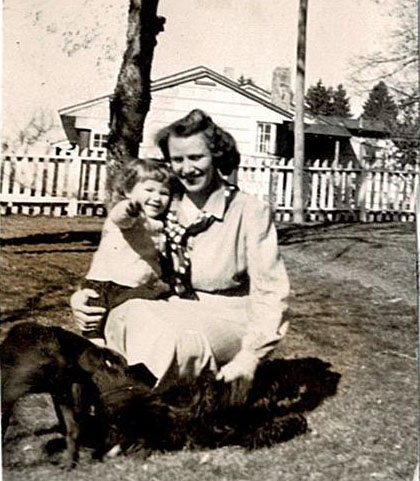
        I can confirm my mitochondrial DNA from my daughter back to my great great grandmother, Johanne Catherine Rasmusdatter. through cousins on ancestry.com. Here are some family photos. My daughter and I at on the top right. My mother, Helen Wolfe Lonski, and I are on the top left.

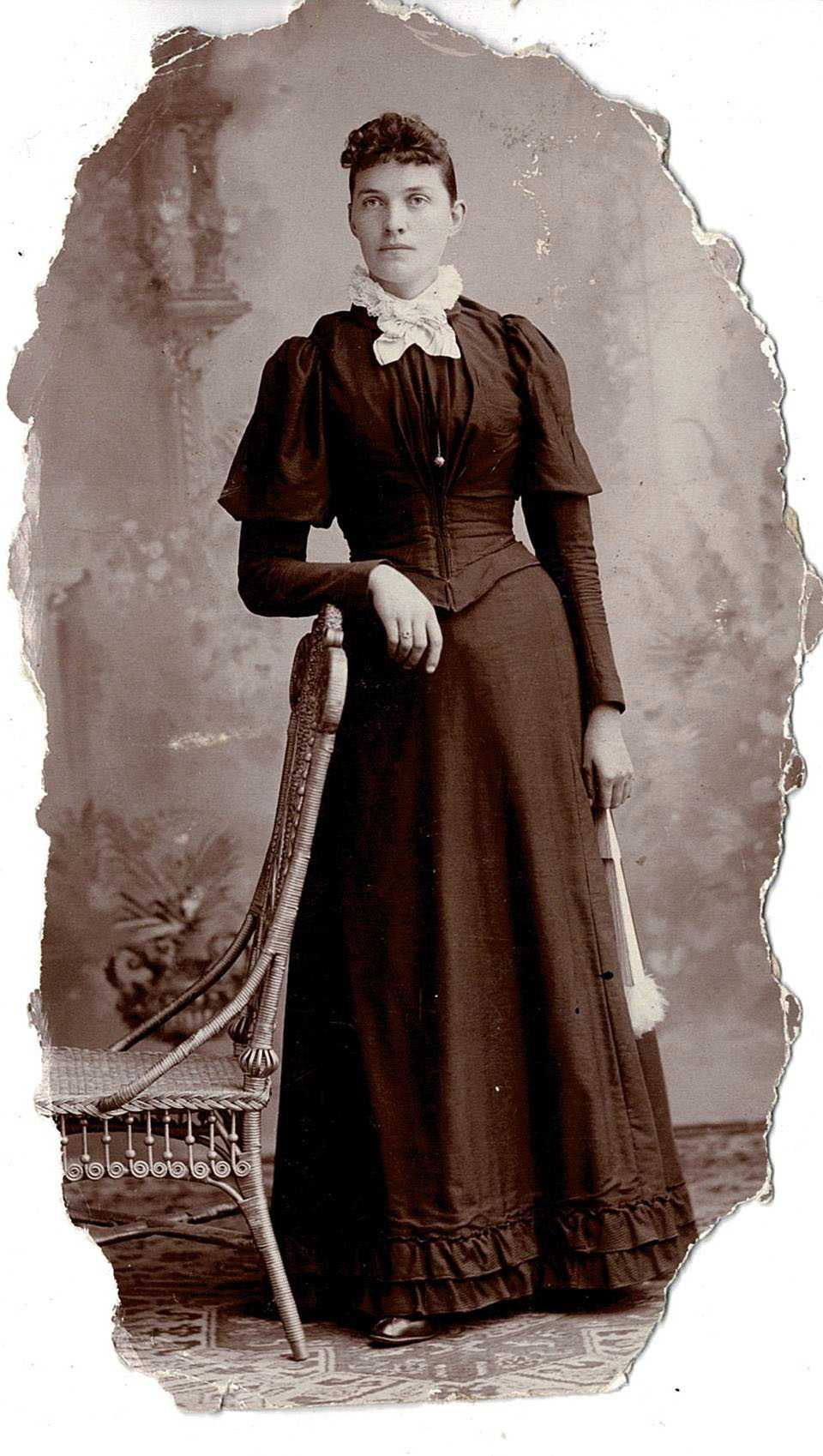
        My grandmother Edna (Dagny Oldsdatter) Wolfe and Helen show on the bottom left. Her mother, Elen Jacobsdatter, is on the bottom right. This last photo was taken in 1885 at Rövig in Hansel, Norway.

      • Our Old House

        Week 13 Home Sweet Home

        Foster’s Jefferson House, Christmas 1998, built 1901

        Week 13 Home Sweet Home

        My husband, Craig and I lived in this house about 36 years. I would like to share what we know about its history.

        Local historian, Mike Barnes of Jefferson identifies this old house at 421 North 2nd Street as the Clarence Miller home built in 1901. Clarence Miller about 2 years old in 1901 was the son of the original owner. Archer C Miller was a sheep raiser from Millersburg. Archer’ ‘s father, George S Miller was a pioneer from Illinois of 1852.

        By 1910 descendants of the Looneys who crossed the plains in 1843 lived in this house. These Looneys included Benjamin F Looney and his family. His wife, Josephine Hale Looney, his son Evert, his daughter, Georgina Looney Smith and his son-in-law, William Smith made up his family.

        The next family, the Smiths are listed in the 1920 census for Jefferson. We have had the good fortune to meet Georgina’s and William’s second son, Benjamin Smith. He shared memories of living in this this house. The 1920 Federal census shows William and Georgina Smith and their three sons, William, Benjamin and Everett still living here.

        Benjamin Smith visited us here in the late 1970s and told us what he remembered about the house. His father built wall to wall glass fronted dish cupboard which is still in the dining room. Lumber from the Looney lumber mill provided wood for the house. When he lived here there was a wood store in the dining room. He remembered a chimney fire. An older women resident saved the wood stove from the fire by picking it up and carrying it outside. The house survived the fire with little damage as did the wood stove. Today a bookcase stands where the wood stove once did. Ben said the layout of the house was the same as when he lived here. He and his brother were in the bedroom upstairs above the kitchen. We later found a vintage valentine to Ben Smith in the floor boards in this bedroom. The Smith family moved from Jefferson to Arizona in 1929.

        Our house is on the right side next to the telephone pole and behind the trees

        By 1972 Robert and Ruth Farrens owned the house. The house had been rented out for some time and was in need of repair and upkeep. The Farrens covered worn walls with Masonite wall paneling, the woodwork with porch paint and the floors with red carpeting.

        We returned the walls to wainscoting and wallpaper. The floors were the original old growth fir which we refinished. We removed the porch paint from the woodwork finished it with a clear finish. Some of the light fixtures Robert Farrens added, we loved.  He rescued three chandeliers from the old Gearhart Hotel near Seaside, Oregon. About the time he was working on this house, the Gearhart Hotel was razed and replaced with condos. In its heyday this grand hotel from the 1920s was one of the largest convention hotels in the state. One of these chandeliers went in the dining room and two in the downstairs living room.

        Robert Farrens as well another neighbor thought this house was used as a stage coach stop in its early life. The Sanborn Fire Insurance map of 1913 shows our house and a horse barn west of our house.

        I have found horse shoes around our yard. We discovered the family room upstairs had been divided into three small rooms and a hall. When we took up the carpet in this big room, the floor boards had been painted. We saw the pattern of where the walls stood because these lines were not painted. Jefferson had a train stop by 1870 so I doubt the stage coach stop was needed.

        In the 36 year we have lived here, we have updated and repaired trying to keep the character of the house intact. In 2002 we had the front yard professionally landscaped by Liz Frances of the Gardens Angels.

      • Man Overboard

        Man Overboard

        Week 16 Oldest Story

        The story of Frances Cabell Coursen Perritt’s 9th great grandfather came in bits and pieces. The first hint I had of this man’s existence was from my husband’s mother. She and I were discussing her family history. She said one of her early relatives came to North America on the Mayflower. She thought he was a Cabell. She was sure he was from her mother’s side, that is Bessie Ferguson Reynolds Cabell’s side. She did not know the name of her Mayflower relative.

        A few years later I started reading a picture book to my kindergarten children. In this story a boy who fell off the Mayflower. In this book the boy who fell overboard, John Howland, served the pilgrim’s leader as a cabin boy.  They were traveling to the New World in search of religious freedom. The rescue of John Howland was suggested by an illustration of a boy clinging to a life preserver. In this picture book story, the pilgrims reached Plymouth. John grew up and married Elizabeth Tilley, another passenger on the Mayflower.

        A Connection

        After I retired from teaching and after I had been researching my husband’s family tree for more than five years, I learned the identity of my mother-in-law’s Mayflower relative.

        Grandmother Perritt’s scrapbook left clues. There was a black-edged calling card of Mrs. D.H. Ferguson. The D. H. stood for Daniel Howes. There was a charcoal drawing of Daniel H. Ferguson. 

        The name Howes puzzled me for a long time. I had published a photo of the charcoal portrait of Daniel on my ancestry site.

        Then in January of 2013, a librarian from Morrow County Public Library in Florida contacted me. She wanted to know about the portrait of Daniel. She said,
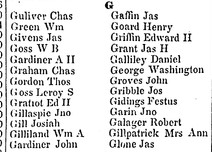
        The Florida History Room of the Monroe County Library has a collection of letters written by Thomas and Rosalinda Ferguson. These letters are from Thomas in California describing his finding gold and Rosalinda in Key West. I have transcribed the letters.

        Daniel is the brother of Thomas Jefferson Ferguson… We have an original penned letter from Fanny Ferguson(mother) to Thomas J. In her letter she mentions two girls at home and the following sons: Thomas, George, Daniel, William, Albert, Fernando, Fred and Colbert. The letter is marked Danbury.

        These letters were originally found 20 years ago in a tin can at one of our local museums- no one knew then how they came to be there.

        I replied telling her what I knew of Daniel. I was able to send her this photo of Daniel’s portrait.

        She sent me copies of her transcriptions and copies of Thomas’s and Rosalinda’s letters to each other, a copy of Fanny’s letter and another family letter. This last letter was from Malchus Reed Howes of Mobile, Alabama to Daniel M. Howes of New York. Malchus and Daniel Howes were both brothers of Fanny. The letter mentions two other siblings of Fanny’s. They were Nathan and Adelia, who had married William Ryder. Here is my transcription of Malchus’s letter.

        Mobile July 15th 1826

        Dear Brother,

        I have received the Deed from Nathan that you spoke of in your last letter. I have executed it and shall send it in the trunk of clothes that I send to Cornelia that is to be left at Uncle John’s. I wish you to take it [the deed] from the trunk as you have already advanced money to my children and I expect you to advance more for at this season of the year it is impossible to get money that I could pay you with. Cornelia wants money to buy hats and shoes; her other clothes I shall send her. Please do see them well supplied and see yourself well paid in the delivery of the Deed. If there should be any [money] left, let Brother [Nathan] be bound to pay it to Mother [(Ruhamah Reed Howes] to support my boys as they want. Don’t see my children outdone by any for in all probability, they are all I shall ever have and I hope that they have aplenty to maintain themselves. If you think best that Adelia should have Cornelia, I wish you to get her to take her [there] and I will see her [Adelia] well paid. The yellow fever is paying us a visit this summer. There has been very sudden death in a few hours from the time they were taken [ill]. I shall see you next year if I should live as long. Give my respects to all friends. Don’t forget to write.

        Yours Respectfully, M. R. Howes

        Daniel Howes Ferguson

        She sent me copies of her transcriptions. She also sent copies of Thomas’s and Rosalinda’s original letters to each other. Additionally she sent a copy of Fanny’s letter and another family letter. This last letter was from Malchus Reed Howes of Mobile, Alabama written to Daniel M. Howes of New York. Malchus and Daniel Howes were both brothers of Fanny. The letter mentions two other siblings of Fanny’s. They were Nathan and Adelia, who had married William Ryder.

        Here is my transcription of Malchus’s letter to his brother Daniel M. Howes.

        Mobile July 15th 1826

        Dear Brother,

        I have received the Deed from Nathan that you spoke of in your last letter. I have executed it and shall send it in the trunk of clothes that I send to Cornelia that is to be left at Uncle John’s. I wish you to take it [the deed] from the trunk as you have already advanced money to my children and I expect you to advance more for at this season of the year it is impossible to get money that I could pay you with. Cornelia wants money to buy hats and shoes; her other clothes I shall send her. Please do see them well supplied and see yourself well paid in the delivery of the Deed. If there should be any [money] left, let Brother [Nathan] be bound to pay it to Mother [(Ruhamah Reed Howes] to support my boys as they want. Don’t see my children outdone by any for in all probability, they are all I shall ever have and I hope that they have aplenty to maintain themselves. If you think best that Adelia should have Cornelia, I wish you to get her to take her [there] and I will see her [Adelia] well paid. The yellow fever is paying us a visit this summer. There has been very sudden death in a few hours from the time they were taken [ill]. I shall see you next year if I should live as long. Give my respects to all friends. Don’t forget to write.

        Yours Respectfully, M. R. Howes

        The above quoted letter was shared. This letter was well read, shared around the neighborhood and sent on to other family members. This letter from Malchus Howes to Daniel Morgan Howes had been read by another family member who wrote on the letter these words, “I was anxious to hear from Reed (Malchus) and thought no harm in opening this…”

        The deed in this letter refers to an 1827 property sale by the heirs of Daniel Howes, Malchus’s and Fanny’s father.  Here is my summary of the deed.

        1827, 10 Apr. Putnam Co. Deeds, Vol. C, pp. 470-474

        Ruhamah Howes of Southeast was the widow of Daniel Howes (1768-1824) of Southeast. Nathaniel Ferguson and wife Fanny, Thomas Ferguson and wife Phebe of Patterson, Putnam, New York, Nathan A. Howes and wife Clarissa, Morgan M. Howes of Southeast, William H. Ryder and wife Adelia of Danbury, Fairfield Co., CT. Fanny, Phebe. Nathan, Daniel Morgan Howes (1805-1830) and Adelia are the adult children of the late Daniel Howes.  Jacob O., Esther, Lavinia, Reuben W. are the underage children of the late Daniel Howes. Three acres in Southeast were sold to Ebenezer Foster, John B. Foster and Eleazer Sprague of Southeast for the sum of $245 to be divided into 11 parts. Nathan was to be paid 2 parts for his role in managing the deal.


        Soon after this treasure trove from my librarian friend at the Monroe County Library arrived, I worked out that Fanny’s family traced back to John Howland and Elizabeth Tilley. John and Elizabeth both arrived on the Mayflower in 1620. Elizabeth had come with her parents and was 14 at this time. Since I had read the picture book of John Howland’s near drowning to my kindergarten class many times, this new revelation seemed awesome.
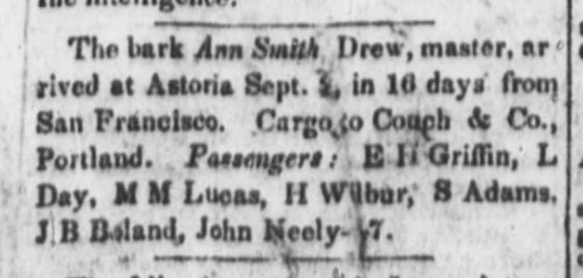
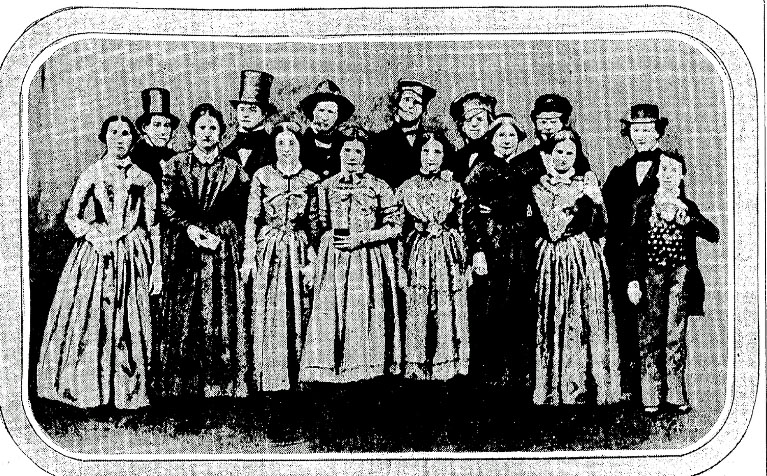
        The real John Howland almost drowned on his trip to the New World. He was not a cabin boy, but a 29-year-old man and one of two man-servants of Governor Carver. He was swept overboard in a strong storm. He managed catch hold of a rope for a top sail that tailed over the side and under water. He was brought back on to the Mayflower by the use of a boat hook. There is a sourced profile of John Howland on WikiTree
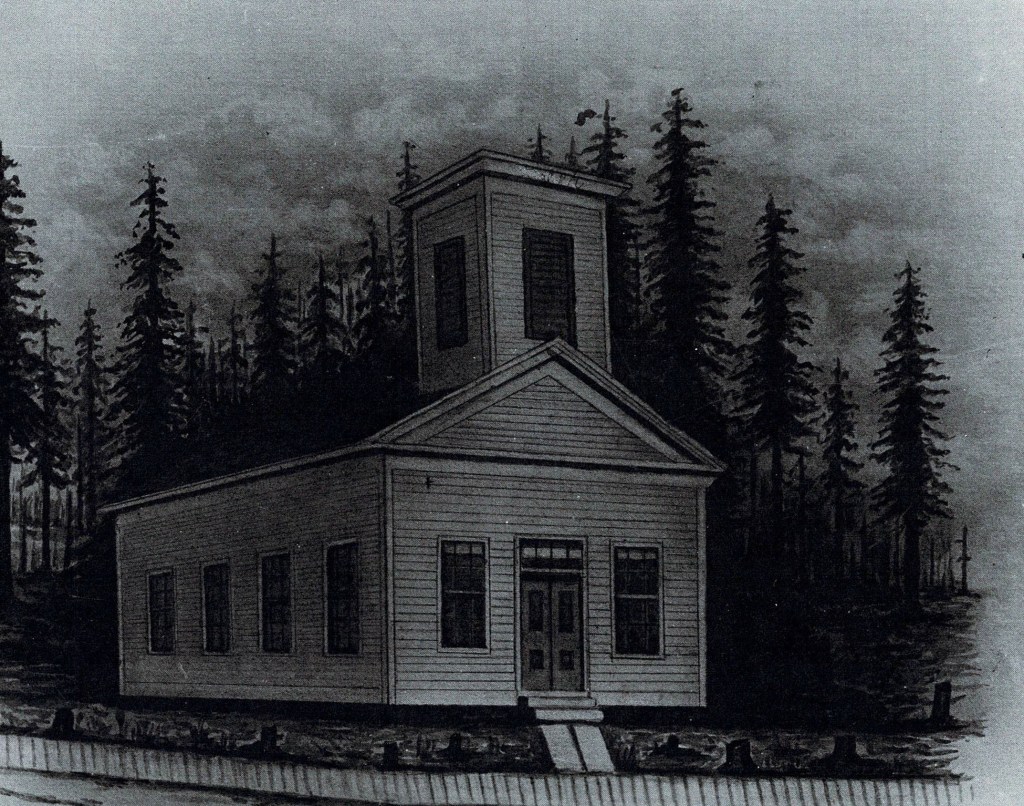
        Here is Mike Haywood’s rendering of the event. Mike Haywood is an artist and  holds a doctorate in Oceanography and specializes in marine paintings.

        Image of an oil painting by Mike Haywood found on a Facebook ad for ordering prints of the painting

        Final Thoughts

        When I was a kindergarten teacher reading that historical fiction picture book to my class, I never dreamed I was telling a family story.

        I made a list going from John Howland to my husband, Craig Shelton Foster

        Some References