Tag: family-history

  • Isaac Roberts Migrates

    Week 8–Migration

    OLYMPUS DIGITAL CAMERA

    A number of Frances Perritt’s relatives migrated to the Oregon Territory in the 1850s. The Isaac Roberts family, being among this group came west with Blunt’s wagon train of about 200 wagons. They traveled in what is known as a prairie schooner made of wood and covered with a canvas trap. Oxen pulled their wagon. When they began their journey in April, their family included Isaac Roberts, his wife, Katharine, and his children, James Bruffey, Emily Catherine and Samuel Houston.

    From their home in Independence, Missouri, they anticipated a trip of about 2,000 miles. Isaac had not picked their final destination. It was to be either northern California to look for gold or the fertile Willamette Valley where they could make a donation land claim and farm. At the beginning of the trip, they were leaning toward the looking for gold opportunity.

    Edwin C. Roberts, the grandson of Isaac’s, describes their journey as long and hard.

    The original intention was to go to California but when they reached Eastern Oregon their stock was poor, their wagons were becoming worn out and all their equipment was badly run down, so they came on (to Oregon) and to The Dalles. General Grant, then a young Lieutenant at the time came out to meet the train.

    The Roberts were among the settlers who arrived in Portland in 1850. They are listed by name in this newspaper article.
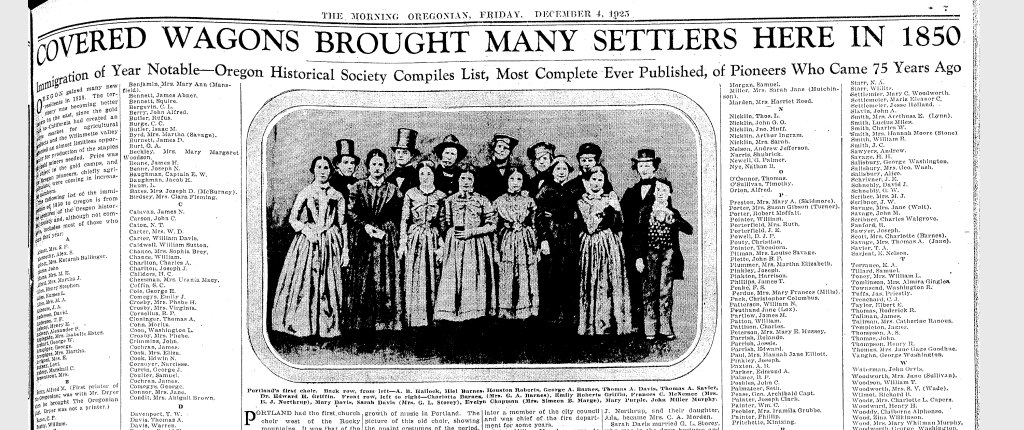
    The Morning Oregonian, Friday, December 4, 1925

    Emily is listed with the names beginning with G as Griffin, Mrs. Emily Catherine Roberts. The others in this family are; Roberts, James B.; Roberts, Samuel Houston; Roberts, Isaac; Roberts, Mrs. Elizabeth (Connor).Elizabeth was substituted for Katharine in error in this article.

    Time in Portland

    On December 9, the 1850 census was taken in Portland City, Washington County, Oregon Territory. The Roberts family lived in dwelling 150. Isaac is listed as a blacksmith. Here is a snippet of this record.
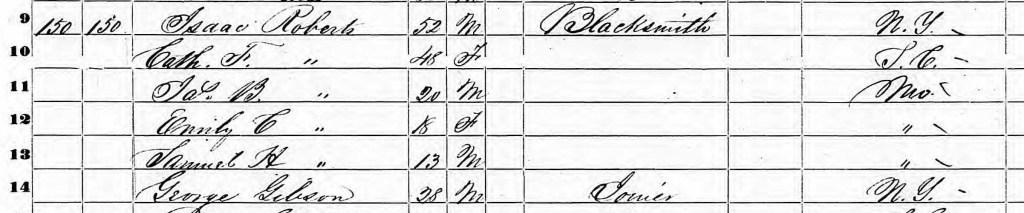
    He made cutlery and edged tools. Earlier that year Isaac had purchased land from Colonel W. W. Chapman at the cost of about $800. These 5 lots were bounded by Fourth, Fifth, Columbia and Clay Street. This block is near to where the Keller auditorium is now in 2022.

    He built the first house in this block during that winter. In 1850 a twenty-eight-year-old man named George Gibson lived with the Roberts. His occupation was listed as a joiner. Joiners fixed wood pieces together without using nails or screws. They often did finish work on houses – door frames, window frames, shutters, fireplace surrounds and built-in cabinets. Isaac’s house needed this type of work in the winter of 1850.

    The Roberts helped build and attended the Taylor-Street Methodist Church. Emily, James and Robert sang in Portland’s first church choir. The choir was directed by Emily’s beau, Dr. Edward Henry Griffin. Emily and Edward’s wedding vows were exchanged at this church on October 26,1851.

    To the Willamette Valley

    In 1852, Isaac and Katherine moved farther south to the Willamette Valley. They took out a land claim near Shedd, Linn, Oregon. He settled at what is now called “Roberts Bridge” on the Calapooia, right in the center of the valley. 

    Robert’s Bridge, Linn County, Oregon

    In the 1860 census, Isaac is listed as a blacksmith. It could be that more of his income came from his metal work than from his farm work.

    When Isaac and Katherine left Portland in 1852, James Roberts and Samuel Houston Roberts came with them. They were still with them in 1860. James age 29, was a farmer and Samuel age 21,was a carpenter.

    James farmed his own homestead of 320 acres. His claim adjoined his parents’ claim. 

    Emily (Roberts) Griffin and her husband Edward Griffin homesteaded a 640 acre claim next to her parents claim.

    Emily had this to say about her family’s homesteading.

    Father and mother took up a donation land claim 10 miles south of Albany and, they were anxious for us to take up a section also, so we moved to the claim adjoining theirs. My husband put out the first big orchard in Linn County. In those days raising Spanish cattle and wheat farming were about the only activities ranchers were engaged in. They had no gardens and rarely raised any vegetables. After nine years on our ranch, we moved to Albany, so where the children went to school.

    Here is a map showing the boundary lines of Donation Claim Sections. This is original Plat on file in the Oregon City office of L. T. Bann, Register. The date was 24 Feb 1881. It shows Isaac and Katherine Roberts claim as well as James Roberts claim and Emily and Edward Griffin claim.
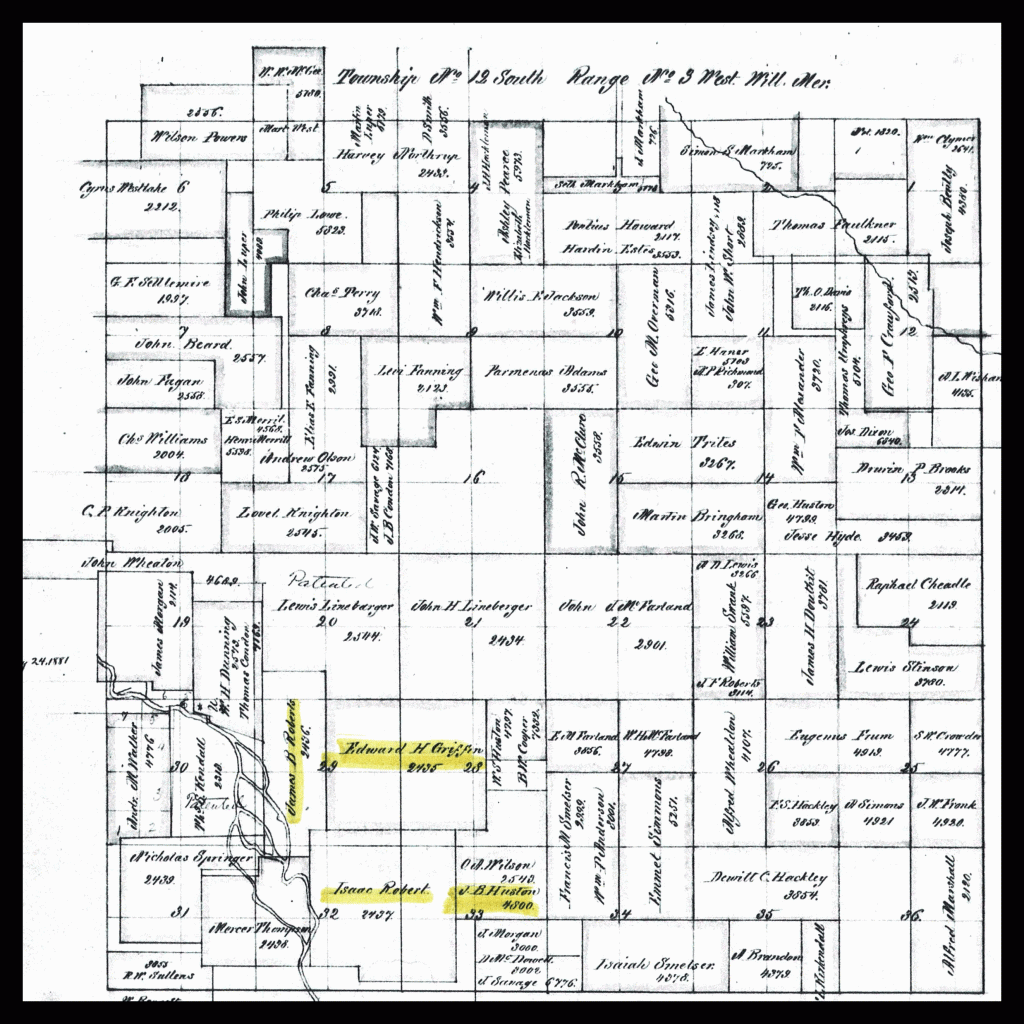
    Map of Roberts Claim, bottom left

    Death

    Isaac died September 6, 1860, on his land claim at Robert’s Bridge, Linn, Oregon. His obituary published in the Pacific Christian Advocate reads:

    Obituary-Died at his residence in Linn County on the 6th inst., (6 Sep 1860) d; Isaac Roberts, in the 63rd year of his age.

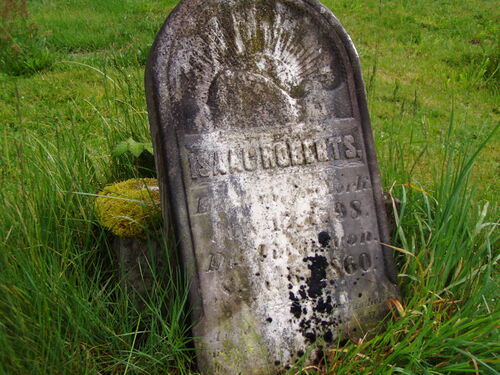
    He is buried in Sandridge Cemetery located near Lebanon, Linn, Oregon, USA. his white marble head stone reads:

    “Isaac Roberts; born in New York, July 17, 1798

    Died in Oregon, Sept. 6, 1860,

    A kind husband and loving father,

    A friend to man, a believer in God and his revealed word.”
  • Howard Melvin Shelton Foster

    Week 9–Family Secret

    Howard Melvin Foster at Jefferson , Oregon in 1986

    On the whole, Howard Foster did not display secretive qualities. He willing talked about any topic that came up. He answered questions about himself in detail. If he didn’t know the details he filled in the details. The only thing he knew about his birth grandfather father was the name, John Lawrence Shelton.

    Howard Melvin Foster, a glass half full person, was my father-in-law. Also, he was Grandmother Perritt’s son-in-law. I spent some time with him and my mother-in-law, Rose. This was when my husband was in the army, stationed in Shemya, Alaska. My obstetric doctor practiced medicine in Portland, Oregon where my in-laws lived.

    Being the positive person Howard was, he was not about to share the unhappy parts of his life. If something bad had happened he quickly forgot about it.

    Being the nosy person I am, I asked questions about his life. If the event was good, I got detailed answers. If not, I got half answers.

    Howard’s Brother Dick

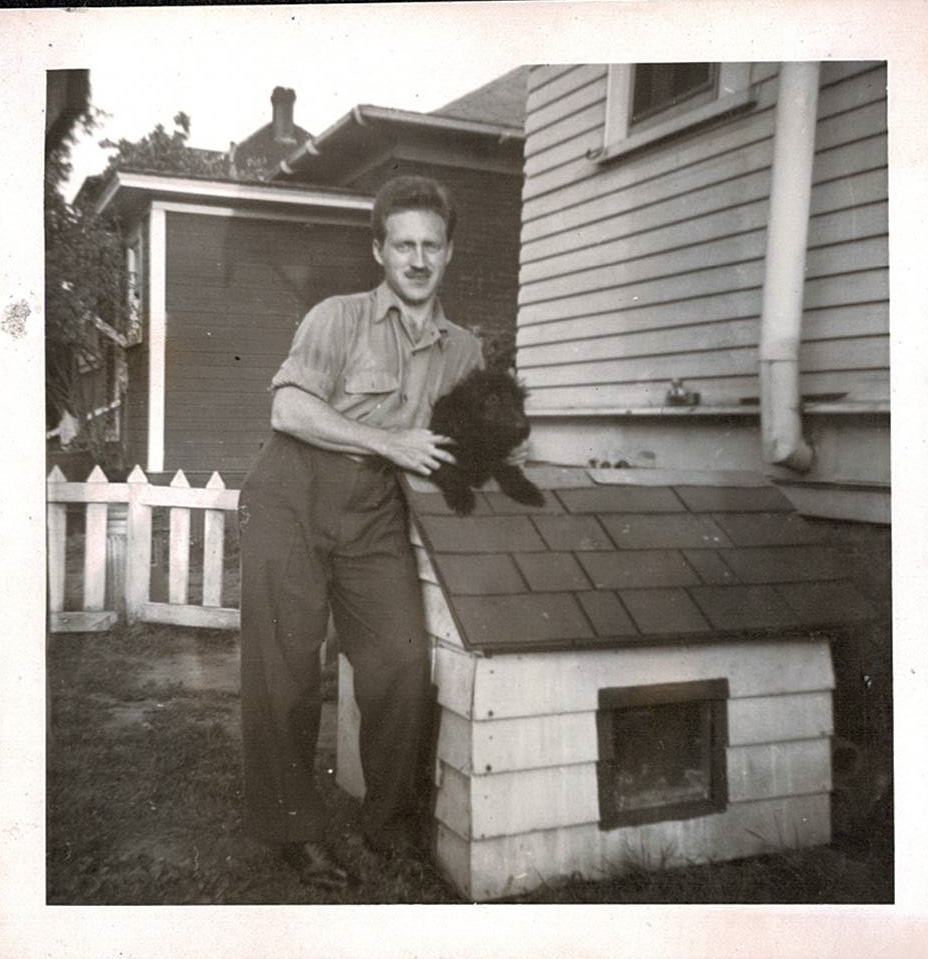
    Charles Richard Foster, his half-brother, was born three years after Howard. They were close while growing up. Charles or “Dick” as the family called him, grew up to be an alcoholic. Howard grew up to be a family man with a house in the suburbs, a business of his own, a loving wife, two sons and a dog named Eagle.

    Dick, on and off the wagon, showed up at regular intervals, drunk and asking for money. Howard helped him until he broke with Dick when his boys were under five.

    I asked what happened to Dick. Howard said he thought he died sometime in the 1950s and his family lived in Silverton, Oregon. Years later, I was searching for a Charles Richard Foster and found him in a Silverton Phone Directive for 1997.

    Dick Foster, Spokane, August 1943

    Early Life

    A wild story about Howard’s early life came from his half-sister, Jean Wardian. How Howard came to have a half-sister, and two half-brothers is a different story I will tell now.

    Edna Naomi Miller fell in love with Carl Shelton in Portland, Oregon. They lived in the same Portland Ward. They were both in their early twenties. When Howard was born on July 31, 1914, in Portland, Oregon, Edna was 25 and Carl was 24.

    Back to the wild story, the first part is true. Auntie Jean, Howard’s half-sister, said Howard’s small family moved to a small logging community in the northeastern part of Oregon. They moved to Enterprise and Enterprise is where Carl died and is buried. I found his grave in Enterprise Cemetery. He had died July 24, 1915, just a few days before Howard ‘s first birthday.

    The wild part of this story involves the reason they moved.  Jean said, “Carl’s parents were well off, well known in the Portland music scene and were trying to get custody of Howard.”

    Howard Melvin Shelton at 3 months

    New Father

    Edna married again on June 10,1916 about a year after Carl died.  Howard grew up knowing no other father beside Charles Wallace Foster.

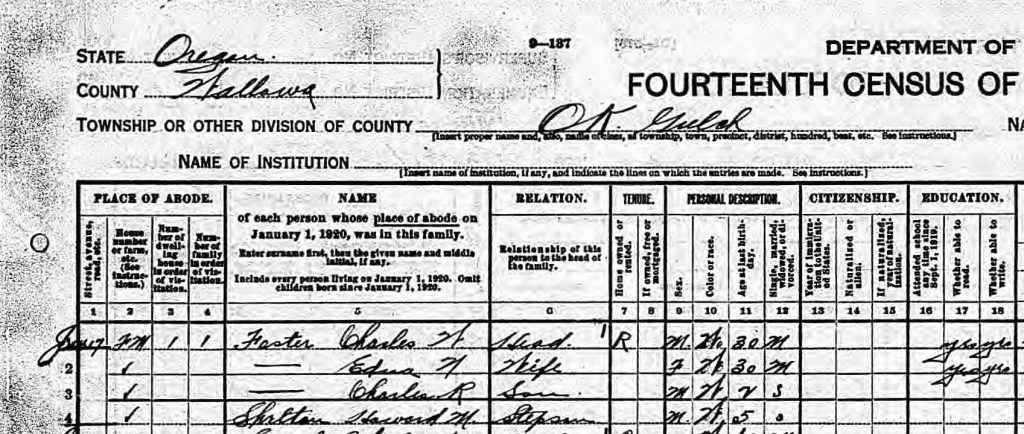
    The Fosters used Shelton as Howard surname in the 1920 U.S. census. Here it is for OK Gulch, Wallowa County, Oregon.

    1920 census showing Charlie Foster’s Family in OK Gulch, Wallowa, Oregon

     Using Foster as His Surname

    After Howard started school in Lewiston, Idaho, he used Foster as his last name. Here is the 1930 U.S. census from Mount Pleasant, Skamania, Washington.

    1930 census showing Charlie Foster’s family in Skamania county, Washington

    A Problem Develops Later in Life

    In 1963 Howard needed a name change. He went through the Multnomah County circuit court system to change his name.  His birth certificate named him Howard M. Shelton. In life people and institutions call him Howard Melvin Foster.

    He graduated from Fort Vancouver High School as Howard Foster.

    He studied for four years at Reed College as Howard Foster.

    He married Rose Coursen on June 3,1940 as Howard Melvin Foster.

    His two boys carried the surname of Foster.

    His printing business was called Balwin-Foster Printing Co.

    As a scout master from 1961-1965 he was known as Howard Foster.

    He served his country in WWII and separated from the army as Private First-class Howard M. Foster.

    I don’t know the immediate reason he needed to do this in 1963. I do know his church was planning a group trip to Israel and Rome. Howard would need a passport for this trip and a birth certificate with the name he had used for 45 years.

    Certificate of Change of Name

    On April 2, 1963, Howard Melvin Shelton, on his own behalf, petitioned the Circuit Court that his name be changed from Howard Melvin Shelton to Howard Melvin Foster. On April 29, 1963, his name was changed, and an official Certificate of Change of Name was issued to Howard.

    Going Ahead to 1972

    Moving ahead, I spent more time with my in-laws in Portland waiting for the baby. During my last month of pregnancy, my obstetrician wanted me to cut out my trips between Seattle where my parents lived and Lebanon where my grandmother lived. Being consigned to Portland, I had more chances to ask Howard about his life. He didn’t want to talk about his experiences in WWII.

    Years later, going through Howard’s papers, I found his separation papers containing a summary of some of what he did. I was impressed. I don’t know if he didn’t talk about this last assignment because he didn’t want to, or he wasn’t supposed to. Here is the quote from his separation papers.

    Title-Description-Related Civilian Occupation

    Master, Ship: Served with 329 Harbor Craft in European Theater of Operations. Served aboard General McNarney’s private yatch. Was second in command of the boat. Drew all rations and supplies to be used. Acted as purchasing agent and bought on the civilian market. Supplies to be used that couldn’t be secured through the army.

    At the time Howard was the Ship Master of this yatch, General Joseph T. McNarney was commanding general of the United States Army Forces, Mediterranean Theater. Howard separated from the army on March 17, 1946.

    Howard Foster, center and army friends oversea on leave in France. Taken in 1944 or 1945.

    Granddaughter

    Then my daughter was born on a hot day in August of 1972 in Portland, Oregon. The grandparents had time to bond strongly with this new human.

    In February of 1973, my husband came home from Shemya, Alaska. Soon after we headed to Fort Devens, Massachusetts where my husband finished his enlistment.

    The grandparents were grieved with our going. This suggests the emotions in the family legend of Howard’s parents taking Howard away from his grandparents about 58 years ago.

    We did come back to Oregon, living and working about 50 miles south of Portland. Howard and Rose attended their granddaughter’s wedding in 1998.

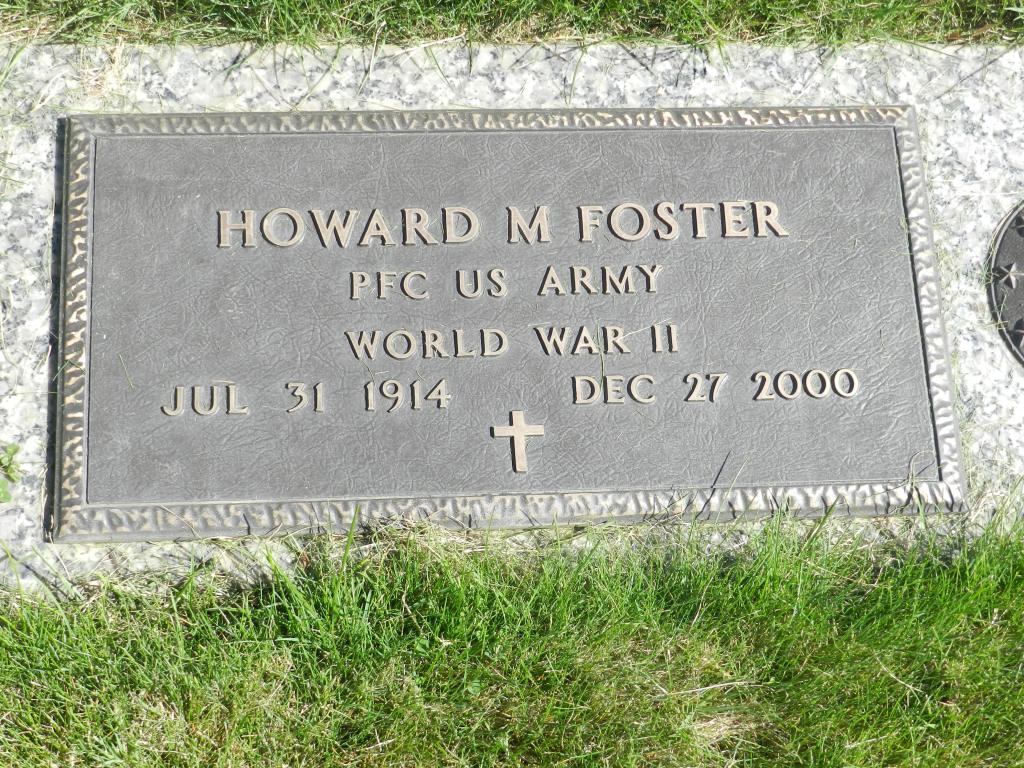
    Howard died on December 27, 2000, in a care home in Portland, Oregon. We buried him in Skyline Memorial Gardens in Portland, Oregon. He has a flat bronze veterans headstone marker.

  • Fanny’s Letter

    Fanny’s Letter

    Week 7–Letters and Diaries

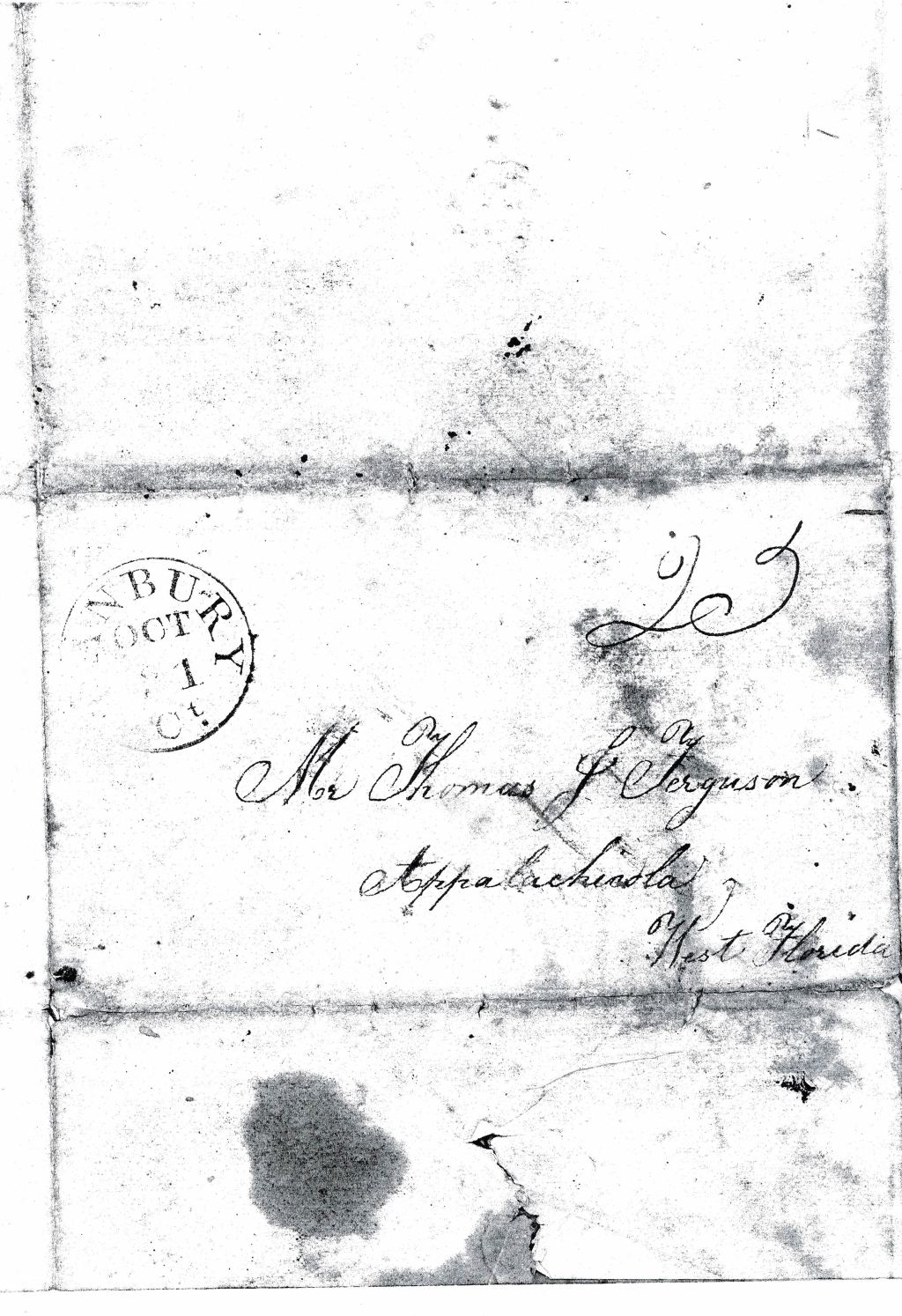
    About 30 years ago when Tom Hambright was working as a curator for the Key West Art and Historical Society. He found some old letters Ferguson letters written in 1849 and 1850. In 2012 Mary Haffenreffer transcribed most of these letters. She published them along with her research about Ferguson family in the Florida Keys Sea Heritage Journal, Fall 2012 and Winter 2013. She sent me a copy of an earlier letter from Fanny Howes Ferguson to her second son Thomas Jefferson Ferguson. Thomas was living in Key West Florida in the 1840s. Fanny’s letter mentions 10 her children, informs Thomas of his upcoming sister Elvina’s wedding and mentions his cousin Cornelia Howes Higgins, daughter of Malchus Reed Howes. Fanny was planning the wedding of her oldest daughter, Elvina, to James P. Sanders and thinking about how much she wants Thomas and all her other sons to be there. Thomas is living in Key West, Florida a long way from Danbury, Connecticut where Fanny lives. In this letter, she gives news about Thomas’s other siblings- George, Daniel, Isaac Reed, Albert, Fred, William, Fernando and his two sisters Elvina and Fannie A.  She mentions her husband but not by name. She writes:

    Danbury Oct 29th 1840

    My Dear and long absent son,

    In the silent hours when labors and care is laid Aside and the rain pouring down in torrents I take up my pen to inform you of this situation of our family which perhaps never will interest no one but you. We have only 2 sisters left with us. George took Fernando last march to live with him till he is a man. George with his wife and 3 children and Fernando made us a long visit last summer, Daniel his wife and one child visit us frequently, they live in Norwalk. Fred & Elbert has not visited us this year, William lives in Miltown [apprenticed] to Mr. Crosly learning the shoemaker trade, he come to see us, and I regret to think that I can’t have it to say that Thomas visits us too, but you are separated far from us in a country where you are surrounded I fear with Indians, I frequently see accounts of their [?] in Florida, and it makes me shudder for fear I shall find your name among the sufferers, but you grant that I never may, I do feel to hope that you will someday come to visit us, last summer we looked forward with bright hope, and begun to anticipate the day when we should embrace you but going to the post office I found a letter there, which told us we must suspend that hope for one year, which caused tears to flow but was glad that we could hear particulars from under your own hand, of your business and situation, and that you intended to come Another year, it would be very pleasant to us, and no doubt it would to come if you could be here on the 19th of next month which is Thanksgiving not only thanksgiving but wedding day, tis expected that Elvina will be married on that day to James P sanders, I expect our relatives all will be present and you are respectfully invited to attend(Elvina would like some of your Figs to treat her company with) Reed and Lydia A Lewis are chosen to stand up with them, you are perhaps would like to hear something about James, suffice it to say we are all pleased with him. We live where we did last year and your Father works at the hatting business, and is doing well, his health is good, and he is quite a reformed man, in the land of civil habits, I wish you to write as soon as you receive this and let us hear how you got along this summer. I hope you will not stay there and expose your life [?] and you all to the massacre of Indians, do come where you can lie down to sleep and not be in danger, this leaves us all well, our friends and relatives likewise. Cornelia Amanda Higgins with her little son 16 months old has visited us this summer, also her step mother from mobile, they met in New York and was to your brother George’s together, the evening is far spent and I must  draw to a close but not till I tell you that Alan Percy is married to Deborah Ann Heveland little you gave my love to Betsey, your housekeeper, and tell her I want she should look well to you and except for yourself the best wishes and prayers of your mother.                                                                                                                                    Fanny Ferguson

    Fanny and Nathaniel

    Fanny and Nathaniel married in Fanny’s hometown of Southeast, Putnam, New York on March 16, 1811.

    They called their first son George Washington Ferguson; the second they named Thomas Jefferson Ferguson. For the third son they used a typical Scottish naming pattern. They named this one for Fanny’s father, Daniel Howes. Their third son was called Daniel Howes Ferguson. When the gold fever struck- four of Fanny’s sons wanted to go. Thomas, Daniel and Albert journeyed to California to find gold. Only two returned, Albert died in San Francisco.

    Less than a year after Fanny wrote the letter, Nathaniel died at their home in Danbury. He died on November 9, 1846 in Norwalk at the age of 70. Only her youngest daughter, also called Fanny, was still at home. Fanny A. was 8 when Nathaniel Ferguson died.

    Road Block

    Fanny and her daughter, Fanny A, lived in Norwalk, Fairfield, Connecticut in 1850. This is where I found the surname, Meeker for Fanny.

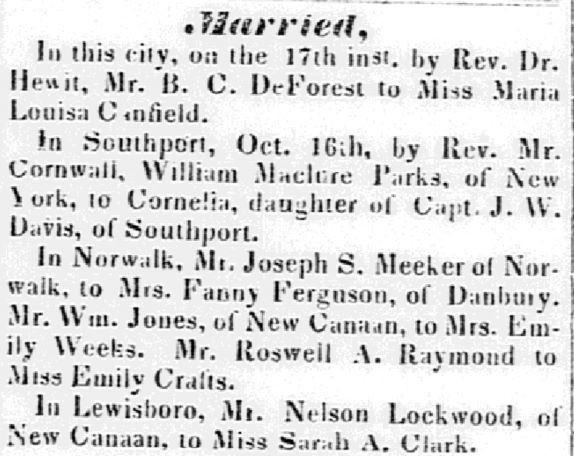
    Several years later, I found a marriage announcement in the Republican Farmer, a Connecticut newspaper.

    On October 15, 1843, in Connecticut, USA, Mrs. Fanny Ferguson married Joseph S. Meeker.  Above is an 1843 news clipping from the Republican Farmer referring to Fanny and Joseph’s marriage in Norwalk. Joseph died November 2, 1846 in Norwalk, Connecticut.

    She was still using the last name of Meeker in 1870. She lived with her sister, Esther Ryder and her brother-in-law in Danbury. Fairfield County, Connecticut. Here is a snippet of the 1870 census for Danbury.

    A final Trip

    Fanny died April 30, 1879 while visiting her daughter Fanny A. Stewart in Davenport, Iowa.