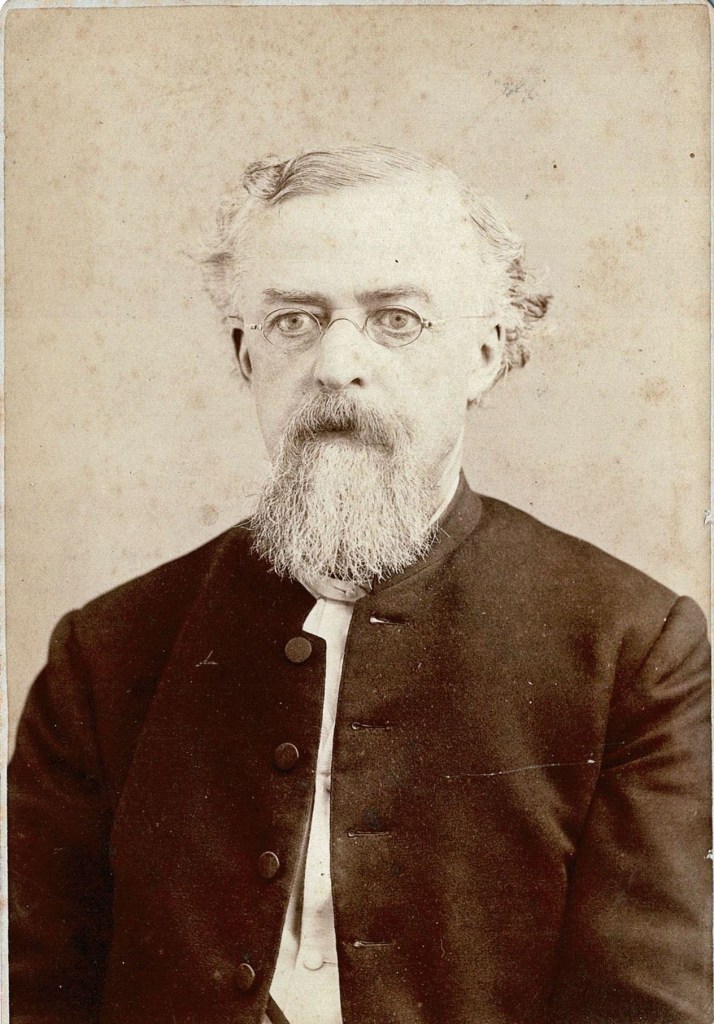
I have written before about Daniel Howes Ferguson and his family. One post about a steamboat disaster on the Willamette River in Oregon, I called Too Much Fire in the Box. Before this Daniel joined the California Gold Rush in 1849. I wrote about this in a post called Traveling by Mailboat. Here are some other related posts.
Places the Fergusons lived in include Norwalk and Danbury and in Connecticut. They also lived Yuba, California, Portland, Linn City and Baker City Oregon, the Cascades, Washington, and Lone Pine, California. Every time I open my research about the Fergusons, I wonder and theorized about his death and burial place.
Why did he die in Maryland when he and Jeannette lived in the state of California? Where was he buried?
Daniel Ferguson died rather suddenly near Washington DC. The Ferguson Family Bible reads, “Daniel H Ferguson died at Beltsville Station, Prince George County, State of Maryland on 28th day of September AD 1876, aged 60 years 6 months and 10 days”
Upon Leaving The Cascades
In my post titled Images, I described the Fergusons in Washington territory. They lived along the Columbia River in a town called the Cascades. Sometimes in the late 1860s the Fergusons left the Cascades.
In 1868 Margaret’s older brother, James Ferguson, moved to Baker City and went into business with Margaret’s husband, Edwin Reynolds. They established a dry goods store in Baker City. James had been working in Eastern Washington in the Fort Colville area in his father’s shipping, selling and trading businesses.
While living in Baker City James became acquainted with a young schoolteacher named Jennie Mann. In June of 1870, he married Jennie Mann of Barre, Vermont. This new couple moved into a house next door to Edwin and Margaret Ferguson Reynolds.
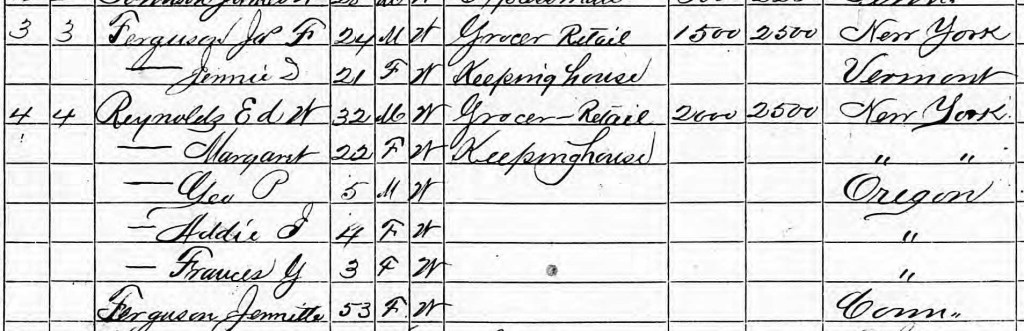
The US census of 1870 for Baker City, Baker, Oregon, dwelling no. 3, family 3 lists James F. Ferguson, age 24, occupation, retail grocer, real estate value, $1500, personal property, $2000, born in New York. Listed next is Jennie Ferguson, age, 21, occupation, keeping house, born in Vermont.
The next entry, dwelling no. 4, family no. 4 is for Edwin W Reynolds and his family. Margaret Ferguson Reynolds, age 22, occupation, keeping house, born in New York is listed next. The three children were George, Addie and Frances, all born in Oregon. Lastly, Jeannette Ferguson, age 53, born in Connecticut is listed. Some of the names are spelled wrong.
Here is an image of this June 28 1870 Federal Census record for Baker City, Baker, Oregon
In June of 1870, Federal Census records placed Daniel Ferguson in Cerro Gordo, Inyo, California. Daniel, head of family no. 18, owned $300 in real estate and $3000 in personal property. His occupation was listed as “teamster” as were the other two men who were Omie Mair and Edward Foster. Here is an image.

Cerro Gordo, California
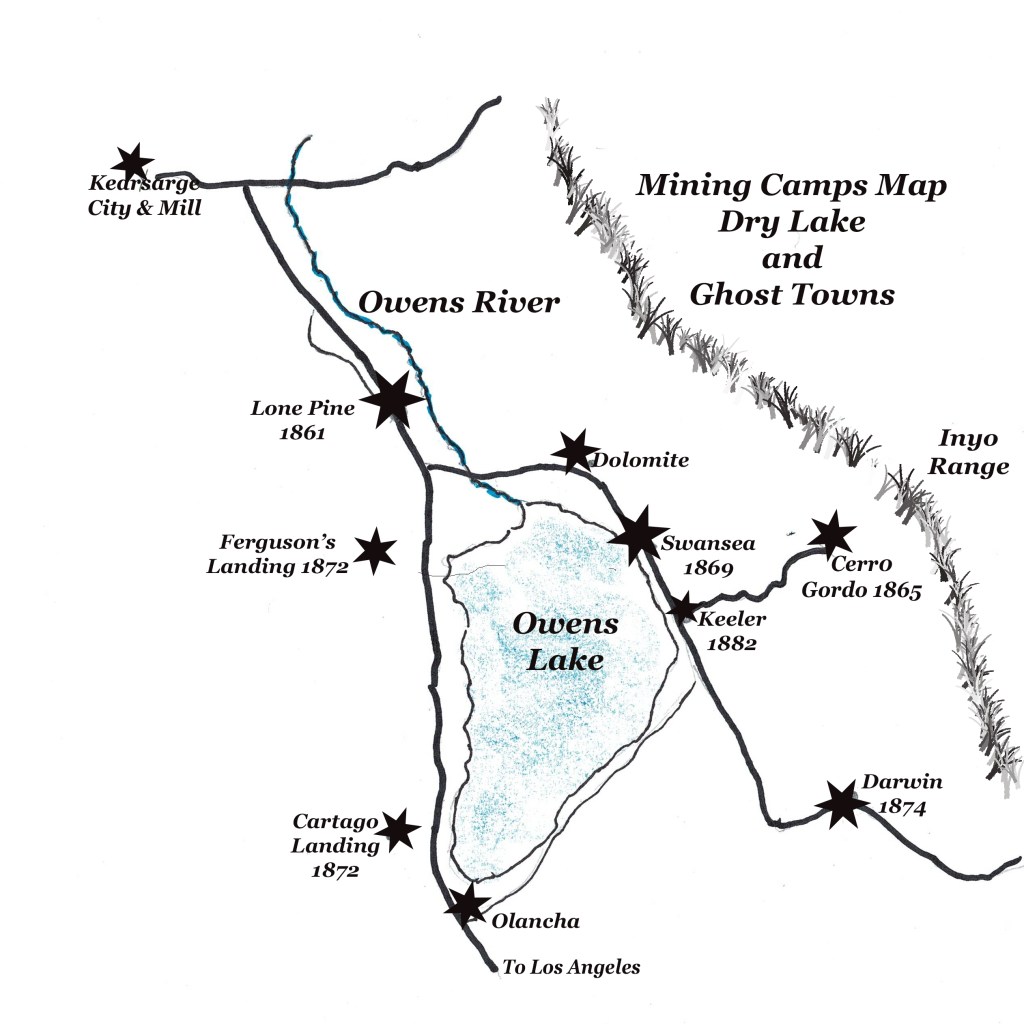
Cerro Gordo Spanish “Fat Hill” was the name of a mountain in the Inyo range. Daniel was here in the mining camp called Cerro Gordo. This mountain, located near Death Valley, is about eight miles east and 5,000 feet above Owens Lake. Other mining communities in this area were Dolomite, Swansea, Keeler, Olancha and Cartago. These camps were located along the shoreline of Owens Lake. In 1872 there was even a place called Ferguson’s Landing on Owens Lake. Today the lake is dry and the towns are ghost towns. Here is a map.
Getting the Ore from the mine to Los Angeles
The first transcontinental railroad was completed in 1869 and there were short line railroads in many western towns. This was not the case for the Cerro Gordo mines. Transport was by mules pulling wagons.These wagons loaded with silver and lead traveled more than 200 miles. It was that far from the Cerro Gordo mines to the ports and markets of Los Angeles. On the return trip the wagons carried supplies for the miners. The miners needed clothing, building materials, utensils, dishes, tools, tack, canned goods, flour, sugar, coffee, liquor and other goods. The drivers of these wagons were called teamsters.
An estimated 17 million dollars’ worth of silver and lead arrived in Los Angeles from these mountain mines. Residents of Los Angeles credit these mines for the size of their city. They say it would not have become the large bustling port town it was in the late 1800s. It would not be the big city it is now.
In the early 1870s Daniel’s wife, Jeannette and son, James joined Daniel in Southern California at Lone Pine. Jeannette’s relatives In Connecticut wrote to Jeannette in Lone Pine, Inyo, California in 1873.
During the 1870s Lone Pine was an important supply town for Kearsarge, Cerro Gordo, Keeler, Swansea and Darwin. Lone Pine was about 5 miles from Ferguson’s Landing and 12 miles from Cerro Gordo.
The Building of the Bessie Brady
Starting in June 1872 the Bessie Brady, hauled ore milled into ingots at Swansea across the lake. Before this the 85-pound silver-lead ingots had to be hauled by mule and wagons around Owens Lake.
In 1872 a shortcut across Owens Lake was orchestrated by James Brady and Daniel Ferguson. I found a credible reference for this partnership. The Los Angeles Department of Water and Power had this to say.
So much silver was extracted that a small steamer, the Bessie Brady, was built in 1872 by James Brady and D.H. Ferguson. (Its purpose) was to ferry the bullion across Owens Lake from Swansea to Cartago Landing, thereby reducing reliance on mule transport.Los Angeles Department of Water and Power ,https://www.lawp.com, page 30
This saved time and money on the 200-mile trek to the ports of Los Angeles. The building of the Bessie Brady involved both men’s time, money, and experience. D. H. Ferguson had knowledge of steamboats and how to build them. My theory is that Daniel’s experience building the ill fated Gazelle, guided much of this project.
Another project Daniel did in 1872 was acquiring a plot of land at the northwest corner of Owens Lake. He built a wharf there and called it Ferguson’s Landing. The daughter of James Brady, Bessie Brady, christened these men’s boat at Ferguson’s Landing on July 4, 1872.
After the Bessie Brady was built, she was moored at Swansea. She crossed Owens Lake to both Ferguson’s Landing and Cartago Landing carrying silver-lead ingots.
This article called “Naming of the Bessie Brady”, provides details about what Daniel and James had been doing. It describes an interesting day in the life of some 1870ers.
Naming of the Bessie Brady
“Naming of the Bessie Brady”, Inyo Independent (Inyo), 29 Sept 1916, Vol.47 No. 21, California Digital Newspaper Collection, archived (http://cdnc.ucr.edu)
By 1872 Cerro Gordo’s bullion output was large. The mode of moving it to tidewater at Santa Monica or San Pedro was by teams, under a general contract. Later this method was brought to precise system; but at that period, it was both unsatisfactory and inadequate. Many tons of bullion were usually pulled up near Owens Lake from the furnaces at Cerro Gordo and at Swansea, awaiting moving. Hauling around the lake was slow and expensive; it takes a twelve-animal team five days to go from Swansea to the foot of the lake…hauling but six tons a load. The need of improvement caused Superintendent James Brady of the Owens Lake Silver-Lead Co and D. H. Ferguson to decide to build a boat. It was constructed in the spring of 1872, at a cost of $10,000. Its dimensions were 85 feet keel, 16 feet beam, 6 feet depth of hold, with a 20-horsepower engine. A 52-inch propeller drove it and with light draft part of the propeller was always out of the water. Though not large the boat was a big step ahead in facilities, for it was able to make a round trip daily from Swansea, at the lake’s northeastern curve to Cartage at the southwest carrying 70 tons of freight.  A comparison with the teaming time and capacity already mentioned is of interest. For nearly ten years, until the coming of the Carson & Colorado railroad caused the Cerro Gordo Freighting Company to quit this field, the boat was a money- saving factor in the valley shipments, both ways for the mines and the valley.
On the Fourth of July 1872, the valley’s chief celebration centered around the christening of the little ship. Twenty carriage loads of people and many horsemen from Independence and Lone Pine and the country between, left Lone Pin that mourning and traveled the five miles to Ferguson’s Landing before the boat, coming across from Swansea, arrived towing a barge to serve as a temporary wharf. A hundred and thirty excursionists embarked. The little Bessie, daughter of Superintendent Brady, stepped to the bow of the boat and broke a bottle of wine on it, lisping "Bessie Brady”. W. H. Creighton, a citizen with poetic aspirations, read an “Ode to the Bessie Brady”.
The first steamer excursion on the lake made its way to the lower end. With the seven-mile speed, the unclouded July sun overhead, an open deck, the reflecting water around and the heat of an unhoused engine to add to its might, it may be supposed that some degree of enthusiasm was required to enjoy the dancing which went on until the perspiring excursionists reached the mouth of Olancho Creek. Disembarking there, the party picnicked, listened to the Declaration of Independence and otherwise spent the time until evening coolness came, and a delightful return journey became possible. The festivities ended at Lone Pine.
The Silver-Lead Company built a 300-foot wharf at Swansea and others were put up at Cartage and Ferguson’s landing. The lake was then supposed to be unfathomable; but its very gradual deepening made light draft a necessity in the boat. Good water was obtained on the eastern side by boxing an underwater spring so that its water rose several feet above the lake level for the steamer’s use.
In September of 1872 James Brady sold his interest in the Bessie Brady to John Daneri and Daniel Ferguson. Unfortunately, in 1875 their steamboat company folded and Casper Titchworth purchased Ferguson’s interest in the Bessie Brady.
Questions and Theories
Here are my theories about Daniel and Jeannette’s travels to the east coast in 1876.
Daniel and Jeannette decided to go back east as far as Washington, D.C. Daniel’s mother Fanny Ferguson died in Davenport, Scott County, Iowa on April 30, 1876. I hope he saw her before she died.
Fanny had moved to Davenport sometime after 1880; her youngest child, Fannie A. Ferguson Stewart and her husband Jacob Stewart lived in Davenport. The old blue scrapbook held two photos of Aunt Fannie, one taken in Davenport around 1880.
Daniel Ferguson died near Washington D.C. The Ferguson Family bible gave the date as September 28, 1876,in Maryland.
After
After Daniel died, Jeannette did not return to the West directly. Instead she stayed with her brother and sister-in-law. In 1880, she was found in the household of her older brother Albert Keeler and his wife Harriet. They lived in Yonkers, New York. Here is a image of the 1880 U.S. census record for Albert and Harriet Keeler ling in Yonkers,Westchester, New York. Jeannette Ferguson, age 65, is listed as a boarder.

She died in Baker City, Oregon on April 19, 1894. Family buried her in Mount Hope Cemetery in an unmarked grave next to her daughter-in-law, Jennie Ferguson. Her obituary reads:
Last Friday’s Oregonian noted the death on the day previous of one of the pioneer women of the state at Baker City,” Mrs. Jeanette Ferguson, aged 79 years, widow of the late D. H. Ferguson, a well-known pioneer of 1853, died of cancer and paralysis. She was born in Danbury, Con., on April 10, 1816, and resided in Oregon City, Or., in 1853.” In the early times before the great flood of 1861 her husband was a prominent businessman and mill owner at this place. When Linn City was flourishing, he was the principal mill owner at that place and many of the old timers remember well both him and his wife. Mrs. Ferguson was a grandmother of Mrs. E. M. Mack (Addie Ferguson) of this city.“Chat About Town”, Oregon City Enterprise (Oregon City), April 27, 1894, Image 3, Col. 3, digital images, Historic Oregon Newspapers,(http://oregonnews.edu accessed: April 23,2015)
Daniel and Jeannette Ferguson were Oregon pioneers, adventurers, parents, and unassuming people. Jeannette was buried in an unmarked grave in Baker City, and we don’t know where Daniel was buried.
Certainly, Daniel Howes Ferguson embodies the definition of an entrepreneur. A definition reads“a person who organizes and operates a business taking on greater than normal financial risk ”. In his sixty years of life, Daniel did this many times. His freighting and trading activities coupled with his inventiveness made life in the American frontier easier.
 francescabellcoursenperritt.com
Leave a comment