
I have been writing a series of blogs about Daniel Ferguson and his family. Even week 7, Fanny’s Letter, touched on this family.
My series started with week 28, Traveling by Mailboat. Then came week 43(urban) with City Girl. The city girl was Daniel’s wife, Jeannette Keeler Ferguson. After that for week 41(water), I wrote Water and Steamboats. This time I am working on week 42(fire). My title is “Too Much Fire in the Box”. It details the Gazelle’s explosion. This happened on the Gazelle’s first regularly scheduled run on the upper Willamette River in Oregon Territory.
Questions
I struggled with a few questions while researching this important event in Daniel Ferguson’s life. Why isn’t Daniel mentioned in the aftermath of the explosion? Why did Gazelle’s two boilers explode? Why did the explosions happen simultaneously?
The Superintendent Question
If Daniel owned the Willamette Falls Company, he would call himself anything he wanted in reference to his company. He preferred superintendent. He called himself that up until the first regular run of the steamboat. In news items and government documents, Daniel is listed as the superintendent of the Willamette Falls Company. Here is a copy of an index card I found at Oregon State Archives in Salem, Oregon. I have copies of the two documents noted on this card. Here is his closing sentence and signature on the petition to amend act of incorporation.
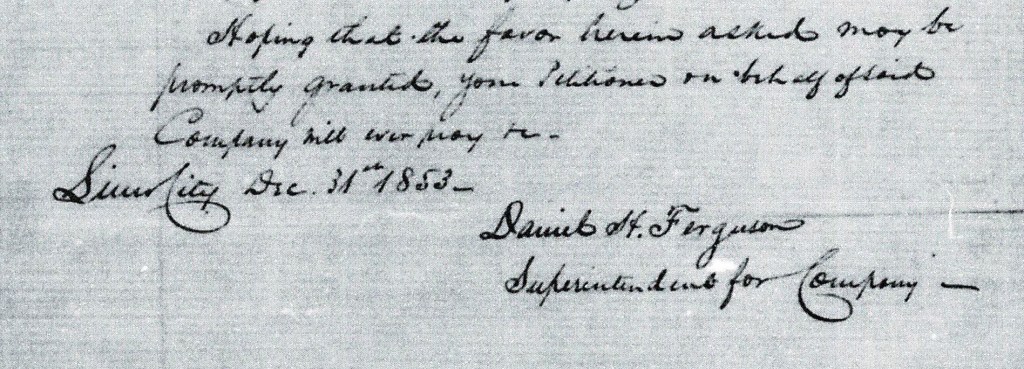
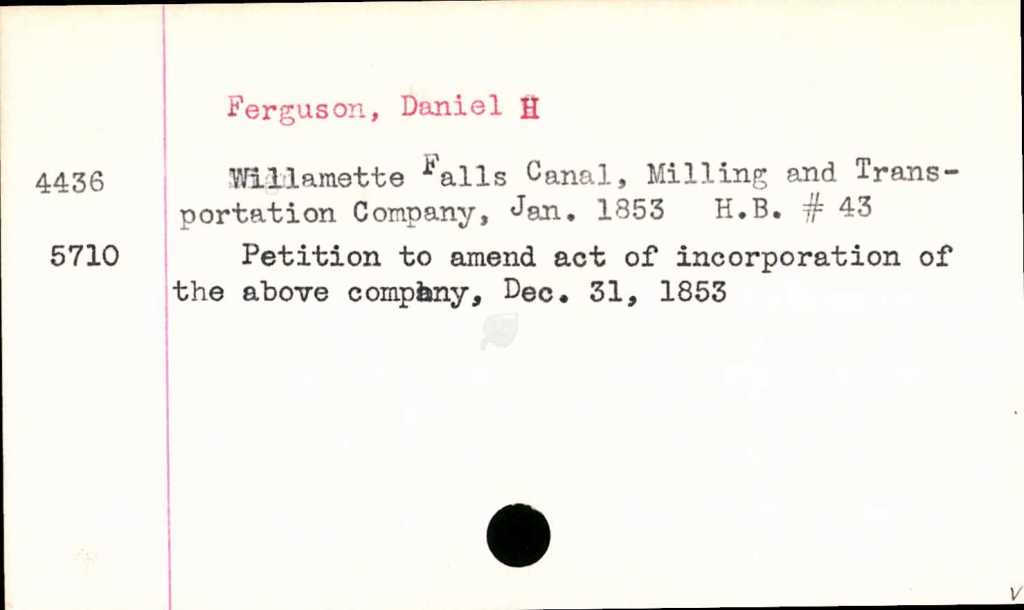
The document titled house bill #43 was approved on January 15, 1853. Daniel Ferguson, C.W. B(unreadable)ley and Colin C Baker are named as associates in this incorporation venture.
Sometime in March of 1853, David Paige came into the business. This man surely was the one Daniel sold and conveyed the Willamette Falls Company to on March 19, 1853. David Paige was not a ship builder, but his company, Paige, Bacon & Co. financed two steamboats for river transportation here. This company’s intent was to control transportation in Willamette Valley. Canemah, located above the falls on the upper Willamette River, was the building site. The second steamboat Paige’s company built, the Gazelle, was finished in March of 1854. Their first boat had burned on October 6, 1853, at Oregon City.
Here is a copy of another index card I found at Oregon State Archives in Salem, Oregon. This one tells a little about David Paige.
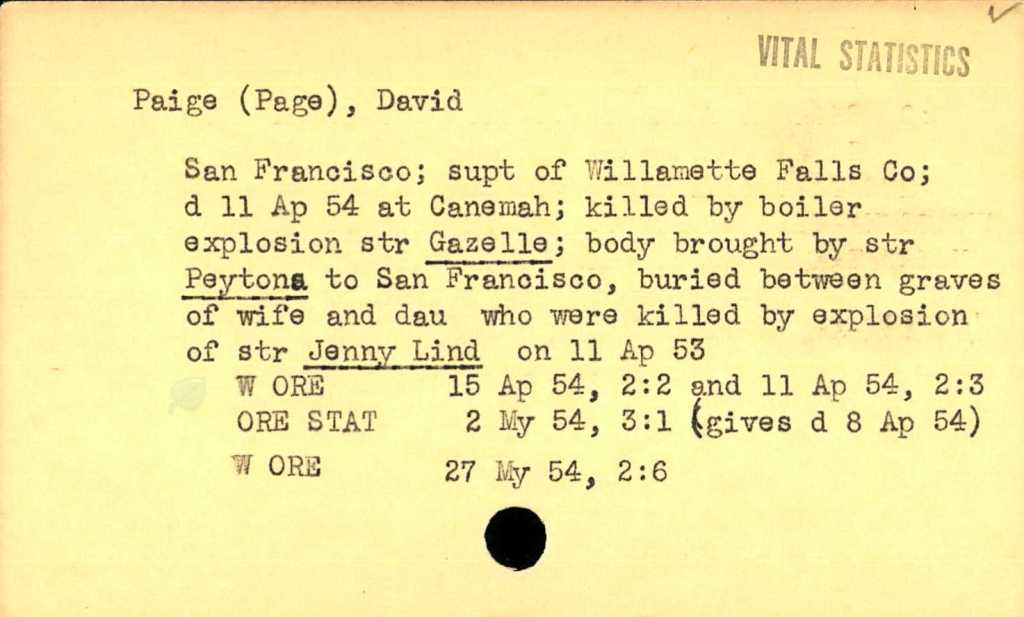
Even after Paige bought the company Daniel did not leave. Daniel remained as superintendent .David would be the chief superintendent.
On December 31, 1853, Daniel sent a petition to the Oregon legislature to amend incorporation of the Willamette Falls Company. He asked for 6 months more time. This document mentioned Paige’s lost steamboat. The calamity Daniel speaks of was the loss of this boat by fire. He writes:
In support of the extension of time, say for six months, your petitioner would only urge this (because of) the magnitude of this undertaking and the happening of the calamity which no reasonable foresight could have avoided. It’s a pledge of future fidelity, in their public engagement to execute the work; your petitioner points to the acts and labors of the company during this past summer and hopes they may be regarded as an ample guaranty. Their improvement can be completed in six months and will be.
Daniel Ferguson, “Petition to amend act of incorporation of the Willamette Falls, Canal, Milling and Transportation Company,” Oregon Territory, Washington County, Dec. 31, 1853, Territorial and Provisional Government Papers, Oregon State Achieves, microfilm no. 5710, accessed: April 2019 (http:sos.oregon.gov/archives/records
More About the Gazelle
The Gazelle, a twin engine side wheeler, had 2 high- pressure boilers. These were tube type boilers. The engines, being built back East, needed to be shipped around the horn to the west coast. About the time these engines were built, the Steamboat Act of 1852 was passed. This act required boilers to be tested and fitted with pressure relief valves. Since there was a report saying the chief engineer tied the pressure valves down, the Gazelle had pressure valves.
The First Regular Trip of the Gazelle
It happened on the day of the Gazelle’s first regular run at 6:30 a.m. on April 8, 1854. The Gazelle was loaded with 60 people and tied up at the dock at Canemah. The engineer, Moses Tonie tied the safety valve of the steam engine down to make the departure fast. Tonie noticed something was wrong and made his own exit. A minute later both engines exploded. Of the 60 on board 20 people died at once and four more died later. Moses Tonie was later charged with gross and culpable negligence. He allowed too much steam in the boilers. The water levels got too low.
Here is a newspaper clipping from the Daily Placer Times.This California newspaper copied an Oregon Spectator article from April 8, 1854. News from Oregon came by steamer.
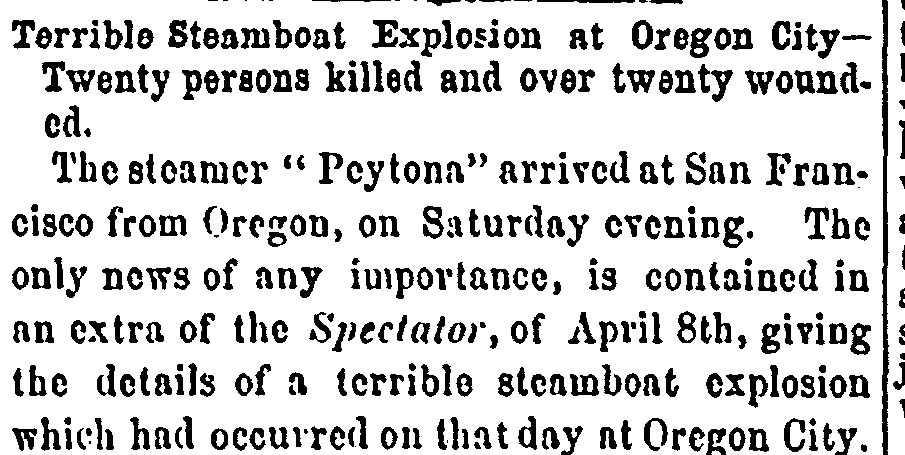

The Oregon Spectator printed this on April 8, 1854 describing the reaction of the Oregon city town’s people. It reads:
This distressing disaster has thrown a deep shade of gloom over the whole community. Stores, shops, iron works, mills are closed for the afternoon–business generally is closed. In Canemah, a feeling of intense grief is manifested by nearly everyone to be seen. Col. White, Mr. Post, Jho. P. Brooks and others, generously open their places of business and spare rooms for the benefit of the wounded, and for the dead bodies, until they are recognized and cared for by the respective friends.
The coroner’s report blamed Moses Tonie for the accident. Tonie did not testify. He ran from the exploding boat and then fled to Washington territory. He wasn’t seen again.
This unhappy event ended Willamette Falls Company’s brief steamboat operations on the Willamette River.


Leave a comment