Week 4-Overlooked

Did Katharine Connor’s parents use Finney as their baby girl middle name lest Katharine’s mother family not be overlooked? When Katharine married Isaac Roberts on November 13, 1828, in Charleston South Carolina, what did she think about changing her name to Mrs. Isaac Roberts? When she died in Albany, Oregon on December 1, 1889, and was buried in Sandridge Cemetery, did she plan to be buried in a unmarked grave?
I don’t have answers to these questions but thanks two men who interviewed Oregon pioneers—Edwin C. Roberts and Fred Lockley, I know something of this woman’s character.
Katharine grew up with music. She danced and sang and played the violin. After marriage and becoming a Methodist, she gave up dancing. Luckily, she still played the violin.
Early Life
Katharine Finney Connor was born in 1802 to John Connor and Katharine Finney. Her family lived in Charleston, Charleston, South Carolina, Untied States at the time of her birth. During her youth, she learned to play the violin quite well and still played as an adult. Before she married she had been one of the best dancers in the county of Charleston.
Marriage and Family
How and where Katharine met Isaac Roberts is not known. They married far from South Carolina on November 13, 1828. Clancy Smith married them in Jefferson County, Missouri. Their marriage record reads:
Let it be remembered that on the 13th day of November 1828, I Chancy Smith, a Justice of the Peace in and for said County (Jefferson) did join in the state of matrimony Isaac Roberts and Catherine F. Conner. Given under my hand this 13th Nov, 1828, Record Nov 13th 1828, Chancy Smith, Justice of the peace, C Smith clerk.
Dancing days were over after Katharine married this strict Methodist northerner who didn’t play cards or dance.
Their children, all born in Missouri, were Thomas who died as an infant, James Bruffey, Emily Catherine, and Samuel Huston. Samuel Houston was named for a cousin of Katharine’s.
Migration to Willamette Valley– Portland, Oregon
Isaac, Katharine, James, Emily and Samuel Roberts left Independence, Missouri in the spring of 1850.
Katharine Roberts, a pioneer woman of tact, bravery and quick thinking demonstrated these qualities during the trip West in a run end with a Sioux Chief in the Great Plains region. This chief rode into their camp and wanted to trade for their daughter Emily Roberts. Natives often traded with the people going west. He asked, “How many ponies?” Rather than discussing this topic Katharine picked up her violin and started playing. After a while, the chief left without losing face by having been turned down outright.
Katharine, like most settlers traveling by oxen hauled wagons, probably walked much of the time. Roughly 2000 miles separated Independence, Missouri and Portland, Oregon. The pace was slow- 11 to 17 miles per day and the days were long. The trail was more of a suggestion than an actual road. Bumps and holes made riding quite jarring. Katharine’s family arrived in Portland in the fall of 1850. They made a tent camp along the Willamette River near what is now 1st and Pine Street.
Portland, Oregon
Mr. William Warren, who was building a hotel, offered the Roberts accommodation in his building while it was being finished. The dining room and kitchen were finished. The Roberts expecting to pay took his offer; but, Mr. William would accept no money.
Katharine had cooked the long spring and summer over an open campfire in all kinds of weather. Living indoors and cooking on a stove would be luxurious. But William Warren had ulterior motives for his generosity. He was interested in her daughter, Emily Roberts.
Her daughter Emily Roberts had turned down William’s proposal of marriage. Emily had another suitor. Edward Griffin and Emily Roberts married on October 26, 1851. They were married by James Wilbur at the newly constructed Methodist Church on Taylor and 3rd Street. This was the church the Roberts helped build.
By December 9, 1850, the Roberts were living in their own home. Their house was the only house built on the block bounded by 4th, 5th, Columbia and Clay Streets.
The Move to Roberts Bridge
A chunk of land on the Calapooia River 10 miles south of Albany, Linn County, Oregon Territory, USA came to be known as Roberts Bridge or the Roberts Bridge community.
This is the site of Katharine’s next home. Katharine had mixed feelings about leaving her Portland community. Her friends and her church were in Portland. On the bright side, this move presented an opportunity to both her and her daughter Emily.
The United States Congress had enacted the Donation Land Claim Act before the Roberts arrived in Portland. It became effective on September 21, 1850. By this act, Katherine’s son, James Bruffey Roberts who was a white male U.S. citizen over 18 could claim 320 acres of federal land. He needed to take out the claim between 1 Dec 1850 and 1 Dec 1853. James did take out a claim next to his mother and father’s claim.
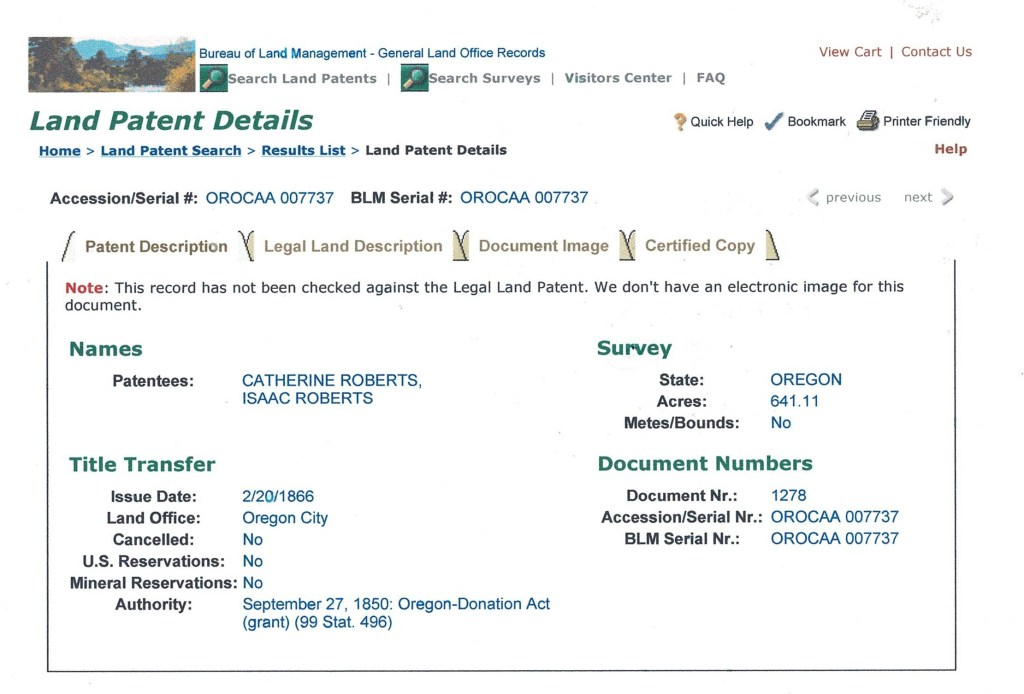
The plus for both Katharine and her daughter, Emily was that married women could own land by this act. As a married couple Katharine and Isaac took out a 640 acre claim, and 320 acres were in Katharine’s name. Allowing a married woman to own property was uncommon in the United States before this time. Here is a copy of the BLM GLO Land Patent Details.
The last in this family group to claim land here were Emily Roberts Griffin and her husband, Edward Griffin. Since they had married before December 1, 1851, they qualified for 640 acres. Their claim adjoined Emily’s parents claim and 320 acres was in Emily’s name.
Later Years
Katharine and Isaac had lived on their homestead less than 10 years when Isaac died there on September 6, 1860. After Isaac died, she acquired a home in Albany at the corner of 4th and Maple Street.
Her son-in-law, Edward Griffin put this ad in the States Rights Democrat in December of 1868.

Albany Home
Katharine moved from Robert’s Bridge area to Albany. She lived in Albany by the time the 1870 census was taken.
The 1870 U.S. census described Katharine F. Roberts as sixty-eight-year-old widow, born in South Carolina, with real estate valued at $550 and personal property of $1200. Also at this place was James A Warner, a thirty-four-year-old surveyor. Here is a snippet of that record.

In 1880, she was still living in Albany and James Warner is still rooming there too. In this census record, Katharine is spelled beginning with a “K” which was her way of spelling her name.

Death
Katherine died on December 1, 1889. Her obituary reads:
The mother of James Roberts, who died near Shedd on the first inst., was interred at Sand Ridge Cemetery. A sermon was preached by Rev. Gould at the home of James Roberts, where a large number of friends were gathered, many of whom followed her to her last resting place.
Some References
- “Interview with Edwin C Roberts in Albany Oregon”. Leslie L Haskin, 1940. wpa-interviews, Linn Genealogical Society.
- Lockley, Fred, “In Earlier Days”, The Oregon Daily Journal(Portland, Oregon),28 Feb 1914, page 4 (col. 8 paragraph 4)
- “Missouri Marriages, 1750-1920”, database, FamilySearch
 francescabellcoursenperritt.com
Leave a comment