Week 11
A figurative brick wall is a challenging obstacle or obstruction. A brick wall can also refer to a wall made from bricks. In my paternal grandfather’s case both definitions apply. He knew how to build brick walls, and his ancestors are mostly unknown to me.
Thomas’s and Luise’s Brick House
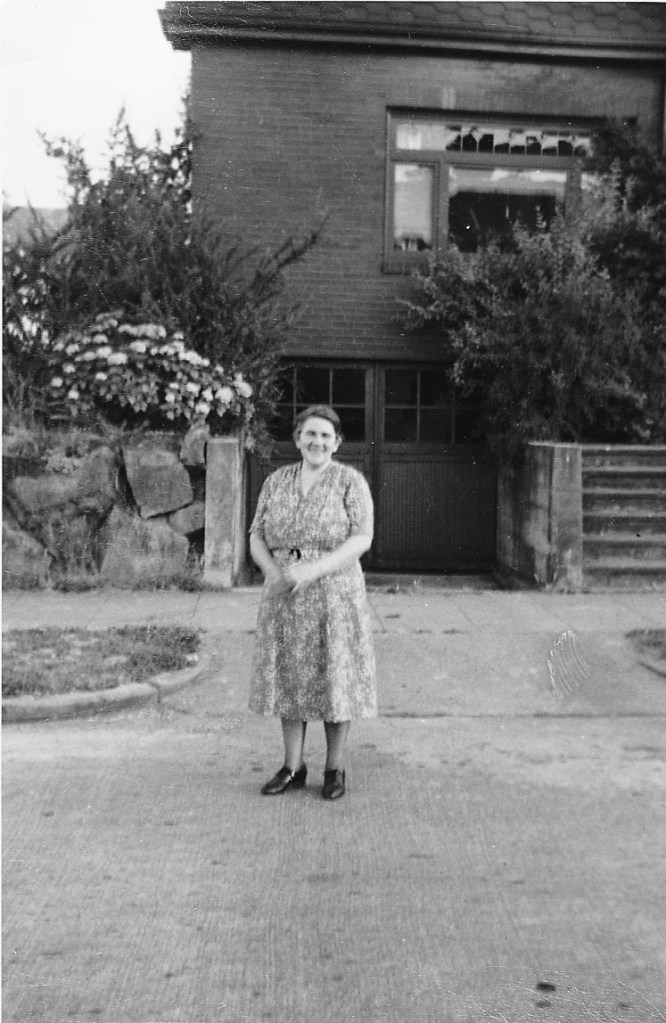
Thomas Steven Lonski, my grandfather, knew how to build brick walls. He built brick walls for two Seattle area houses. I lived in one of these houses with my family during my first eight years of school. The other brick walls were for his house on Lander Street. He, his wife, Luise, and his children, Ruth, Walter and my father, Albert, lived in this house for many years.
The house Thomas built for his family had a partly daylight basement as it was built on a slope.
A living area with a living room, dining room, kitchen, half bathroom and entry hall topped the basement level. Upstairs were 3 bedrooms and a full bathroom. a steep roof topped this home.
Albert’s Brick House
The brick walls he built for my family held up a different sort of house, although this house also sat on a slope. We had a great view of Lake Washington from this house.
Both Thomas and my father, Albert, worked on building this house. Thomas lay brick early in the day. Albert worked in the late afternoon and evening after his day job at Boeing Company.
Sometimes the neighbor who lived directly behind this building project. Thomas told this man named Edward Kennedy that the finished product would be a two-story house with a peaked roof.
One evening, while my father worked on our house, Edward came over asking about the thickness of floorboards, the height of the walls and the size of the attic. Edward looked and sounded decidedly grumpy. My father didn’t know why. Then my father explained that this house was to be a one-story building with a flat roof. Albert showed Edward the building plans, Edward smiled broadly; he knew his view would still be there.
After this, the old man laying bricks at Albert Lonski’s house site became known as a prankster and someone you shouldn’t play poker with.
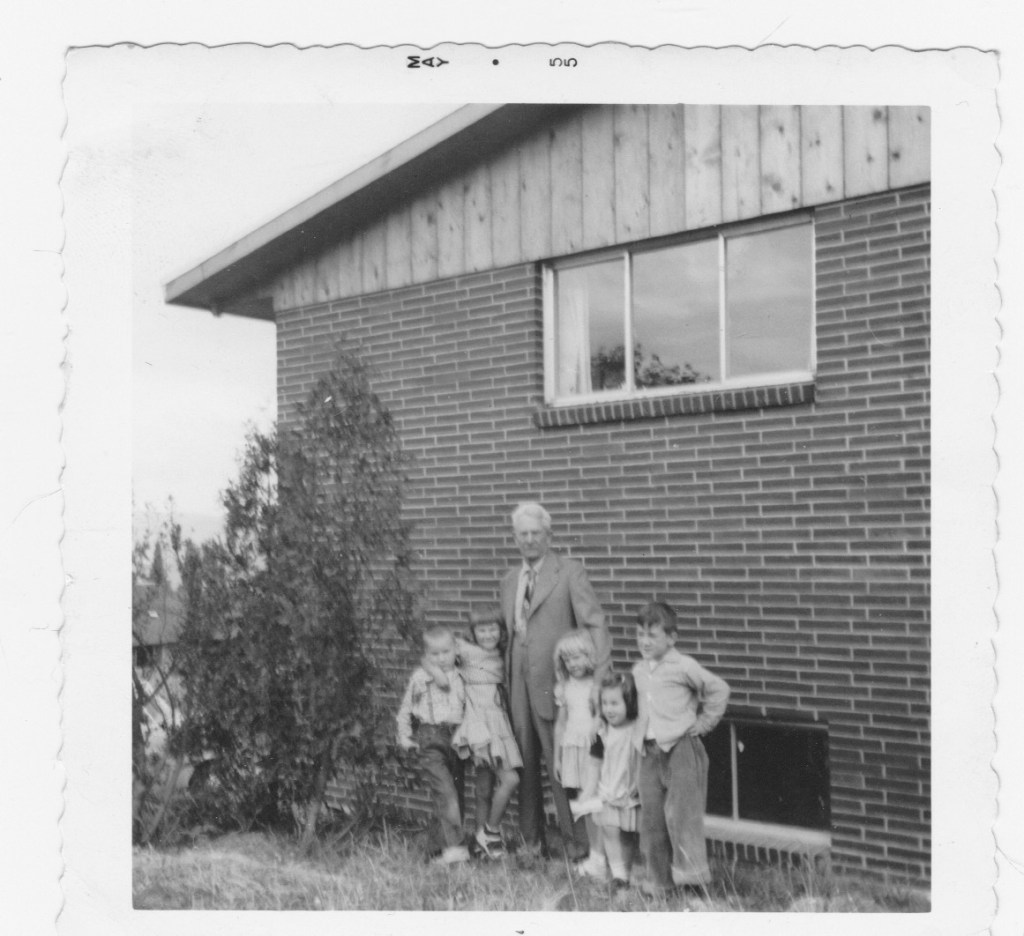
So, my Grandfather Lonski built the bricks wall for my childhood home. More importantly, he was there for me during my formative years.
He took me on outings. If we ate out, we usually ordered French Dip sandwiches—his favorite.
During these times grandfather would tell me about our Lonski family. I remember his facial expressions. When he said his mother’s name, Marianna Napontiac, he looked wistful. His mouth was soft, and his eye pupils widened.
On the other hand, when Grandfather spoke of his father, Michael Lonski, his eyebrows came together, and his voice became louder. He said his father had once been Michael von Lonski. Because of problems with alcohol, he sold the “von” part of his name. Since von in German means from or of, could this mean Michael had owned land and sold his right to it?
When Grandfather was young, his hometown in Poland, was Tuchel (now called Tuchola). He lived with his mother, father and seven brothers—John, Michael, Paul, Vincent, Franz, William (named for the Kaiser) and Joseph. He was a middle child, born on December 17,1880. In 1880, 3,066 people lived in Tuchel. He grew up hearing both German and Polish spoken in his household so was fluent in both languages.
Military School
Grandfather told me he was in the German army from 1902 to 1904. There was compulsory military service for preteen boys in Kaiser Wilhelm’s army.

When Gdansk Was Danzig
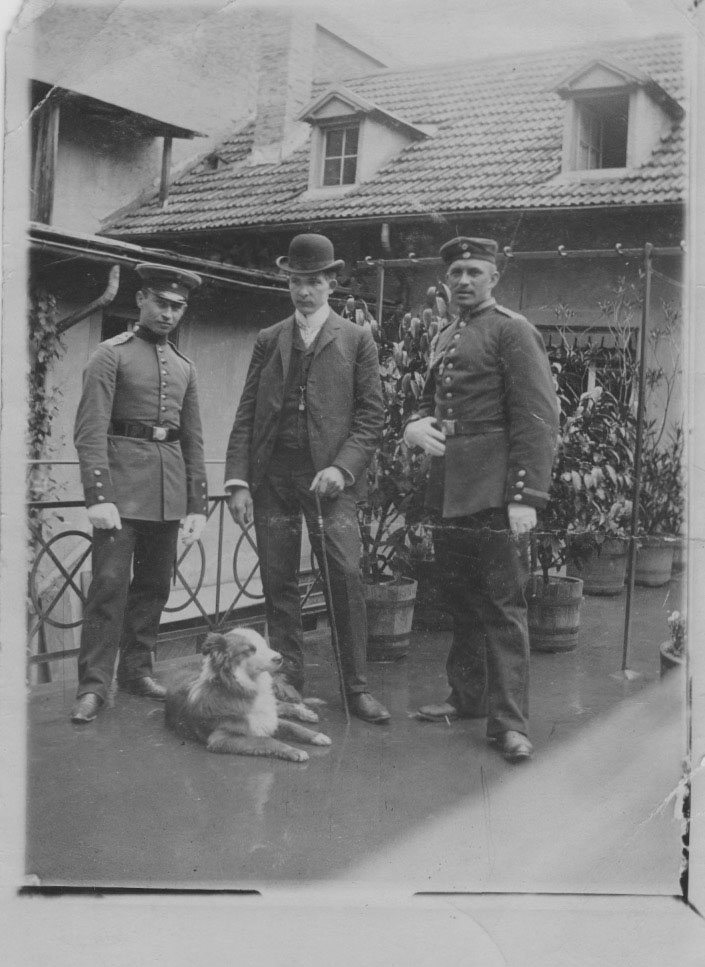
He and his two brothers would visit the large port city of Danzig (now called Gdansk) when they were young men. They would roam the streets of this city by the Baltic Sea together looking for fun. Paul, born in 1877, was 3 years older than Thomas. Vincent born in 1882, was 2 years younger. Here is a photo of the three together.
Switzerland
He left home in 1910, he said, to avoid further military service. He found work in Switzerland as a tailor working as a cutter and fitter. I remember him talking about cutting many layers of wool fabric with extra-large scissors. I have the thimble he used from this job.
Canada
By 1913 he had migrated to Canada, obtained his British citizenship and lived in Saskatoon, Saskatchewan at Bose 1135. In May of 1913 his brothers Paul and Vincent met him in Saskatoon. they had in New York aboard the SS Zeeland. They had sailed from Antwerp, Belgium. These three young men Paul, a carpenter, Vincent, a plumber and Grandfather headed for Salmon Arms near Kamloops, British Columbia. They staked a land claim and built a cabin.
Paul and Vincent returned to German Poland in December of 1913. Paul returned to a wife in Dusseldorf and Vincent to a brother, Joseph Lonski, who also lived in Dusseldorf.
Grandfather stayed in Salmon Arms a while. He told my mother he lived with a woman there and left her rather abruptly. He went to Vancouver, B.C. where he met my grandmother, Anna Luise Taubert.
Anna Luise Taubert
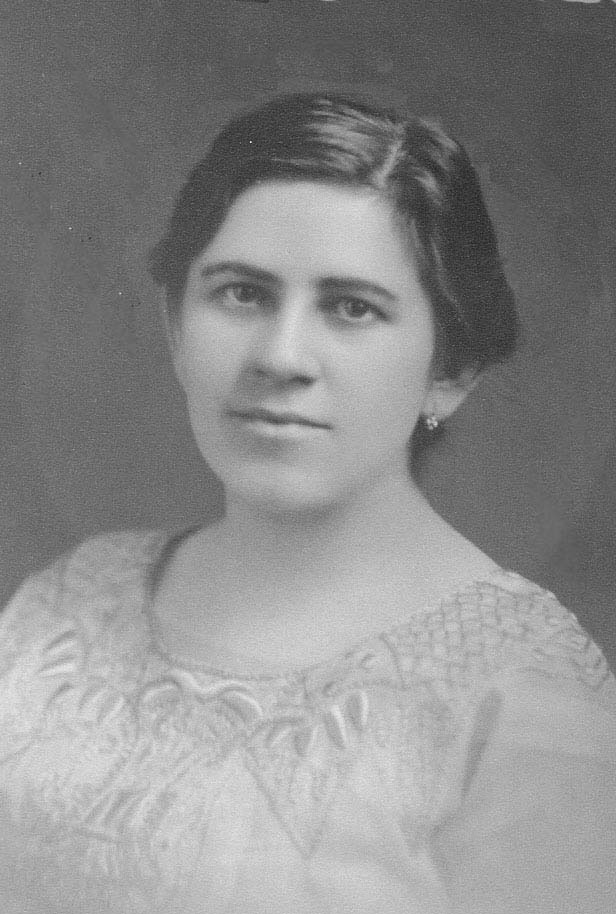
Grandfather said a friend named George wanted to talk to the pretty German girl working for the von Roons. The von Roons were Germans living in Vancouver, B.C., Canada while the political situation in Germany settled down. because George didn’t speak German and Thomas did. Apparently, the things my grandfather said to Luise caused her to take an interest in him. Around this time the von Roons decided it was safe to go back to Germany. Luise decided to stay in Vancouver; Grandfather thought it was because of him.
Thomas crossed the border into the United States in 1816. Luise Taubert came to Seattle separately by ferry. They married at the courthouse in Seattle, Washington on April 18, 1916.
Thomas lost all contact with his family. He always looked unhappy when he spoke of this.
Climbing the Lonski Family Tree
About 20 years ago, I started writing down information about my family on tree forms. I didn’t find anything beyond what Thomas wrote on his application for social security. His father was Michael Lonski. His mother was Marianna Napontiac.
Then came the story of Camp No. 7, located in Tuchel and surrounded by the beautiful Tuchola forests. This was the forest Grandfather thought of when he hiked the trails around Mount Rainier close to Seattle.
Prisoner of war camps were located in and near Tuchel in WWI. Camp No. 7 was a prisoner of war camp ran by the Germans. Poles, Italians, French, and British captured persons with imprisoned there. Conditions there were horrible and many died.
At this time, I thought of genealogy as my hobby, It was supposed to be fun.
Renewed Effort
I revisited the Lonski family recently finding casualty list for German soldiers in WWI. The list (Verlustisten) named German and Austro-Hungarian soldiers who were dead, wounded, caught, missing or returned. I found 6 Vincenz Lonskis on this list. The Vincenz of Tuchel who died October 29, 1914 may have been Thomas Lonski’s brother. There were other men with the Lonski surname. There were 10 men named Franz Lonski, 11 named Johann Lonski, 5 named Josef Lonski and 1 named Paul Lonski.
Then I started having war dreams. I again stopped looking.
Thus, my grandfather, who had built the brick walls for our home, left me with another brick wall. It is the “I’m stuck” kind. But, I am extremely grateful he left Germanic Poland before WWI, knew and loved me and told me his stories.
 francescabellcoursenperritt.com
Leave a comment